P1228
4-H Forestry Project No. 2: Big Tree Contest
The Mississippi State University Extension Service 4-H Big Tree Contest allows youth to enhance tree identification and tree measurement skills while helping meet larger objectives. 4-H’ers can be the eyes and ears for local, state, and national champion big tree programs. The goal is to locate and document the largest specimens within various tree species, also known as champion trees. This provides valuable scientific information about the growing conditions required to sustain these stately monuments, which have withstood the test of time.
In 1940, the American Forestry Association, now known as American Forests, began the National Champion Tree Program. The September 1940 issue of American Forests magazine included a headline reading, “WANTED! The Location and Measurement of the Largest Specimen of the Following American Tree Species.” A list of 100 trees followed, from ash to walnut.
The National Champion Tree Program, housed at the University of Tennessee School of Natural Resources, has enjoyed steady growth in size and scope and currently contains nearly 550 trees. There are more than 1,000 eligible species, so it’s possible there are previously undocumented champion trees in Mississippi. The Mississippi Forestry Commission maintains a tree registry to recognize these Magnolia State champions.
4-H’ers and Big Trees
4-H members can have fun, learn new skills, and earn recognition by participating in a big tree program. Participants who nominate a champion will receive a certificate acknowledging their effort. 4-H clubs can also start a big tree program in their county. Ample opportunities to find county champions are available, allowing more 4-H members to become involved.
Measurement and Selection
Champion big trees are determined by the points awarded in three different measurement categories: circumference, height, and crown spread.
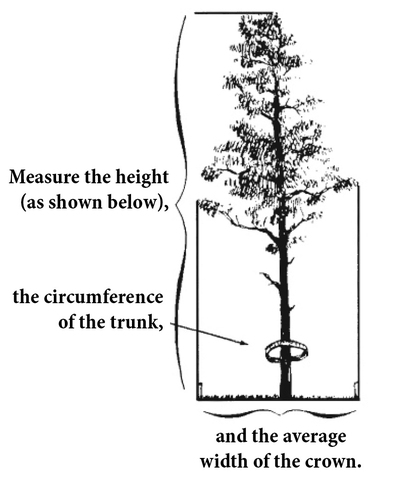
- Circumference is the distance around the tree measured at 4.5 feet above the ground. One point is given for each inch in circumference.
- Height is the distance from the base to the top of the tree. One point is given for each foot (12 inches) in height.
- Crown spread is the average distance that the crown extends from the main trunk of the tree. It should be measured from the dripline of the crown to the other side in at least two locations. It can be convenient to measure from north to south and east to west. After averaging the two figures, one-fourth of a point is given for each foot of crown spread. (It takes 4 feet of crown spread to get one point.)
For example, you have measured a post oak with the following dimensions: circumference: 144 inches; height: 70 feet; and average crown spread: 80 feet. You should score the tree this way:
circumference: 144 inches × 1 point = 144 points
height: 70 feet × 1 point = 70 points
average crown spread: 80 feet × ¼ point = 20 points
total = 234 points
The entry with the highest total points will be declared the champion of its species and will be cited in the Mississippi Forestry Commission’s Champion Big Tree Contest Register. Co-champions will be listed when entries are within 100 points of one another. Mississippi champions that score higher than those listed in the National Champion Tree Program will be submitted for consideration.
Project References
- National Champion Tree Program
- National Champion Tree Program Tree Measurements and Points Calculation
- Extension Publication 146 Know Your Trees
- Extension Publication 1473 4-H Forestry Project No. 5: Measuring Standing Sawtimber
Project Materials
- A piece of non-stretch string about 25 feet in length
- A tape measure or logger’s tape
- A straight stick at least as long as your arm. Note: A wooden yardstick works well. A clinometer can be used under the supervision of a registered forester.
- Four sharp sticks to use as stakes.
Sources of Help and Information
Local forestry and natural resource professionals and Master Gardeners can help you locate big trees. They may also help start a county big tree program.
- MSU Extension agents; find yours at your county MSU Extension office
- Area forester with the Mississippi Forestry Commission (Find Your Forester - MFC)
- District conservationist with the USDA Natural Resources Conservation Service (USDA Service Center Locator)
- Registered foresters (Mississippi Board of Registration for Foresters)
- Park managers with the Mississippi Department of Wildlife, Fisheries, and Parks (Mississippi’s State Parks)
Instructions
- Locate a tree that you think may be of champion size.
- Contact the owner and request permission to measure the tree.
- Measure the tree circumference (distance around) at 4.5 feet above the ground (see illustration). If a tape measure is not long enough, measure the amount of non-stretch string required to wrap around the tree.
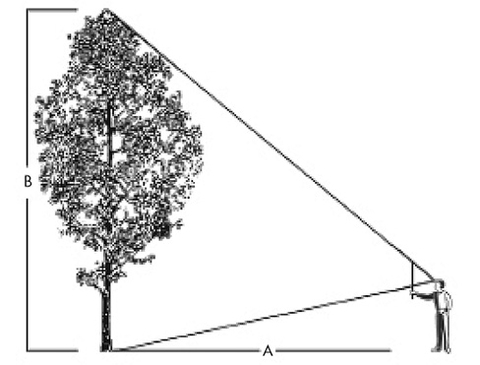
- Measure tree height. Tree height can be estimated with a straight stick. Hold the stick straight up and down at arm’s length in front of you. The length of the stick above your hand must be the same as the distance from your hand to your eye (see illustration). You can get this distance by placing one end of the stick just under your eye, stretching your arm, and then grasping the stick at the other end. By keeping your hand at that point, the length of the stick above your hand will be the same as the distance from your hand to your eye. Now, hold the stick upright at arm’s length and, without moving anything but your eyes, look up at the top of the stick. Move slowly away from the tree until the top of the stick is lined up with the top of the tree. Remember to keep the base of the tree in line with the top of your hand. Make a mark on the ground where you are standing. Estimate tree height by measuring the distance from the mark to the base of the tree. A registered forester can also provide instruction on how to measure tree height using a clinometer.
- Measure crown spread at two points to get an average. Place stakes on the north, south, east, and west edges of the tree crown. Measure the distance from the north stake to the south stake and from the west stake to the east stake. Add both distances and divide by two to get the average crown spread.
- Determine tree score by using your measurements.
- Ask a registered forester and your adult 4-H leader to verify and sign your record sheet.
- Nominate the potential champion tree by following the instructions on the Mississippi Champion Tree Registry page. On the Mississippi Champion Tree nomination form, you will provide the species name, circumference, height, and average crown spread measurements; at least two photographs of the tree, with a size reference in one; the tree’s location and county and whether it is on private or public land; the owner’s contact information (name, email, and phone number); and confirmation that the owner approves the nomination, will allow the Mississippi Forestry Commission to verify the tree nomination, and will allow the public to visit the property.
Download the PDF for the 4-H Forestry Project No. 2 record form.
Publication 1228 (POD-09-26)
Revised by James Shannon, PhD, Extension Specialist I, North Mississippi Research and Extension Center, from previous editions by Brady Self, PhD, Extension Professor, Forestry, and Thomas A. Monaghan, Extension Professor (retired), Forestry.
The Mississippi State University Extension Service is working to ensure all web content is accessible to all users. If you need assistance accessing any of our content, please email the webteam or call 662-325-2262.
Download
P1228
4-H Forestry Project No. 2: Big Tree Contest
309.04 KB
Departments
Authors
-
 Extension Specialist I
- North MS Research and Extension Ctr
-
 Extension Professor
- Forestry