M2499
Educational Tips for Farmers: Zoonotic Diseases in Small Ruminants
Zoonotic diseases are infections that can spread between animals and people. Each disease has varying levels of severity for both humans and livestock. Following are prevalent zoonotic diseases between small ruminants and humans in the U.S.
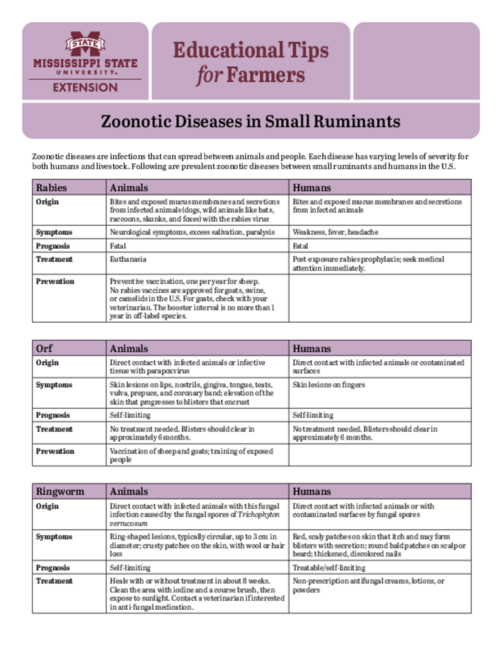
| Rabies | Animals | Humans |
|---|---|---|
| Origin | Bites and exposed mucus membranes and secretions from infected animals (dogs, wild animals like bats, raccoons, skunks, and foxes) with the rabies virus | Bites and exposed mucus membranes and secretions from infected animals |
| Symptoms | Neurological symptoms, excess salivation, paralysis | Weakness, fever, headache |
| Prognosis | Fatal | Fatal |
| Treatment | Euthanasia | Post-exposure rabies prophylaxis; seek medical attention immediately. |
| Prevention | Preventive vaccination, one per year for sheep. No rabies vaccines are approved for goats, swine, or camelids in the U.S. For goats, check with your veterinarian. The booster interval is no more than 1 year in off-label species. |
| Orf | Animals | Humans |
|---|---|---|
| Origin | Direct contact with infected animals or infective tissue with parapoxvirus | Direct contact with infected animals or contaminated surfaces |
| Symptoms | Skin lesions on lips, nostrils, gingiva, tongue, teats, vulva, prepuce, and coronary band; elevation of the skin that progresses to blisters that encrust | Skin lesions on fingers |
| Prognosis | Self-limiting | Self-limiting |
| Treatment | No treatment needed. Blisters should clear in approximately 6 months. | No treatment needed. Blisters should clear in approximately 6 months. |
| Prevention | Vaccination of sheep and goats; training of exposed people |
| Ringworm | Animals | Humans |
|---|---|---|
| Origin | Direct contact with infected animals with this fungal infection caused by the fungal spores of Trichophyton verrucosum | Direct contact with infected animals or with contaminated surfaces by fungal spores |
| Symptoms | Ring-shaped lesions, typically circular, up to 3 cm in diameter; crusty patches on the skin, with wool or hair loss | Red, scaly patches on skin that itch and may form blisters with secretion; round bald patches on scalp or beard; thickened, discolored nails |
| Prognosis | Self-limiting | Treatable/self-limiting |
| Treatment | Heals with or without treatment in about 8 weeks. Clean the area with iodine and a course brush, then expose to sunlight. Contact a veterinarian if interested in anti-fungal medication. | Non-prescription antifungal creams, lotions, or powders |
| Q Fever | Animals | Humans |
|---|---|---|
| Origin | Caused by the bacteria Coxiella burnetiid; through contaminated forages, tick bites, and direct contact with contaminated material from infected animals | Breathing in dust contaminated by infected animal feces, urine, milk, and birth products that contain C. burnetiid; direct contact with contaminated animal bodily fluids, and consumption of contaminated raw/unpasteurized dairy products |
| Symptoms | Abortion, stillbirth, birth of weak lambs/kids, jaundice. Adult animals are typically asymptomatic and can shed the bacteria for a long time in milk, urine, feces, and reproductive secretions. | High fever, flu-like symptoms, pneumonitis, sweats, nonproductive cough, nausea, vomiting, diarrhea, abdominal pain, chest pain, hepatitis, abortion, endocarditis, and chronic fatigue syndrome |
| Prognosis | Treatable | Fatal without treatment |
| Treatment | Antibiotics are not effective. | Seek medical attention immediately if suspicious of exposure. Long-term antibiotics may be needed. |
| Prevention | Vaccination, manure management, restriction of animal movement, hygiene measures, training of exposed people | Vaccination of people at risk |
| Chlamydiosis | Animals | Humans |
|---|---|---|
| Origin | Caused by the bacteria Chlamydia abortus (formerly Chlamydophila abortus); contact with infected placental material and contaminated bedding/waste, and inhalation of contaminated dust | Consumption of contaminated food and water, inhalation of contaminated dust, and contact with contaminated animal material (often aborted fetuses, placenta, and reproductive fluids) |
| Symptoms | Late-term abortion, retained fetal membrane, stillbirth, epididymitis, pneumonia, and conjunctivitis | Flu-like signs with headache, joint pain, light sensitivity, vomiting, sore throat, pneumonitis, and abortion |
| Prognosis | Treatable | Treatable |
| Treatment | Antibiotics; work with your veterinarian. | Antibiotics; seek medical attention. |
| Prevention | Vaccination of ewes and does; training of exposed people |
| Salmonellosis | Animals | Humans |
|---|---|---|
| Origin | Infectious disease from oral intake of Salmonella bacteria through contaminated feed or water | Oral intake of bacteria through contaminated food or water, or direct contact with infected animals |
| Symptoms | Abortion, diarrhea, fever, arthritis | Severe vomiting, abdominal pain, fever, headache |
| Prognosis | Can be fatal without proper treatment | Treatable |
| Treatment | Antibiotic treatment: potentiated sulphonamides, ampicillin, and amoxicillin; contact your veterinarian. | Increase fluid intake; if seriously ill, seek medical attention and antibiotics. |
| Prevention | Hygiene measures |
M2499 (POD-03-26)
By Trinity Best, Undergraduate Student; Lindsey Dearborn, Master of Science Graduate; Leyla Rios, PhD, Assistant Professor, Animal and Dairy Sciences; and Michael Pesato, DVM, Four State Veterinary Services.
The Mississippi State University Extension Service is working to ensure all web content is accessible to all users. If you need assistance accessing any of our content, please email the webteam or call 662-325-2262.
Download
M2499
Educational Tips for Farmers: Zoonotic Diseases in Small Ruminants
69.73 KB
Departments
Authors
-
 Assistant Professor
- Animal & Dairy Science