M2500
Educational Tips for Farmers: Sore Mouth in Small Ruminants
Sore Mouth
- Known as the orf virus, sore mouth is a parapoxvirus.
- Sore mouth is zoonotic, which means humans can contract the disease. Wear gloves to check animals suspected to have sore mouth.
Symptoms
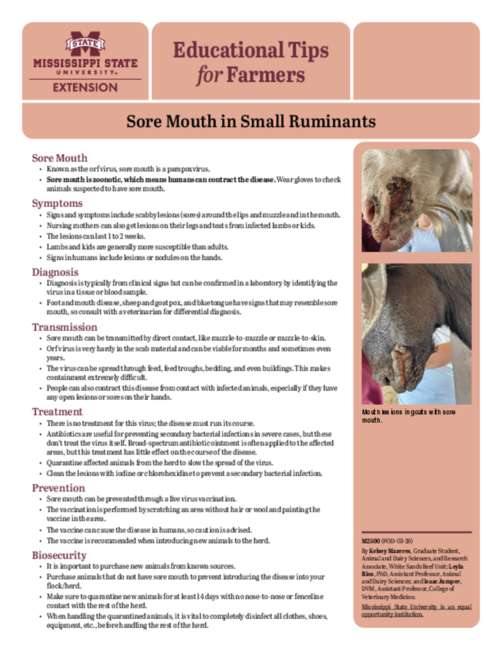
- Signs and symptoms include scabby lesions (sores) around the lips and muzzle and in the mouth.
- Nursing mothers can also get lesions on their legs and teats from infected lambs or kids.
- The lesions can last 1 to 2 weeks.
- Lambs and kids are generally more susceptible than adults.
- Signs in humans include lesions or nodules on the hands.


Diagnosis
- Diagnosis is typically from clinical signs but can be confirmed in a laboratory by identifying the virus in a tissue or blood sample.
- Foot and mouth disease, sheep and goat pox, and bluetongue have signs that may resemble sore mouth, so consult with a veterinarian for differential diagnosis.
Transmission
- Sore mouth can be transmitted by direct contact, like muzzle-to-muzzle or muzzle-to-skin.
- Orf virus is very hardy in the scab material and can be viable for months and sometimes even years.
- The virus can be spread through feed, feed troughs, bedding, and even buildings. This makes containment extremely difficult.
- People can also contract this disease from contact with infected animals, especially if they have any open lesions or sores on their hands.
Treatment
- There is no treatment for this virus; the disease must run its course.
- Antibiotics are useful for preventing secondary bacterial infections in severe cases, but these don’t treat the virus itself. Broad-spectrum antibiotic ointment is often applied to the affected areas, but this treatment has little effect on the course of the disease.
- Quarantine affected animals from the herd to slow the spread of the virus.
- Clean the lesions with iodine or chlorohexidine to prevent a secondary bacterial infection.
Prevention
- Sore mouth can be prevented through a live virus vaccination.
- The vaccination is performed by scratching an area without hair or wool and painting the vaccine in the area.
- The vaccine can cause the disease in humans, so caution is advised.
- The vaccine is recommended when introducing new animals to the herd.
Biosecurity
- It is important to purchase new animals from known sources.
- Purchase animals that do not have sore mouth to prevent introducing the disease into your flock/herd.
- Make sure to quarantine new animals for at least 14 days with no nose-to-nose or fenceline contact with the rest of the herd.
- When handling the quarantined animals, it is vital to completely disinfect all clothes, shoes, equipment, etc., before handling the rest of the herd.
M2500 (POD-03-26)
By Kelsey Mazeres, Graduate Student, Animal and Dairy Sciences, and Research Associate, White Sands Beef Unit; Leyla Rios, PhD, Assistant Professor, Animal and Dairy Sciences; and Isaac Jumper, DVM, Assistant Professor, College of Veterinary Medicine.
The Mississippi State University Extension Service is working to ensure all web content is accessible to all users. If you need assistance accessing any of our content, please email the webteam or call 662-325-2262.
Download
M2500
Educational Tips for Farmers: Sore Mouth in Small Ruminants
222.59 KB
Departments
Authors
-
 Assistant Professor
- Animal & Dairy Science