M2498
Educational Tips for Farmers: Foot Rot Versus Foot Scald in Sheep and Goats
Foot rot is a highly contagious disease that affects the interdigital and digital zones. It is caused by exposure to contaminated soil.
Foot scald, also known as interdigital dermatitis, is a noncontagious inflammation between the toes. It is caused by a microorganism found in ruminant feces.
Signs and Symptoms
Both foot rot and foot scald start with an injury or trauma to the hoof in addition to moisture from the environment.
- Damaged interdigital skin allows microorganisms to enter.
- Problems start with the presence of Fusobacterium necrophorum, leading to foot scald.
- Foot scald can predispose to foot rot with the addition of a second bacteria, Dichelobacter nodosus.
Foot rot can be benign or virulent depending on the strain of D. nodosus.
Problem Symptoms Diagnosis Foot Rot Fever, loss of appetite, hoof deformity. Severe odor, pus, erosion of tissue between the sole, the toe, and the wall horn. Foot Scald Lameness, reduced weight gain, grazing on front knees. Skin between toes appears pink to white, moist, raw, and sensitive to the touch, and has a bad odor.
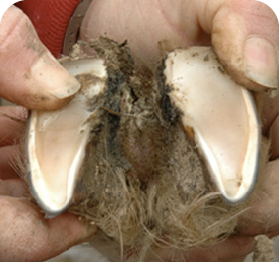
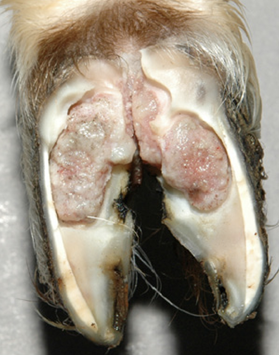
Prevention and Control
- Move animals to dry pastures.
- Ensure pens are clean and well-bedded.
- Trim hooves frequently and disinfect trimming instruments.
Treatment
Consult your veterinarian for treatment options.
M2498 (POD-02-26)
By Ryen Greer, former student, Animal and Dairy Sciences; Kenisha Gordon, former student, Animal and Dairy Sciences; Derris Burnett, PhD, Tuskegee University; Leyla Rios, PhD, Assistant Professor, Animal and Dairy Sciences; and Michael Pesato, DVM, Four State Veterinary Services. Photos used with permission from Purdue University Extension.
The Mississippi State University Extension Service is working to ensure all web content is accessible to all users. If you need assistance accessing any of our content, please email the webteam or call 662-325-2262.
Download
M2498
Educational Tips for Farmers: Foot Rot Versus Foot Scald in Sheep and Goats
111.75 KB
Departments
Authors
-
 Assistant Professor
- Animal & Dairy Science