P4156
Protecting Your Commercial Poultry Investment
If you own a farm and produce poultry commercially, chances are you have a substantial financial investment in your operation—not to mention the sweat equity you’ve put in over the years. Modern poultry houses are equipped with safety features, alarms, and backup systems that can alert you to problems whether you are on the farm or away, and even older houses still provide helpful protections when issues arise. Beyond technology, the house itself is an important part of the system, with mechanical features and structural components that help ensure everything runs smoothly.
Unexpected events can be devastating to a poultry operation. All the features, mechanisms, technologies, and structural engineering in poultry houses are valuable tools for preventing or lessening disasters, but they are only as effective as their upkeep. Regular maintenance is essential to keep systems reliable and structures sound. This publication highlights the key priorities for preventing or reducing disasters on commercial poultry farms to help growers protect their investment and avoid unnecessary financial losses.
Generators
The backup generator is one of the most essential pieces of equipment for keeping your poultry flock safe. When a storm approaches and the power goes out, having a generator that can keep your systems running is vital. It’s a good idea to perform regular checks on your generator to ensure it is in good working order.
Set your generator to run an automatic exercise cycle weekly, when you will be there to hear it run. Be sure to check the hour meter every week to confirm it completes the exercise cycles. During this weekly check, also inspect the generator’s fuel, oil, coolant, block heater, grounding, and belts. Always keep the fuel tank full. Maintaining a full tank prevents condensation from forming, which could contaminate the system with water, and it also ensures you don’t run out of fuel prematurely during an emergency.
Develop an annual generator service schedule to service the machine and replace fluids, filters, batteries, and belts as needed. Some of these tasks can be done by yourself on the farm, or you can opt to have a certified generator technician service the generator. Having a professional inspect the entire system and perform a load test to ensure it operates at peak performance is very important and offers peace of mind.
It is also wise to have a plan and some supplies, such as spare filters, belts, and coolant, on hand in case the power goes out and the generator runs for an extended period. In addition to spare parts, it’s smart to ensure you have enough fuel to refill tanks during a prolonged power outage. If you live in or expect very cold weather, you might want to consider using an anti-gel additive in your fuel to prevent fuel gelling.
Controllers
Electronic controllers are now standard for managing the environment inside poultry houses. These tools are highly effective and can simplify environmental management, but they require regular maintenance. Make sure the controllers are fully reset and updated before placement day for the next flock. Always verify in advance that the controller is set to operate the necessary systems. For example, if you expect a heat wave or a cold front that will cause sharp temperature changes, make sure you’re prepared to adjust accordingly.
If your controller has levels that activate when conditions change, double-check that each level is properly set. For example, if a tunnel level, requiring many fans and high air speed to keep birds comfortable, is limited in ventilation for some reason, mortality issues can occur. Many controllers also feature password protection to restrict changes to authorized personnel—this is worth considering.
Backups
Controllers are valuable tools, but having a mechanical backup system to take over and keep your flock alive if the controller fails is absolutely essential. Always reset the backup thermostats at the start of the flock to an appropriate setting and keep them maintained throughout the grow-out. Make sure the correct number of backups is set and suitable for the birds’ age and the season. You don’t want to find yourself in a situation where the backup is needed but is disabled, leading to mortality.
Alarms
Alarms are a great way to ensure you stay informed about incidents on the farm, but you should verify that everything is working properly before fully relying on them. Before starting a new flock, it’s a good idea to thoroughly test your alarm system to confirm it functions correctly. Test all batteries, horns or sirens, and call-out methods, whether that’s a landline dial-out, internet, or cellular signal. If you’re fortunate enough to have multiple notification methods, this adds an extra layer of protection in case something fails. Although redundancy is beneficial, it’s easy to overlook a secondary system if you mainly depend on another. Be sure to regularly check all systems.
Ventilation System and Equipment
It is wise to regularly inspect your ventilation system and related equipment to ensure they function properly when needed. Since air movement is the primary source of cooling in a commercial poultry house, you should examine the fans to confirm they are in excellent condition. Check fan belts and pulleys for looseness or wear, and make sure belts are sitting correctly in the pulleys (Figure 1).
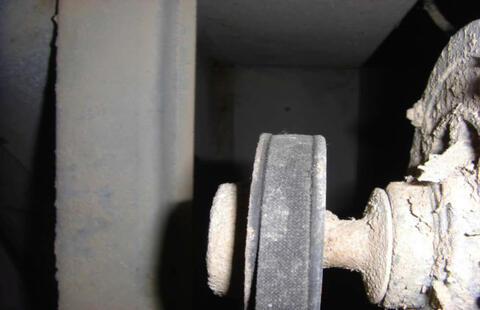
Cleaning fans and shutters between flocks is important to remove dust buildup from the fan body, blades, and louvers. Dust can hinder the fan’s ability to move air effectively. Loose or worn belts riding low in pulleys can decrease the fan’s RPM, and combined with dirty fans and shutters, this can reduce efficiency by up to 20–30 percent. Such efficiency loss across all fans can significantly slow down the wind speed in the house.
To keep secondary cooling systems like sprinklers and cool cells ready, regularly test all valves, sprinkler heads, header pipes, pumps, floats, filters, and sumps to make sure they are working properly. Inspect all vent and tunnel machines, along with their cabling, to identify potential problem spots. When the vent and tunnel machines are operating, listen for abnormal noises, and lubricate the parts as needed.
Grounding
Poultry growers should always be cautious when bad weather occurs—strong winds, rain, and especially lightning. The chicken house is filled with electrical controllers, backups, motors, lights, generators, and other equipment needed to keep the birds alive. All this electrical equipment can be damaged if struck by lightning.
One way to stay as protected as possible is to ensure your houses are properly grounded. Some of the most important grounding points are at electrical panels, generator frames, generator transfer switches, and feed bins. In recent years, it has become common to ground the rebar in the stem wall footing of the poultry house.
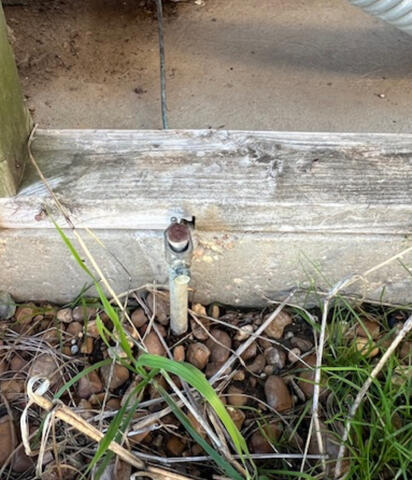
Checking for proper grounding is straightforward with an earth ground resistance meter or an electrician who has one. Once the grounding systems are identified, use the resistance meter to check the grounding. A system that is properly grounded should have a resistance of 25 ohms (Ω) or less. Use a copper-clad or galvanized steel grounding rod about five-eighths to three-quarters of an inch in diameter and 8–10 feet long. A heavy gauge copper wire should connect the equipment to the ground rod with the appropriate acorn-style clamps (Figure 2).
Barn Structure
Of course, the poultry house is one of the most important parts of the poultry farm, and care should be taken to keep it in excellent condition. Sometimes problems aren’t obvious; you need to pay close attention to details to catch issues early before they become serious.
The roof is especially important for maintaining the house’s integrity. Just one small damaged area can cause a single truss to fail, leading to a domino effect that can collapse large sections or even the entire roof. If you notice leaks in your roof, address them as soon as possible. After rain or a storm, take the time to check for leaks by walking around the house. Look for wet spots, water running down the interior walls, or sagging, dripping areas on the ceiling, as these are clear signs of potential roof issues.
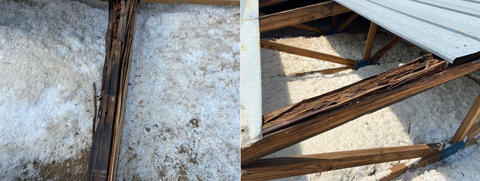
Keep in mind that the absence of visible leaks doesn’t mean everything is fine. Over time, with many heat cycles and exposure to weather, deterioration can occur, weakening roof fasteners and sealing washers. If the screws back out of the purlins or the sealing washers begin to leak, it can cause wood deterioration (Figure 3). This process is slow and may have no obvious signs, but it remains a concern.
Inspecting the condition of the ceiling try-ply is also important. Check for holes or areas where strapping staples have failed and caused sagging. These holes can affect house tightness and allow damp air to enter the attic, which may lead to deterioration over time. Visually inspect the roof and ceiling for dips or buckles, as well as fasteners that seem to be backing out. A dip in the ceiling could indicate wet and sagging insulation or a failing truss.
In addition to an external check, the roof trusses and insulation should be examined inside the attic. The attic can be accessed through a series of scuttle holes in the chicken house ceiling. Look for signs of discoloration, rot, separation or loosening of truss gang nails, truss bowing, and improper insulation coverage that can lead to sweating and lumber rot.
A common area for structural issues is at truss junctions, where gang nails may become loose. The attic of a chicken house is typically a dry environment, which over time can cause gang nails to back out. Regular inspections can help identify and fix this issue easily and inexpensively before major problems develop.
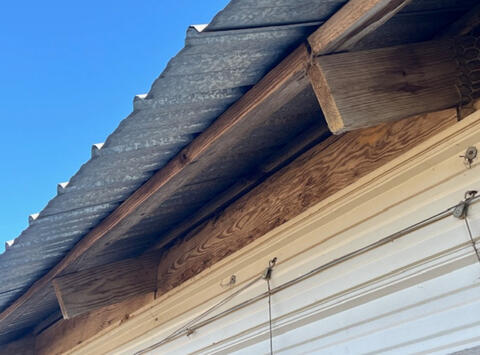
Another concern is the roof truss tail and the outermost purlin. Deterioration or loose fasteners in these areas can weaken the structure, making it easier for straight-line winds to lift the roof. If the truss tail is in good condition, an improvement to better secure the roof edge is to replace the outermost purlin with a metal purlin, secured to the truss with longer screws, and to tie the roof tin with appropriate new screws (Figures 4 and 5).
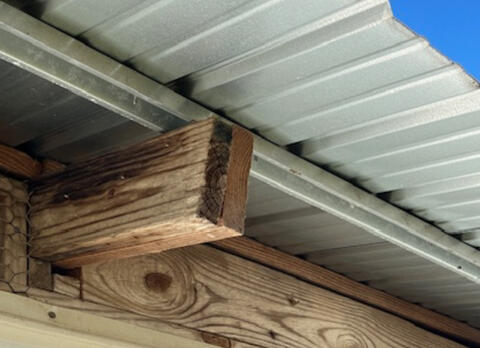
Another area worth inspecting is the side walls. Over time, sidewall posts can deteriorate when embedded in the ground or stem wall. Materials that are in constant contact with chicken litter, like concrete and wood, can start to break down over time.
The area where the wall connects to the roof is also a concern. Most poultry houses built today will have knee braces to help strengthen the structure, especially against heavy winds that might push the house to one side or the other. These braces connect the sidewall post to the roof trusses to prevent lateral movement. If your houses lack knee braces and you plan to operate for many years, it might be worth considering this upgrade.
Many aspects of your poultry house can be easily inspected. Whenever you are inside walking your birds, it also serves as an opportunity to check things like equipment and the interior structure. However, items in the attic area are not as easy to see, such as the condition of trusses and insulation, unless you enter the attic. Conducting a thorough annual inspection, including entering the attic, is recommended to spot issues before they become major problems.
Pest Management
Rodents pose a biosecurity risk because they can carry several pathogenic microorganisms, contaminate feed and water, and directly transmit disease. Rats and mice are notorious chewers that can gnaw through nearly any material except steel. If unchecked, they reproduce rapidly and become a major problem.
They can cause significant structural damage, chewing through ceilings and walls to create access holes that weaken insulation and house integrity. They often chew electrical wires while urinating and defecating in electrical components. This disrupts the proper functioning of controllers, generators, and equipment, creating operational issues and fire hazards.
To prevent entry, place bait stations around each house’s perimeter, but once rodents get inside, outside stations become ineffective. Addressing an internal infestation requires new application methods and careful timing. For roof rats, it’s best to securely place bait stations in the attic near access holes in the ceiling. Another effective approach is to place bait along the house between flocks when no birds are present, leaving it out as long as possible for maximum effectiveness. It is crucial to check bait stations frequently and rotate baits with different active ingredients to maintain their effectiveness.
Like rodents, litter-darkling beetles pose a biosecurity risk because they are reservoirs of several pathogens and parasites, which can cause serious problems if transmitted to birds. They tend to migrate to the walls, where they burrow into hard surfaces, causing damage to insulation and compromising the house’s tightness. A strong beetle management plan with treatments for litter and walls between each flock is essential. Rotating insecticides with different active ingredients that target all life stages is the most effective way to control them.
Together, rodents and beetles threaten bird health and the house structure, but they can also harm you financially in other ways. They both consume poultry feed and, in heavy infestations, can reduce your feed conversion ratio by eating feed meant for the birds. One rat can eat over 30 pounds of feed per year, and when you include their reproduction rate, this can quickly become a major problem. Heavy infestations of both rodents and litter beetles can also disturb the birds, causing stress and decreased performance. The loss of feed and reduced production will result in lower pay at the end of each flock.
Conclusion
Protecting a commercial poultry operation requires more than relying on modern equipment and advanced technology—it depends on consistent maintenance, regular inspections, and proactive management of the house structure and the threats that endanger it. Generators, controllers, backups, alarms, and ventilation systems must be serviced and tested regularly to ensure they work when needed, while grounding and structural upkeep safeguard the house and equipment against long-term deterioration and sudden disasters. Pest management is crucial for protecting both bird health and farm profitability, as rodents and beetles can damage equipment, compromise biosecurity, and directly reduce performance.
Most producers understand these risks, but it’s easy to let maintenance slip through the cracks. By committing to preventive care and a comprehensive management plan, growers can minimize risks, protect their investment, and maintain the health and productivity of their flocks. For more detailed information, contact MSU Extension poultry specialist Jonathan Moon at jwm133@msstate.edu or (662) 325-3416.
The information given here is for educational purposes only. References to commercial products, trade names, or suppliers are made with the understanding that no endorsement is implied and that no discrimination against other products or suppliers is intended.
Publication 4156 (POD-11-25)
By Jonathan Moon, Extension Instructor, Poultry Science.
The Mississippi State University Extension Service is working to ensure all web content is accessible to all users. If you need assistance accessing any of our content, please email the webteam or call 662-325-2262.
Download
P4156
Protecting Your Commercial Poultry Investment
710.69 KB
Authors
-
 Extension Instructor
- Poultry Science