P4164
Impact of Pre-breeding Body Weight on Replacement Beef Heifer Production
Introduction
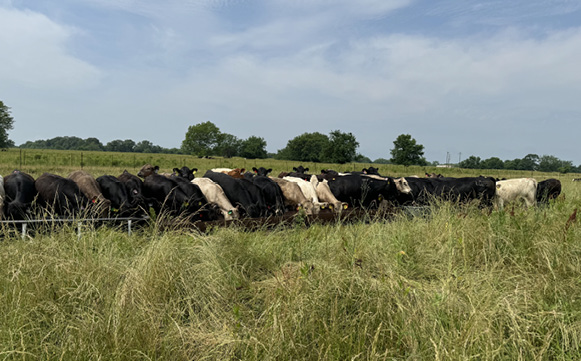
Productive cow-calf operations are measured by how successful the cows are at giving birth to a calf every year. Therefore, replacement heifer development is a crucial part of cow-calf operations, as they represent the next cattle generation that will boost the herd’s efficiency and profitability. Because producers typically cull 10 to 15 percent of their herd, they should have a replacement rate of 10 to 20 percent to maintain or build up their herd. Developing quality replacement heifers takes time and money, meaning heifers must have high conception rates at their first breeding to provide earlier financial returns to the producer. Good nutritional management after weaning until the breeding season is necessary for heifers to reach their full genetic potential and longevity. Many factors play a role in heifer development and are discussed in this publication.
Reproduction
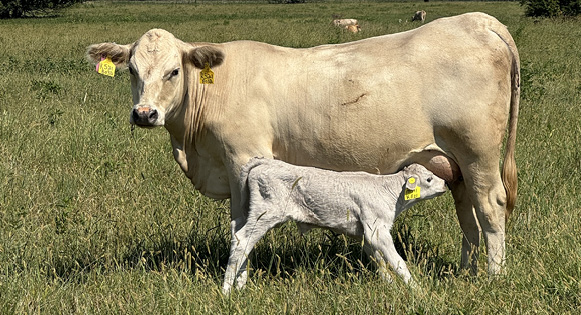
A critical part of successful beef cattle production is heifer reproduction, as it determines the herd’s future productivity and genetic progress. Proper reproductive management begins with picking heifers that show desirable traits like early puberty, good structure, and the right frame size. Puberty plays an important role in a heifer’s reproductive life. Heifers should reach puberty by 12 months of age so they can successfully conceive at 15 months. Puberty occurs when a heifer ovulates (releases an egg), has visual signs of being in heat, and has a normal reproductive cycle. The hormone activity related to this process is stopped until the heifer reaches a sufficient age, size, and body composition to reproduce successfully.
Additionally, previous research showed a 21 percent increase in fertility when heifers were bred on their third or later heat cycle after reaching puberty. Therefore, heifers should reach puberty one to three months before they are bred to avoid economic losses for the producer, such as decreased weaning weight of offspring and increased overall costs due to heifers being bred at a later age. Another factor to consider is the breed of cattle that a producer raises. If the producer’s herd is more Bos taurus based, these cattle will typically reach puberty and their target pre-breeding body weight between 12 and 14 months of age. However, if a producer has a herd that is more predominantly Bos indicus based, these heifers will typically reach puberty and pre-breeding target weight between 15 and 24 months of age.
Nutrition
Heifer nutritional management should be based on breed composition and mature size to ensure an adequate body weight gain before breeding. Typically, it is recommended for heifers to be 60 to 65 percent of their mature body weight by puberty (Table 1) and reach 85 percent of their mature body weight prior to calving to allow for easy calving and adequate body condition score. At the time of calving, heifers are still growing and need extra nutrients because they are producing milk as well.
| Expected Mature Body Weight | 55% Pre-Breeding Body Weight | 65% Pre-Breeding Body Weight |
|---|---|---|
| 900 lbs | 496 lbs | 584 lbs |
| 1000 lbs | 549 lbs | 650 lbs |
| 1100 lbs | 604 lbs | 714 lbs |
| 1200 lbs | 659 lbs | 780 lbs |
| 1300 lbs | 714 lbs | 844 lbs |
A goal for the producer is feeding beef heifers to reach their peak performance. Beef heifers require a balanced diet that has adequate energy, protein, vitamins, and minerals to help maintain a steady growth rate. Heifers need an average daily gain of 1.25 to 2.75 pounds per day to reach their target pre-breeding body weight by the breeding season. Forage-based diets that are supplemented with grains as needed can help achieve the targeted pre-breeding body weight.
Producers, however, should be aware of over-conditioning developing heifers, which can lead to lower fertility. To help monitor growth and average daily gain, producers can weigh heifers every 30 days and make adjustments to the amount of feed the heifers consume. If livestock scales are not available, producers can assess animals’ nutritional health by looking at the body condition score (BCS). A good target for heifer BCS at breeding is a BCS of 6. If a heifer BCS becomes too low or too high, this can lead to infertility and other issues. For more information on BCS, refer to Mississippi State University Extension Publication 2508 Body Condition Scoring Beef Cattle.
60 to 65 Percent Mature Body Weight
It is commonly recommended that producers feed heifers to attain 60 to 65 percent mature body weight by breeding. Feeding developing heifers to this percentage can be effective across different breeds of cattle. Because most producers have a variety of cattle within the cow herd, this strategy is usually a good target to ensure heifers reproduce successfully.
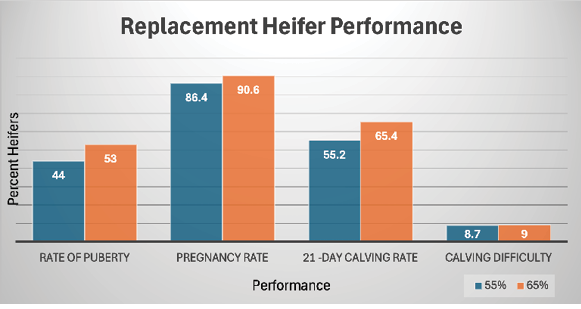
Research has shown that feeding heifers to reach 60 to 65 percent of their mature body weight makes calving easier. These results are due to the larger pelvic areas and well-developed reproductive tracts of those heifers. Heifers fed to 65 percent of mature body weight compared to 55 percent of mature body weight had greater rates of puberty, pregnancy, and 21-day calving; however, there was no difference shown in the calving difficulty rate (Figure 1).
There are some downsides to using this nutritional strategy; one is elevated feed and input costs. Feed prices have been on a steady rise in recent years, and this puts an increased financial burden on beef producers. Drought conditions cause feed prices to rise sharply, due to low hay supplies and poor grazing conditions which increase demand for alternatives. Another factor to consider is selection pressure on the herd. Feeding heifers to reach 60 to 65 percent of mature body weight results in lower selection pressure because better nutrition speeds up puberty. There are concerns that too much feed can cause fat to build up in the reproductive organs, which may hurt fertility. However, feeding heifers to 60 to 65 percent of mature body weight remains one of the most widely adopted development strategies.
50 to 55 Percent Mature Body Weight
Developing replacement heifers to 50 to 55 percent of mature body weight may be one strategy to mitigate costs while maintaining herd productivity. Some cases reported that this feeding strategy may increase calving difficulty in those heifers; however, research has shown that dystocia (difficult or slow labor during birth) was unaffected, and rebreeding rates did not decrease in heifers fed to reach 50 to 55 percent of mature body weight by breeding.
Researchers also found that heifers grown to 55 percent of mature body weight grew more slowly before breeding but grew faster during the breeding season compared to those raised to 62 percent. They concluded that these heifers gained more because of their ability to respond to improved forage quality. Further, heifers fed in this manner have similar longevity compared to cohorts reared to reach 60 to 65 percent of mature body weight by breeding. However, there are drawbacks and factors that must be considered with this feeding strategy. For example, most research on feeding heifers to 50 to 55 percent of mature body weight used crossbred heifers, which usually reach puberty earlier than purebred heifers.
Additionally, the percentage of heifers that conceived within the first 21 days of the breeding season was reduced when heifers were only developed to 50 to 55 percent of mature body weight, while overall pregnancy rates were not affected. Heifers that breed and calve earlier are usually more productive and cost-effective, which is important in overall operational goals. More importantly, feeding heifers to 55 percent of their mature body weight reduces the costs to the producer compared to feeding to 65 percent of mature body weight.
In one study comparing 55 percent versus 62 percent body weight development target for heifers found that feeding costs were reduced in moderate-gain heifers (55 percent) compared to high-gain heifers (62 percent). Developing these heifers to a high gain over a 202-day development period cost the producer an additional $58 per head (21 percent higher) compared to moderate gain, and this was due to increased feed and labor costs. It should be noted that this study is over 10 years old, and input costs are greater now, so these feed cost numbers would be increased.
Conclusion
Collectively, replacement heifer development represents a significant part of cow-calf operations, and nutrient management should be tailored to suit individual operational goals. There are a variety of nutritional strategies available to ensure replacement heifers reach puberty and conceive in a timely manner. For example, if forage resources are plentiful, or if the operation has limited cow numbers or marketing options for open heifers, feeding replacement heifers to reach 60 to 65 percent of their mature body weight may be preferred. Alternatively, if forage and feed resources are limited, the herd is large, and cows are moderately framed, the beef producer may consider feeding replacement heifers to reach 50 to 55 percent of mature body weight by the time of breeding. For more information about beef replacement heifer management, contact your local MSU Extension office.
References
Engelken, T. J. (2008). Developing replacement beef heifers. Theriogenology, 70, 569–572.
Hall, J. B. (2020). Heifer development: Same challenges, more options. In Proceedings of the Applied Reproductive Strategies in Beef Cattle Conference (pp. 131–144). Beef Reproduction Task Force.
Kasimanickam, R. K., Kasimanickam, V. R., & McCann, M. L. (2021). Difference in body weight at breeding affects reproductive performance in replacement beef heifers and carries consequences to next generation heifers. Animals, 11, 2800.
Lardner, H. A., Damiran, D., Hendrick, S., Larson, K., & Funston, R. (2014). Effect of development system on growth and reproductive performance of beef heifers. Journal of Animal Science, 92, 3116–3126.
Larson, R. L. (2007). Heifer development: Reproduction and nutrition. Veterinary Clinics of North America: Food Animal Practice, 23, 53–68.
Moran, C., Quirke, J. F., & Roche, J. F. (1989). Puberty in heifers: A review. Animal Reproduction Science, 18, 167–182.
Patterson, D. J., Perry, R. C., Kiracofe, G. H., Bellows, R. A., Staigmiller, R. B., & Corah, L. R. (1992). Management considerations in heifer development and puberty. Journal of Animal Science, 70, 4018–4035.
Perry, R. C., Corah, L. R., Cochran, R. C., Brethour, J. R., Olson, K. C., & Higgins, J. J. (1991). Effects of hay quality, breed, and ovarian development on onset of puberty and reproductive performance of beef heifers. Journal of Production Agriculture, 4, 13–18.
Publication 4164 (POD-12-25)
By Mason Drewery, Extension Agent I, Tippah County, Kelsey Harvey, PhD, Assistant Professor, Prairie Research Unit, and Brandi Karisch, PhD, Associate Extension/Research Professor, Animal and Dairy Sciences.
The Mississippi State University Extension Service is working to ensure all web content is accessible to all users. If you need assistance accessing any of our content, please email the webteam or call 662-325-2262.
Download
P4164
Impact of Pre-breeding Body Weight on Replacement Beef Heifer Production
277.68 KB
Programs
Departments
Authors
-
 Assoc Extension/Research Prof
- Animal & Dairy Science
-
 Extension Agent I
- MSU Extension- Tippah County