P3797
The Buddy System: Pair Housing Dairy Calves to Improve Production, Function, and Developmental Potential
Introduction
A heifer calf is vital to a dairy operation as she is the future of the milking herd. The heifer will improve the genetics of your farm once she is in the milking herd, and once she joins the herd, her dam can also return to production. However, she also represents a large investment of both labor and money. By the time a first-calf heifer calves at 2 years of age, an average of $278 has already been invested. Ensuring that her early-life experiences set her up for later success is crucial to a dairy operation.
Until recently, U.S. dairy producers had been advised to raise calves individually, and without contact with other calves, from birth until they are grouped with similar-aged heifers at weaning. These animals would then remain in groups of varying size and complexity throughout their lifetimes. Raising dairy calves individually during the first few weeks of life does have benefits; it decreases the opportunity for disease spread and early-life injury while also improving the individualized care given to each calf. However, cattle typically thrive in an environment where they have open social interactions, as they are innately gregarious in nature. These social interactions improve the animal’s ability to cope with stress. Pairing or grouping calves from birth—or social housing—is an emerging practice that has only been adopted by 14.7 percent of U.S. dairy producers so far.
Food animal welfare is of increasing public concern, and consumer preferences have affected modern farming practices. For example, legislation has been introduced in several states to ban certain forms of livestock housing (for example, farm animal anti-confinement legislation). Consumers have shown an interest in social forms of housing for dairy calves. In a survey conducted by researchers at the University of Minnesota, both adult and youth respondents showed strong preference for social forms of housing for dairy cattle. Respondents frequently cited improved socialization and space allowance as benefits of social forms of housing. Individual housing was mostly accepted by rural residents, adult males, and those with previous livestock experience, likely because they are most familiar with this calf management practice.
Immunological Status of Pair-Housed Calves
A sick calf will not perform to its greatest potential. Part of the support for individual housing is related to the belief that it limits disease transfer between calves. However, large-scale studies have found no differences in immunological status of calf herds when housed in pairs or small groups with proper hygiene. Results from other studies varied, but these variations are likely due to management differences. For example, in one study that evaluated group housing timing, calves housed in groups from birth had a higher incidence of diarrhea and pneumonia. However, these calves were fed using an automatic feeder with a shared single nipple, which may explain the increased cases of respiratory illness. In another study, researchers sought to determine if group housing calves in environments with poor drainage and ventilation had negative effects on successful rearing. Results indicate that even in poor indoor environments, there is no significant effect of pair or group housing compared to individually housed calves. Therefore, the disease status of a calf is variable due to factors such as hygiene, ventilation, feeding practices, and initial immunological status of the calf and not solely the social structure of provided housing.
Benefits of Pair Housing
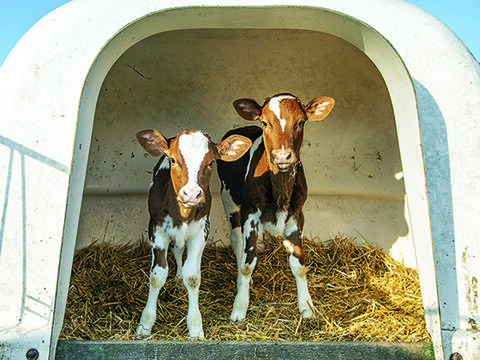
Pair housing is useful to a producer only if it improves calf mortality and productive traits. Industry leaders in the past advised producers to employ individual housing in their heifer rearing programs to improve individualized care of calves during the preweaning period. However, raising dairy calves in pairs can be advantageous to calf welfare and performance.
Production: The most important factor for the success of a calf program is the ability of calves to survive and develop appropriately. The housing system is the most critical aspect of fostering this ability. In multiple studies, calves that were housed in pairs had growth rates similar to those housed individually. Individually housed calves can have a slower growth rate at and after weaning compared with pair-housed calves. This is most likely due to pair-housed calves having increased concentrate intake during the preweaning period, which allows for a smoother transition during weaning. While pair-housing may have slightly better or equal effects on calf growth during the preweaning period, the use of early pairing is still useful for growth and intake rates during the postweaning period.
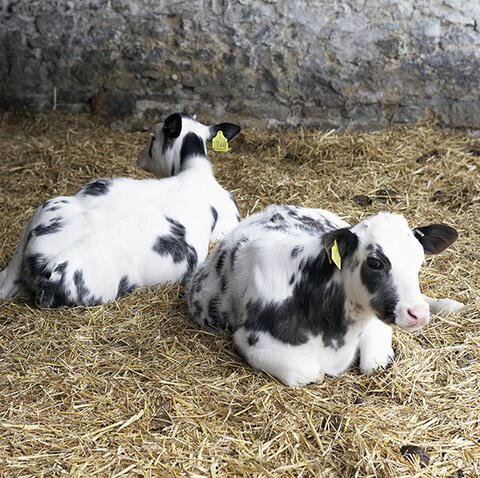
Cognitive Function: A calf’s ability to learn behaviors and alter learned behaviors based on environmental changes is crucial for the success of the animal later in life. Socially reared dairy calves (either groups or pairs) can learn and relearn tasks, while individually housed calves struggle with relearning behaviors. In fact, individually housed calves were given twice the opportunity and were still not able to relearn tasks. This has implications for the calf over her whole life, as she will be faced with scenarios where she will need to modify learned behaviors (such as housing changes, entering the milking parlor, and regrouping). Further, throughout the life of a dairy cow, she will experience novelty in her environment, such as changes in diet, location, and housing. The ability of an animal to cope with novelty is important to its future performance. Socially housed calves have greater intake of novel feeds compared with individually housed calves. Calves in social forms of housing may have improved response to novel feeds due to social learning from peers approaching and manipulating feed. This allows for dairy cattle to easily transition when presented with new feeds such as at weaning and freshening.
Social Development: Although individually housed calves typically receive visual and auditory stimuli from other calves, having physical contact with their counterparts has been shown to foster social improvement. Proper socialization is important to the development of dairy cattle, as they typically live in a herd environment after weaning. During this time, grouping may change in complexity, so dairy cattle need to be able to cope with these changes. Individually housed calves show more reactivity with novelty in their environment, which may influence their ability to form social connections later in life. Socially housed calves exhibit increased play behaviors during the preweaning phase and maintain improved success in competitive situations such as feeding. Further, when regrouped with unfamiliar calves, pair-housed calves are more willing to approach their new pen mates. Calves have also been observed to form connections that are long-lasting before the age of 3.5 months. Therefore, socializing calves together may improve their response to one another after freshening and entering the milking herd.
Conclusion
The welfare of a dairy calf is of great consideration to both farmers and consumers. Housing is an important factor for providing proper welfare, and socialization during early life has shown marked improvements in the production, cognitive development, and social development of calves compared to individually housed counterparts. When they are provided with the opportunity to have physical contact with other calves, the welfare of each calf is improved, which also enhances production traits and the development of behaviors that may make future life experiences less difficult.
References
Bolt, S. L., Boyland, N. K., Mlynski, D. T., James, R., & Croft, D. P. (2017). Pair housing of dairy calves and age at pairing: Effects on weaning stress, health, production and social networks. PLOS ONE, 12(1), e0166926.
Bučková, K., Šárová, R., Moravcsíková, Á., & Špinka, M. (2021). The effect of pair housing on dairy calf health, performance, and behavior. Journal of Dairy Science, 104(9), 10282–10290.
Chua, B., Coenen, E., van Delen, J., & Weary, D. M. (2002). Effects of pair versus individual housing on the behavior and performance of dairy calves. Journal of Dairy Science, 85(2), 360–364.
Cobb, C. J., Obeidat, B. S., Sellers, M. D., Pepper-Yowell, A. R., & Ballou, M. A. (2014). Group housing of Holstein calves in a poor indoor environment increases respiratory disease but does not influence performance or leukocyte responses. Journal of Dairy Science, 97(5), 3099–3109.
Costa, J. H. C., Daros, R. R., von Keyserlingk, M. A. G., & Weary, D. M. (2014). Complex social housing reduces food neophobia in dairy calves. Journal of Dairy Science, 97(12), 7804–7810.
Costa, J. H. C., Meagher, R. K., von Keyserlingk, M. A. G., & Weary, D. M. (2015). Early pair housing increases solid feed intake and weight gains in dairy calves. Journal of Dairy Science, 98(9), 6381–6386.
Costa, J. H. C., von Keyserlingk, M. A. G., & Weary, D. M. (2016). Invited review: Effects of group housing of dairy calves on behavior, cognition, performance, and health. Journal of Dairy Science, 99(4), 2453–2467.
Curtis, G. C., Argo, C. M. G., Jones, D., & Grove-White, D. H. (2016). Impact of feeding and housing systems on disease incidence in dairy calves. The Veterinary Record, 179(20), 512.
de Paula Vieira, A., de Passillé, A. M., & Weary, D. M. (2012). Effects of the early social environment on behavioral responses of dairy calves to novel events. Journal of Dairy Science, 95(9), 5149–5155.
De Vries, A. (2006). Economic value of pregnancy in dairy cattle. Journal of Dairy Science, 89(10), 3876–3885.
Duve, L. R., Weary, D. M., Halekoh, U., & Jensen, M. B. (2012). The effects of social contact and milk allowance on responses to handling, play, and social behavior in young dairy calves. Journal of Dairy Science, 95(11), 6571–6581.
Gaillard, C., Meagher, R. K., von Keyserlingk, M. A. G., & Weary, D. M. (2014). Social housing improves dairy calves’ performance in two cognitive tests. PLOS ONE, 9(2), e90205.
Meagher, R. K., Daros, R. R., Costa, J. H. C., von Keyserlingk, M. A. G., Hötzel, M. J., & Weary, D. M. (2015). Effects of degree and timing of social housing on reversal learning and response to novel objects in dairy calves. PLOS ONE, 10(8), e0132828.
Perttu, R. K., Ventura, B. A., & Endres, M. I. (2020). Youth and adult public views of dairy calf housing options. Journal of Dairy Science, 103(9), 8507–8517.
Quigley, J. (1997). Raising replacement heifers from birth to weaning.
Raussi, S., Niskanen, S., Siivonen, J., Hänninen, L., Hepola, H., Jauhiainen, L., & Veissier, I. (2010). The formation of preferential relationships at early age in cattle. Behavioural Processes, 84(3), 726–731.
Wells, S. J., Dargatz, D. A., & Ott, S. L. (1996). Factors associated with mortality to 21 days of life in dairy heifers in the United States. Preventive Veterinary Medicine, 29(1), 9–19.
Whalin, L., Weary, D. M., & von Keyserlingk, M. A. G. (2018). Short communication: Pair housing dairy calves in modified calf hutches. Journal of Dairy Science, 101(6), 5428–5433.
Publication 3797 (POD-12-25)
Reviewed by Jessica Halfen, PhD, Assistant Professor and Extension Dairy Specialist; and Clay Cavinder, PhD, Professor and Extension Horse Specialist, Animal and Dairy Sciences. Written by Kevin Braman, former Graduate Research Assistant; Cavinder; and Amanda Stone, PhD, former Assistant Professor, Animal and Dairy Sciences.
The Mississippi State University Extension Service is working to ensure all web content is accessible to all users. If you need assistance accessing any of our content, please email the webteam or call 662-325-2262.
Download
P3797
The Buddy System: Pair Housing Dairy Calves to Improve Production, Function, and Developmental Potential
742.34 KB
Departments
Authors
-
 Professor
- Animal & Dairy Science