P4190
Grazing in Harmony: Benefits of Mixed-Species Grazing or Co-Grazing
Download the full publication by selecting the publication image in the right column.
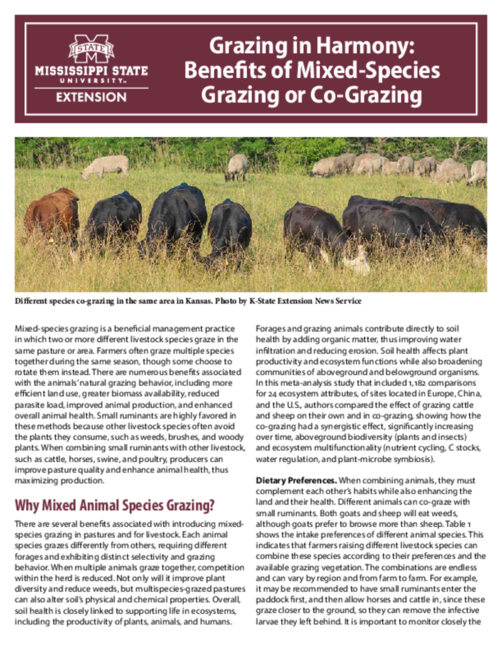
Mixed-species grazing is a beneficial management practice in which two or more different livestock species graze in the same pasture or area. Farmers often graze multiple species together during the same season, though some choose to rotate them instead. There are numerous benefits associated with the animals’ natural grazing behavior, including more efficient land use, greater biomass availability, reduced parasite load, improved animal production, and enhanced overall animal health. Small ruminants are highly favored in these methods because other livestock species often avoid the plants they consume, such as weeds, brushes, and woody plants. When combining small ruminants with other livestock, such as cattle, horses, swine, and poultry, producers can improve pasture quality and enhance animal health, thus maximizing production.
You can also contact state Extension specialists or your local Extension office for answers to specific questions.
Publication 4190 (POD-07-26)
By Gabrielle Champ, Undergraduate Student, Larry Leon, Graduate Student, and Leyla Rios, PhD, Assistant Professor, Animal and Dairy Sciences. Reviewers: Rocky Lemus, PhD, Extension/Research Professor, Plant and Soil Sciences, and Santiago Cornejo, PhD, Assistant Professor, Animal and Dairy Sciences.
The Mississippi State University Extension Service is working to ensure all web content is accessible to all users. If you need assistance accessing any of our content, please email the webteam or call 662-325-2262.
Download
P4190
Grazing in Harmony: Benefits of Mixed-Species Grazing or Co-Grazing
196.84 KB
Departments
Authors
-
 Assistant Professor
- Animal & Dairy Science
-
 Graduate Research Assistant
- Animal & Dairy Science