P3465
Recognizing Heat Stress in Dairy Cattle: How to Visually Record Respiration Rate
Heat Stress on Dairy Cows
High temperature, humidity, and exposure to solar radiation can cause cows to become stressed. Temperature humidity index (THI) is a value that includes both ambient temperature and relative humidity and can be used to assess the intensity of heat load for an animal.
At a THI of 68 or higher, lactating dairy cows experience heat stress. As an example, an ambient temperature of just 72°F with 45 percent relative humidity and an ambient temperature of 76°F with 15 percent humidity both equal a THI of 68. You may not be hot in these conditions, but dairy cows have a lower heat stress threshold compared to people. Dairy cows in the southeastern U.S. spend nearly 50 percent of the year in a state of heat stress. Cows in Mississippi are in a constant state of heat stress from May to September, so during this time, they rarely get a chance to relax, recover, and prepare for another day of being heat stressed.
Non-evaporative cooling methods are used with milder temperatures. These can include conduction (lying on a cool surface), convection (wind moves heat from near the surface of the cow’s skin and is replaced with cooler air), and radiation (when all or parts of the surroundings are cooler than the cow’s skin). Evaporative cooling methods like panting and sweating are used when environmental temperatures are high. In regions with a subtropical climate, like the southeastern U.S., the high relative humidity limits the rate of heat loss via evaporative cooling.
When a cow’s natural heat abatement methods become insufficient because the heat and humidity are just too much, the result is decreased milk yield, decreased conception rates, increased days open, increased chance of abortion, and, in extreme cases, death. Somatic cell count and clinical mastitis infection rate can also increase indirectly from heat stress. This occurs when cows that already have a lowered immune response then lay in mud and manure to try to cool themselves.
Heat stress on cows already causes a decrease in production of up to 4,568 pounds per cow per year, and the higher risk of resulting mastitis decreases milk yield even more. The decrease in production and performance caused by heat stress leads to an economic loss of $900 million each year for the dairy industry.
Recording Respiration Rate
Respiration rate has been identified as one of the most sensitive ways of observing if a cow is in a state of heat stress. A non-heat-stressed cow will have a respiration rate range of 26 to 50 breaths per minute. When respiration rate exceeds 120 breaths per minute, the cow is experiencing severe heat stress.
Ideally, producers would employ heat abatement strategies like fans and sprinklers automatically when THI is close to 68, but many producers house cows outdoors or do not have automated systems to do this. In these cases, recording respiration rate is recommended. Use this method on about 10 percent of the herd each evening, as well as when any cow is exhibiting uncommon behaviors (e.g., isolation from the rest of the herd, holding head low to the ground, drooling, panting with her tongue out).
To measure respiration rate, it is important to be quiet and keep a reasonable distance from the animal you’re observing. If cows are eating or drinking, wait until they finish before collecting respiration rate data. Do not observe respiration rates in the holding pen because they are typically crowded, elevating their temperature and respiration rate even more.
To visually observe respiration rate, you will need:
- pen/pencil and paper or notes app on smartphone
- stopwatch
Focusing on the flank area of the cow (Figure 1), start on an exhale and use the stopwatch to record the time it takes to count 10 full breaths. One full breath is defined as one inhale and one exhale. The cow is exhaling when the flank looks sunken in and inhaling when the flank looks full of air.
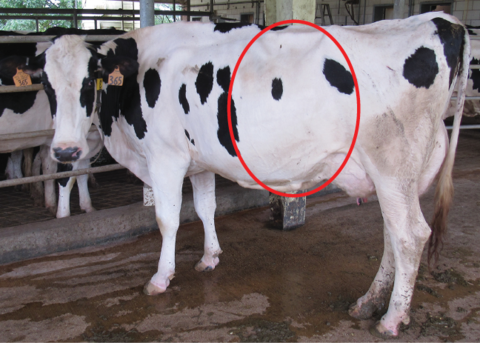
Once you have recorded the time for a cow to take 10 full breaths, use the following equation to calculate breaths per minute:
10 ÷ number of seconds it took to take 10 breaths × 60
For example, you observe your cow take 10 full breaths in 14.4 seconds:
10 ÷ 14.4 seconds × 60 = 41.67 breaths per minute
This cow is within the non-heat-stressed range for respiration rate.
Collecting respiration rate data from 10% of the herd each day should give you a good idea of when to intervene (turn on fans, misters, sprinklers, etc.) and whether your cow-cooling techniques are enough (or if an investment in cow cooling should be a priority). Early intervention can help reduce the amount of milk lost due to heat stress.
Please refer to MSU Extension Publication 3464 Recognizing Heat Stress in Dairy Cattle: A Scoring System to Help Producers Assess Heat Stress to learn how to further assess dairy cattle for signs of heat stress.
References
Berman, A. J. (2005). Estimates of heat stress relief needs for Holstein dairy cows. Journal of Animal Science, 83, 1377–1384.
Bohmanova, J., Misztal, I., & Cole, J. B. (2007). Temperature-humidity indices as indicators of milk production losses due to heat stress. Journal of Dairy Science, 90, 1947–1956.
Brown-Brandl, T. M., Eigenberg, R. E., Nienaber, J. A., & Hahn, G. L. (2005). Dynamic response indicators of heat stress in shaded and non-shaded feedlot cattle: Part 1. Analyses of indicators. Biosystems Engineering, 90, 451–462.
De Rensis, F., & Scaramuzzi, R. J. (2003). Heat stress and seasonal effects on reproduction in the dairy cow—a review. Theriogenology, 60(6), 1139–1151.
Hahn, G. L. (1999). Dynamic responses of cattle to thermal heat loads. Journal of Animal Science, 77(Suppl. 2), 10–20.
Mader, T. L., Davis, M. S., & Brown-Brandl, T. (2006). Environmental factors influencing heat stress in feedlot cattle. Journal of Animal Science, 84, 712–719.
Morton, J. M., Tranter, W. P., Mayer, D. G., & Jonsson, N. N. (2007). Effects of environmental heat on conception rates in lactating dairy cows: Critical periods of exposure. Journal of Dairy Science, 90, 2271–2278.
Nienaber, J., Hahn, G., & Eigenberg, R. (1999). Quantifying livestock responses for stress management: A review. International Journal of Biometeorology, 42, 183.
Richards, J. I. (1985). Effect of high daytime temperatures on the intake and utilisation of water in lactating Friesian cows. Tropical Animal Health and Production, 17, 209–217.
Shultz, T. A. (1984). Weather and shade effects on cow corral activities. Journal of Dairy Science, 67, 868–873.
Silva, R. G. d., Morais, D. A. E. F., & Guilhermino, M. M. (2007). Evaluation of thermal stress indexes for dairy cows in tropical regions. Revista Brasileira de Zootecnia, 36(4), 1192–1198.
St-Pierre, N. R., Cobanov, B., & Schnitkey, G. (2003). Economic losses from heat stress by U.S. livestock industries. Journal of Dairy Science, 86(E Suppl.), E52–E77.
Stull, C. L., McV. Messam, L. L., Collar, C. A., Peterson, N. G., Castillo, A. R., Reed, B. A., Andersen, K. L., & VerBoort, W. R. (2008). Precipitation and temperature effects on mortality and lactation parameters of dairy cattle in California. Journal of Dairy Science, 91, 4579–4591.
Thom, E. C. (1959). The discomfort index. Weatherwise, 12, 57–59.
Vitali, A., Segnalini, M., Bertocchi, L., Bernabucci, U., Nardone, A., & Lacetera, N. (2009). Seasonal pattern of mortality and relationships between mortality and temperature-humidity index in dairy cows. Journal of Dairy Science, 92(8), 3781–3790.
West, J. W. (2003). Effects of heat stress on production in dairy cattle. Journal of Dairy Science, 86, 2131–2144.
Wheelock, J., Rhoads, R., VanBaale, M., Sanders, S., & Baumgard, L. (2010). Effects of heat stress on energetic metabolism in lactating Holstein cows. Journal of Dairy Science, 93(2), 644–655.
Yousef, M. K. (1985). Stress physiology in livestock (Vol. 1). CRC Press.
Publication 3465 (POD-04-26)
Reviewed by Kandy Tilley, Graduate Research Assistant, and Jessica Halfen, PhD, Assistant Extension/Research Professor, Animal and Dairy Sciences. Written by Carly A. Becker, former Master’s Student, Animal and Dairy Sciences; Amelia R. Woolums, DVM, PhD, Endowed Professor, Pathobiology and Population Medicine, MSU College of Veterinary Medicine; and Amanda E. Stone, PhD, former Associate Professor, Animal and Dairy Sciences.
The Mississippi State University Extension Service is working to ensure all web content is accessible to all users. If you need assistance accessing any of our content, please email the webteam or call 662-325-2262.
Download
P3465
Recognizing Heat Stress in Dairy Cattle: How to Visually Record Respiration Rate
313.1 KB