P4178
Land Manager’s Guide to Wildlife Food Plot Herbicides
Sustainable food plot production relies on promoting growth of desired species while reducing competition from undesirable species. Managers typically consider a “weed” to be an undesirable plant that will hinder food plot success. A recent survey of food plot managers revealed the two most important metrics of success were 1) use of the food plot by white-tailed deer and wild turkey, and 2) good establishment of planted species with few weeds.
A manager’s tolerance for unplanted species should vary based on food plot objectives. If the objective of a food plot is to maximize pounds of the planted forage, then tolerance for unplanted species will likely be low. However, if the objective is to optimize forage production of planted species with the forage and structural value of naturally occurring plants, tolerance for unplanted species should be greater.
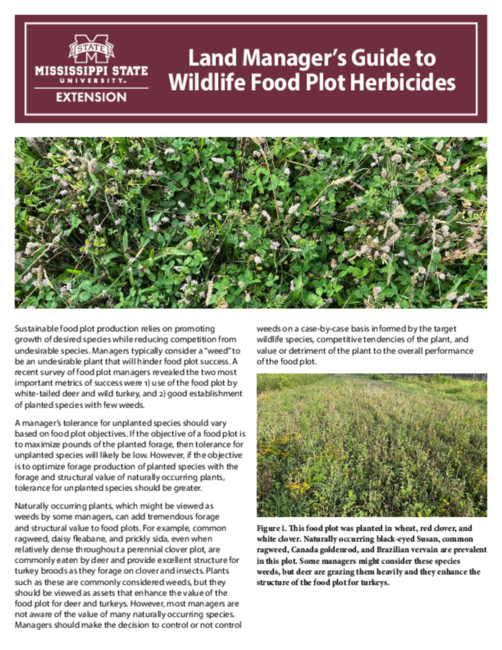
Naturally occurring plants, which might be viewed as weeds by some managers, can add tremendous forage and structural value to food plots. For example, common ragweed, daisy fleabane, and prickly sida, even when relatively dense throughout a perennial clover plot, are commonly eaten by deer and provide excellent structure for turkey broods as they forage on clover and insects. Plants such as these are commonly considered weeds, but they should be viewed as assets that enhance the value of the food plot for deer and turkeys. However, most managers are not aware of the value of many naturally occurring species. Managers should make the decision to control or not control weeds on a case-by-case basis informed by the target wildlife species, competitive tendencies of the plant, and value or detriment of the plant to the overall performance of the food plot.
Some unplanted species enhance the structure and forage value of a food plot, but many inhibit performance by outcompeting planted species for sunlight, water, and nutrients. Weeds cost food plot managers time and money by suppressing or killing planted species that are expensive to grow. If not controlled, many weeds will produce seed and become progressively more problematic. The foundation of long-term management is an understanding of plant identification, plant biology, value for wildlife, various weed control techniques, and knowing when and how to apply management techniques to achieve desired species composition and structure. Collectively, we refer to this process as integrated weed management, which consists of three primary weed control strategies: cultural, mechanical, and chemical.
Download the PDF for the full publication.
Publication 4178 (POD-06-26)
By Luke Resop, Graduate Research Assistant, Wildlife, Fisheries, and Aquaculture; Bronson Strickland, PhD, Extension Professor, Wildlife, Fisheries, and Aquaculture; Craig Harper, PhD, Professor, School of Natural Resources, University of Tennessee; and Jacob Dykes, PhD, Assistant Professor, Wildlife, Fisheries, and Aquaculture.
The Mississippi State University Extension Service is working to ensure all web content is accessible to all users. If you need assistance accessing any of our content, please email the webteam or call 662-325-2262.
Download
P4178
Land Manager’s Guide to Wildlife Food Plot Herbicides
2.73 MB
Departments
Authors
-
 Assistant Professor
- Wildlife, Fisheries & Aquaculture