M2492
Shiitake Production on Hardwood Logs
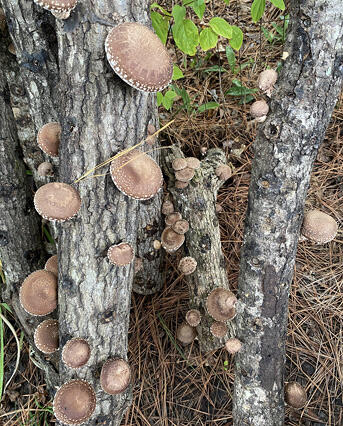
Shiitake (Lentinula edodes) mushrooms are native to various parts of Asia notably Japan, China, and Korea. They are not found growing wild in the United States. The shiitake has an umbrella-shaped cap that is tannish brown on top with whitish, cream color underside gills.
Shiitake mushrooms are grown indoors on hardwood sawdust blocks and outdoors on hardwood logs known as bolts. Outdoor growers use the natural environment of the forest to create perfect conditions for growing shiitake.
Supplies needed:
- Fresh cut hardwood logs, 4–8 inches in diameter and 18–36 inches long
- Drill/angle grinder and drill bit with stop (12 mm sawdust or 8.5 mm plug)
- Shiitake sawdust or wooden dowel plug; wide-range strain of spawn
- Inoculation tool: thumb or palm plunger (sawdust) or hammer (dowels)
- Hot plate, an old pot to melt wax, or an electric kettle cooker (350–400°F)
- Food-grade, paraffin-based wax
- Wool/cotton daubers, or non-plastic brushes for applying melted wax
- Aluminum identification tags and light- to heavy-duty stapler, 6–10 mm staples
- Safety glasses, ear plugs, hair ties, and plastic gloves
Steps to Growing Shiitake Mushrooms on Logs
1. Acquire Logs
In Mississippi, hardwood logs are harvested when the sap is down in the tree, from November to March. Do not use wood that is dry (firewood), rotting or scarred. Make sure the bark is intact and not loose. The best tree species to use are oak (Quercus spp.), sweetgum (Liquidambar), beech (Fagus), hophornbeam (Ostrya), hornbeam (Carpinus), or persimmon (Diospyros). It is easier to manage small diameter trees or limbs that are 4–6 inches in diameter and 2–3 feet in length.
2. Drill Holes
- Dowel Plug Spawn: Requires a 5/16-inch (8.5 mm) diameter hole drilled to a depth of 1–1½ inches.
- Sawdust Spawn: Requires a wider hole that is about 12–12.5 mm drilled to 1-inch deep.
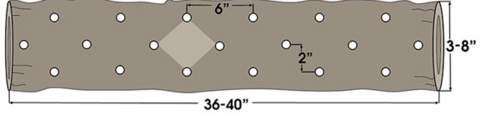
Drill approximately 40 holes into each log using a high-speed corded drill or adapted angle grinder. Use a drill bit with a built-in stop. Drill rows of holes 6 inches apart along the length of the log. Each row is spaced 2 inches apart, and the holes are offset or staggered, creating a diamond or spiral pattern.
3. Fill Holes with Spawn
Choose a wide-range spawn strain in dowel plug or packed sawdust form. Use plastic disposable gloves when handling spawn to keep cross contamination down. Hammer the dowel plug until it’s flush with the hole. The sawdust spawn requires a special spring-loaded thumb or palm pressure, plunger-type inoculation tool. Pack the plunger full of spawn and transfer it into the hole, so it fills level or just below the bark.
4. Wax over the Holes
Melt food-grade, cheese/paraffin wax in an electric kettle. Using a cotton, wool, or foam dauber, apply the wax to each hole, covering the plug or sawdust and the area immediately surrounding it. This ensures a compete seal to prevent moisture loss and keep pests away from the inoculation site. Heat the wax to a high enough temperature so it sizzles when applied. This ensures a tight barrier which will stay in place while the mushroom mycelium grows into the wood. There is no need to wax the cut end of the bolt.
5. Label with Aluminum Tag
Write relevant information, such as the mushroom strain, inoculation date, and wood variety, on the impressionable tag. Use a light- to heavy-duty stapler (6–10 mm staples) to adhere tag to the cut end of the inoculated bolt.
6. Spawn Run
After inoculation, place bolts outside in 60 percent shade and near a water source, exposed to the outdoor elements (rain, cool temperatures) for 9–18 months. During the dry summer months (June through September), set a sprinkler to water bolts in a shaded shrub bed. Stack bolts on pavers or a pallet or in a mulched area, but never on bare dirt. You want to recreate an environment where mushrooms grow naturally. When the temperatures drop to 60°F or below and the rains become prevalent (October–January), fruiting (mushroom cap) begins.
7. Soak Bolt to Force Mushroom Production
The term forcing means to trick the bolt into producing mushrooms by increasing moisture content and decreasing temperature. After the spawn run, when mushroom mycelium runs through the bolt (9–18 months) and the ends appear whitish, soak it in chilly water for 12–24 hours. Use fresh water in a stock tank or plastic tub. Municipal water needs to sit overnight to dissipate chlorine. A flush of mushrooms usually appear 10 days after forcing.
8. Fruit and Harvest
Lean hardwood bolts against a tree or fence in the shade for easier harvesting. Bolts will fruit naturally in the fall and throughout mild winters. Rainy weather and a temperature drop trigger mushroom cap production. Look for swelling at the inoculation holes. Mushrooms can grow from a little bump to fist size in three days. The shiitake cap is tan to brown with a white stem and gills. Harvest mushrooms when they are 75 percent open, with the outer rim still curled under. Cut the stem off close to the bolt. At this point, the stem is too woody to eat, so remove it from the cap. Place mushroom caps in a paper bag. Other more colorful fungi with different shapes may also grow on the inoculated bolt. Log contamination is common. This is okay, but DO NOT treat or harvest it like the edible shiitake.
9. Fruit Storage and Use
After harvest, store mushrooms in the paper bag in the refrigerator for up to one week. Slice and dehydrate shiitake mushrooms for long-term storage. Shiitake mushrooms are best cooked prior to consumption. Fresh mushrooms are commonly sautéed in butter or oil to maximize their flavor.
10. Bolt Care
Keep the hardwood bolt in shade. After harvesting, let the bolts rest and dry out slightly for 8–10 weeks before soaking again during cool weather months. The second and third mushroom flushes are the most productive. A bolt should be fruitful for 2–3 years depending upon its initial size.
Reference
Cornell Small Farms Program. (2023). Community Mushroom Educator Program. Cornell University College of Agriculture and Life Sciences.
M2492 (POD-12-25)
By Donna H. Beliech, Area Extension Agent IV, Rankin County.
The Mississippi State University Extension Service is working to ensure all web content is accessible to all users. If you need assistance accessing any of our content, please email the webteam or call 662-325-2262.
Download
M2492
Shiitake Production on Hardwood Logs
321.34 KB