P4179
Perched in Peculiar Places: Mississippi’s Black-bellied Whistling Ducks
Introduction
The black-bellied whistling duck (Dendrocygna autumnalis) has become an increasingly familiar sight in Mississippi’s wetlands, urban, and agricultural landscapes. Once considered a rare visitor, this striking species has expanded its breeding range significantly. Formerly restricted to the western Gulf Coast and parts of Central America, black-bellied whistling ducks now breed well into northern Mississippi and even farther north into parts of the lower Midwest. Their bold appearance, vocal nature, perching behavior, and adaptability to a variety of wetlands and urban areas have made them a notable addition to Mississippi’s waterfowl community.
Most black-bellied whistling ducks observed in Mississippi are seasonal breeders that migrate out of the state for winter. While a few may overwinter in Mississippi during mild years, most of them depart in late summer or fall, mainly wintering along the Gulf Coast of Louisiana and Texas. Studies in Arkansas and Louisiana, as well as nest box data from Mississippi, show that while some keep returning to the same breeding spots, few remain into the wintering period.
As black-bellied whistling duck numbers increase, understanding their habitat needs, nesting behavior, and potential competition with other cavity-nesting species, such as wood ducks (Aix sponsa), is essential for landowners, hunters, and wetlands managers.
Description and Identification
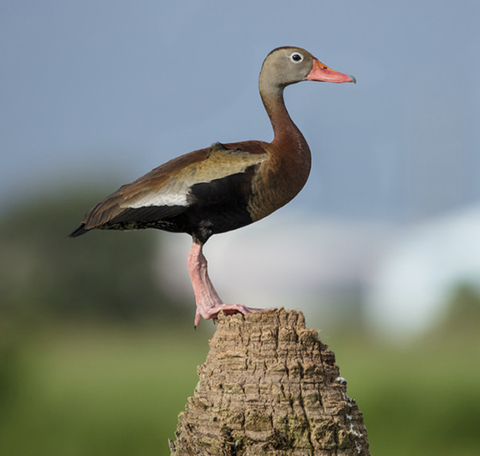
Black-bellied whistling ducks are medium-sized waterfowl with long pink legs, bright pink bills, and bold plumage (feathers). Adults are mostly chestnut brown with a black belly, gray face, and white wing stripes that can be seen in flight. Males and females are sexually monomorphic (identical in appearance) and show a distinctive upright posture when walking or perched.
These social, vocal birds are well known for their high-pitched whistling calls. Unlike most duck species, they often perch in trees and frequently loaf on fence posts, rooftops, grain bins, utility poles, and other odd places for perching.
Habitat
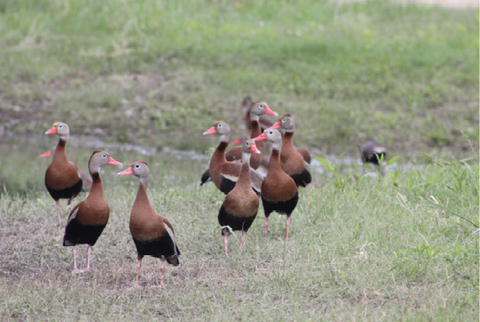
Black-bellied whistling ducks use a variety of wetland and upland areas. Wetland areas include marshes, flooded agricultural fields, catfish ponds, reservoirs, and managed moist-soil impoundments. Upland areas range from pastures and grasslands to even urban areas. In Mississippi, they are frequently observed in and around rice fields, aquaculture facilities, and both natural and managed wetlands.
Unlike many other duck species, black-bellied whistling ducks readily tolerate open landscapes and human activity. They are often seen on manmade structures such as utility poles and rooftops, especially near grain sources or other foraging sites.
Nesting and Brood Rearing
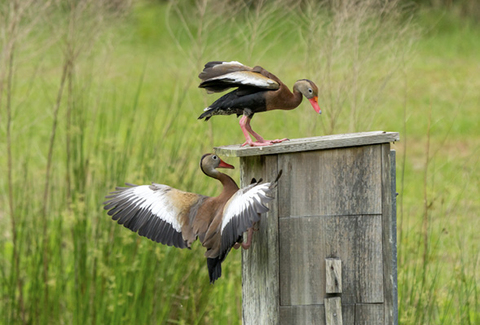
Black-bellied whistling ducks are cavity nesters; they prefer tree cavities but will readily use man-made nest boxes when natural sites are limited. They are socially monogamous, typically forming long-term bonds with a single mate. Like geese and swans, both sexes share responsibilities for nest site selection, incubation, and brood care, behaviors that are relatively rare among North American duck species. Pairs often remain together across multiple breeding seasons, with some showing strong site fidelity by returning to previously successful nesting locations.
Despite their monogamous behavior, black-bellied whistling ducks commonly engage in egg dumping, where a female lays eggs in the nest of another female (brood parasitism). This behavior is particularly interesting because it often occurs even when nesting cavities are abundant and competition is low, suggesting social factors may drive this strategy.
These ducks are flexible cavity nesters, using natural tree cavities, abandoned woodpecker holes, or man-made nest boxes. When cavities are limited, they may also nest on the ground in dense vegetation. In Mississippi, nesting typically begins in late spring and can extend into late summer. Researchers at Mississippi State University (MSU) observed active nests beginning in mid-May and continuing as late as early September.
Typical clutch sizes of whistling ducks range from 10 to 16 eggs, but in cases of brood parasitism, clutch sizes may range from 20 to 30 eggs. The same study found that 69 percent of black-bellied whistling duck nests at the Sam D. Hamilton Noxubee National Wildlife Refuge and a private wetland site in the Mississippi Delta experienced egg dumping, mostly by other whistling ducks but also in some instances by wood ducks.
Interestingly, egg dumped nests had greater success rates (75 percent) than non-parasitized nests (25 percent) at those sites. This suggests that black-bellied whistling ducks tolerate egg dumping––and may even benefit from it––if brood survival rises along with nest success. Incubation extends about 25 to 30 days, with both parents tending the nest and leading ducklings to water after hatching. Pairs often re-nest multiple times per season.
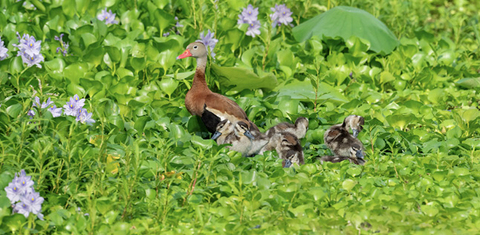
After hatching, broods need high-quality wetland areas to forage and avoid predators. Like wood ducks, whistling-duck ducklings are especially vulnerable during their first weeks of life and depend on shallow, calm wetlands rich in both food and cover.
Ideal brood-rearing cover includes shallow water between 4 and 18 inches deep, which allows ducklings to move and feed easily while staying safer from predators.
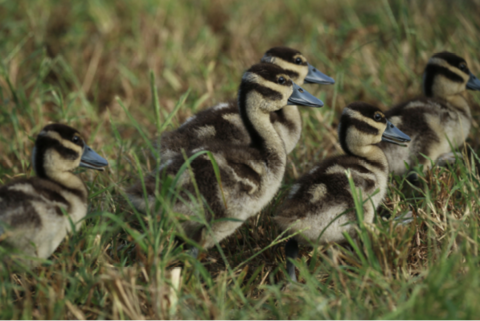
A diverse mix of wetland vegetation—including smartweed, wild millet, buttonbush, willows, duck potato, lotus, sedges, rushes, and other water-edge or underwater plants provide both food and cover. Scattered open water patches support duckling movement and foraging but should be balanced with protective cover. Gradual wetland slopes are also important to allow easy access between water and upland areas.
Moist-soil impoundments, which are seasonal wetlands typically flooded in fall and winter and drawn down from spring to early summer, can provide excellent brood-rearing cover. These wet-dry cycles produce abundant annual vegetation and diverse plant communities. However, maintaining “summer water” into July, August, or even September is important, as black-bellied whistling ducks often nest later than wood ducks and stay with broods longer. Holding water later into summer also benefits early migrating dabbling ducks such as blue-winged teal (Spatula discors) and northern shovelers (Spatula clypeata).
Molt
After the nesting season, black-bellied whistling ducks undergo a wing molt, becoming flightless for several weeks. During this vulnerable period, they gather in secluded wetlands or flooded fields that provide secure loafing and foraging areas.
Providing safe molting cover is critical, as flightless birds are especially vulnerable to predators and human disturbance. The molting period may also overlap with late-season brood rearing, stressing the need for cover that offers both protection and abundant food resources.
Food Habits
Black-bellied whistling ducks forage in shallow water and dry fields, mainly feeding on the tender leaves, shoots, and seeds of grasses and aquatic vegetation. In agricultural landscapes, waste grain, such as rice and corn, is also an important food source. During the breeding season, their diet shifts toward invertebrates like snails and insects to meet increased protein demands. This flexible diet allows them to thrive in a variety of agricultural and wetland environments.
Predators
Eggs and ducklings are vulnerable to common nest predators such as raccoons, snakes, and opossums. Ground nests are especially vulnerable to both predators and disturbance. Even after hatching, ducklings face threats from raptors, herons, and snapping turtles, as well as fish like gar and largemouth bass.
Adult whistling ducks watch out for potential threats as a group. Wetland vegetation that stands taller than both adults and broods can greatly improve duckling survival by providing cover from both aerial and aquatic predators.
Management Recommendations
Landowners can play a key role in supporting black-bellied whistling ducks by managing shallow wetlands, moist-soil impoundments, and flooded cropland to provide high-quality foraging and brood-rearing cover. Among these, well-managed moist-soil impoundments are some of the most productive and sustainable options, benefiting not only whistling ducks but also a wide range of waterfowl and wetland-dependent wildlife.
Moist-soil units support diverse seed-producing plants, aquatic invertebrates, and thick plants that offers critical cover for broods, especially with proper drawdown timing, water depth, and vegetation control. Landowners are encouraged to apply or maintain moist-soil and other wetland management practices when possible. Reducing human disturbance during the brood-rearing season (May through August) is also essential to ensure duckling survival and development.
As black-bellied whistling ducks spread into new areas, they are using nest boxes and natural cavities originally occupied by wood ducks. The standard three-by-four-inch entrance holes are too small for them. Enlarging the holes to 4–5 inches in diameter allows both species to use the nest boxes. Landowners should also provide plenty of brood-rearing cover and more nest sites.
To accommodate both species, landowners should:
- Monitor nest boxes regularly for overcrowding and excessive egg dumping.
- Place additional boxes in areas with high cavity competition.
- Mount boxes 4–6 feet above ground or water in open areas near brood cover.
- Use predator guards to keep nests safer from predators.
- Ensure sufficient brood cover is located near box sites. Placing boxes in areas with little or no cover may result in poor brood survival.
If you favor wood ducks and would like to discourage whistling ducks, keep the nest box entrance its original size.
For more detailed guidance on moist-soil management, wetland restoration, and waterfowl habitat planning, refer to MSU Extension Publication 1864 Waterfowl Habitat Management Handbook for the Lower Mississippi River Valley. This resource provides comprehensive strategies for developing and maintaining high-quality habitat for black-bellied whistling ducks, wood ducks, and other waterfowl species in the region.
Reference
Gibson, J. T. (2022). Nesting ecology of wood ducks and other cavity-nesting ducks in Mississippi (Master’s thesis). Mississippi State University.
Publication 4179 (POD-02-26)
By James Callicutt, Extension Waterfowl and Upland Gamebird Specialist and Extension Instructor I, Logan T. Kelly, Extension Associate I, and J. Brian Davis, PhD, Professor, Wildlife, Fisheries, and Aquaculture. Thanks to the following reviewers of this publication: Bill Hamrick, Senior Extension Associate, and Edward D. Entsminger, PhD, Extension Associate III, Wildlife, Fisheries, and Aquaculture.
The Mississippi State University Extension Service is working to ensure all web content is accessible to all users. If you need assistance accessing any of our content, please email the webteam or call 662-325-2262.
Download
P4179
Perched in Peculiar Places: Mississippi’s Black-bellied Whistling Ducks
849.81 KB
Departments
Authors
-
 Extension Instructor I
- Wildlife, Fisheries & Aquaculture