P4209
Diaprepes Root Weevil (Diaprepes abbreviatus)
Other names: citrus root weevil, sugarcane rootstock weevil
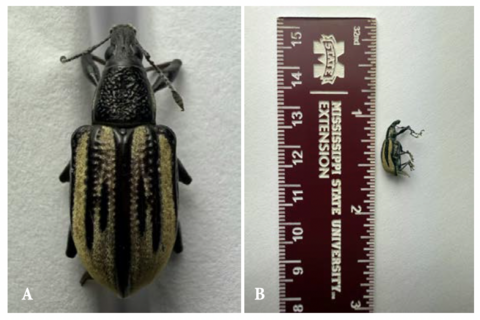
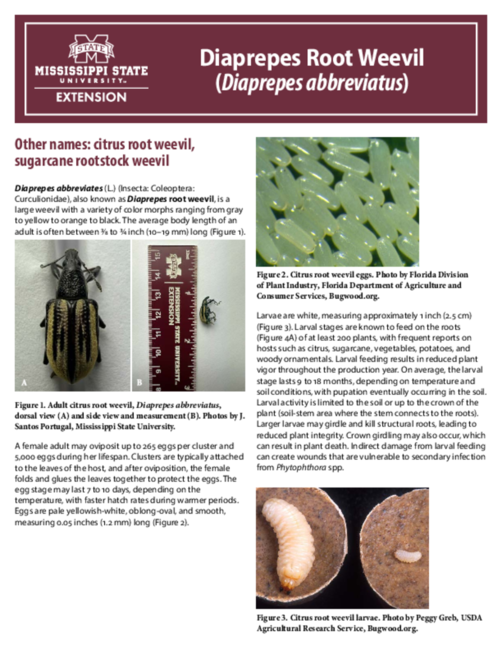
Diaprepes abbreviates (L.) (Insecta: Coleoptera: Curculionidae), also known as Diaprepes root weevil, is a large weevil with a variety of color morphs ranging from gray to yellow to orange to black. The average body length of an adult is often between 3/8 to 3/4 inch (10–19 mm) long (Figure 1).
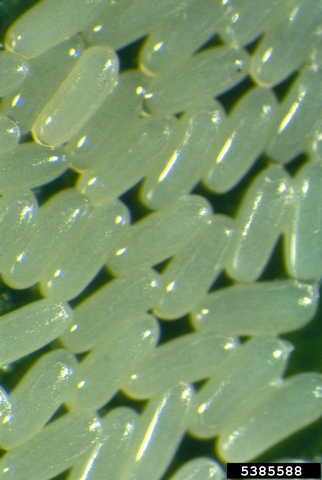
A female adult may oviposit up to 265 eggs per cluster and 5,000 eggs during her lifespan. Clusters are typically attached to the leaves of the host, and after oviposition, the female folds and glues the leaves together to protect the eggs. The egg stage may last 7 to 10 days, depending on the temperature, with faster hatch rates during warmer periods. Eggs are pale yellowish-white, oblong-oval, and smooth, measuring 0.05 inches (1.2 mm) long (Figure 2).
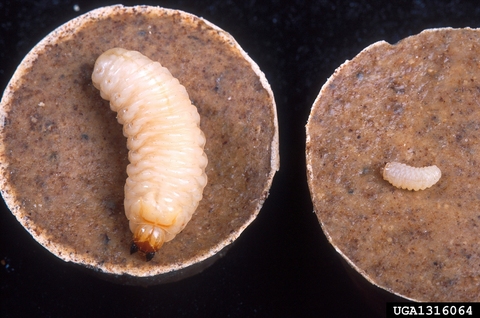
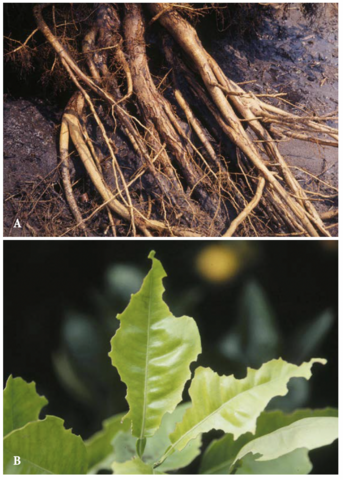
Larvae are white, measuring approximately 1 inch (2.5 cm) (Figure 3). Larval stages are known to feed on the roots (Figure 4A) of at least 200 plants, with frequent reports on hosts such as citrus, sugarcane, vegetables, potatoes, and woody ornamentals. Larval feeding results in reduced plant vigor throughout the production year. On average, the larval stage lasts 9 to 18 months, depending on temperature and soil conditions, with pupation eventually occurring in the soil. Larval activity is limited to the soil or up to the crown of the plant (soil-stem area where the stem connects to the roots). Larger larvae may girdle and kill structural roots, leading to reduced plant integrity. Crown girdling may also occur, which can result in plant death. Indirect damage from larval feeding can create wounds that are vulnerable to secondary infection from Phytophthora spp.
Adults emerge after rain events. Adults feeding on young plants lead to defoliation, while adults feeding on mature plants may have little economic impact. Typical symptoms of adult feeding include leaf notching (Figure 4B) around the margins of young/tender leaves (most visible indicator of plant injury). Feeding appears similar to grasshopper feeding seen in other crops. There are two population peaks (late May to early July and late August to mid-October) and up to three generations per year. Adult presence is heavy in April/May, July/August, and October/November. Management options are listed in Table 1.
The Mississippi Department of Agriculture and Commerce – Bureau of Plant Industry (MDAC BPI) considers Diaprepes root weevil a regulated pest of non-quarantine significance (list A), which means that this insect must be controlled to meet general certification for certain sale or shipment of commodities. The MSU Extension Entomology Insect Identification Laboratory received the first confirmed specimen in October 2025. Report and submit any suspected samples/images to the insect ID lab for confirmation.
| Management option | Diaprepes root weevil life stage | Phytophthora spp. secondary infection | ||
|---|---|---|---|---|
| Adult | Larvae | Eggs | ||
| Mulching (e.g., landscape fabric) | Limits adult emergence | Reduces number of larvae pupating in the soil | – | – |
| Natural enemies* (parasitoids, predators, parasitic microorganisms) | Attacks life stage | Attacks life stage | Attacks life stage | – |
| Parasitic nematodes | – | Attacks life stage | – | – |
| Horticultural oils** | – | – | Eggs exposed to predators and weather conditions by oils separating folded leaves. | – |
| Insecticides** (e.g., carbaryl, bifenthrin, phosmet, fenpropathrin, diflubenzuron) | Foliar sprays | Soil drenches | Foliar sprays | – |
| Fungicides** | – | – | – | Only effective after managing weevil population |
*Depends on natural enemy species.
**Use pesticides safely. Always read the label. Labels contain specific safety information and application guidelines.
References
Duncan, L. W., Stenlinksi, L., & Diepenbrock, M. (2023). 2025–2026 Florida citrus production guide: Citrus root weevils: CPG ch. 27, CG006/ENY-611, rev. 8/2025. EDIS, 2025(CPG). (Original work published August 16, 2023)
Duncan, L. W., Stuart, R. J., Gmitter, F. G., & LaPointe, S. L. (2009). Use of landscape fabric to manage Diaprepes root weevil in citrus groves. Florida Entomologist, 92(1), 74–79.
Graham, J. H., Bright, D. B., & McCoy, C. W. (2003). Phytophthora-Diaprepes weevil complex: Phytophthora spp. relationships with citrus rootstocks. Plant Disease, 87(1), 85–90.
Weissling, T. J., Peña, J. E., Giblin-Davis, R. M., & Knapp Jr., J. L. (2022). Diaprepes root weevil, Diaprepes abbreviatus (Linnaeus) (Insecta: Coleoptera: Curculionidae). UF/IFAS (ENY-024).
Wolcott, G. N. (1936). The life history of Diaprepes abbreviatus, at Rio Piedras, Puerto Rico. Journal of Agriculture of the University of Puerto Rico, 20(4), 883–914.

This work is supported by Crop Protection and Pest Management, Extension Implementation Program, award no. 2024-70006-43496, from the U.S. Department of Agriculture’s National Institute of Food and Agriculture. Any opinions, findings, conclusions, or recommendations expressed in this publication are those of the author(s) and should not be construed to represent any official USDA or U.S. Government determination or policy.
Publication 4209 (POD-08-26)
By Jermaine Perier, PhD, Assistant Professor, Vegetable, Fruit, and Nut Entomology, Central Mississippi Research and Extension Center.
The Mississippi State University Extension Service is working to ensure all web content is accessible to all users. If you need assistance accessing any of our content, please email the webteam or call 662-325-2262.
Download
P4209
Diaprepes Root Weevil (Diaprepes abbreviatus)
312.72 KB
Departments
Authors
-
 Assistant Professor
- Central MS Research & Ext Center