4221
Cross-Striped Cabbageworms (Evergestis rimosalis)
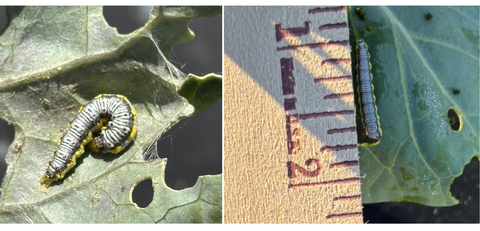
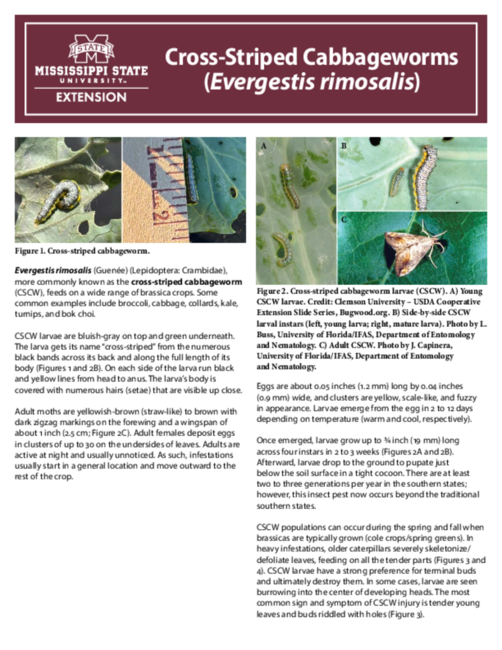
Figure 1. Cross-striped cabbageworm.
Evergestis rimosalis (Guenée) (Lepidoptera: Crambidae), more commonly known as the cross-striped cabbageworm (CSCW), feeds on a wide range of brassica crops. Some common examples include broccoli, cabbage, collards, kale, turnips, and bok choi.
CSCW larvae are bluish-gray on top and green underneath. The larva gets its name “cross-striped” from the numerous black bands across its back and along the full length of its body (Figures 1 and 2B). On each side of the larva run black and yellow lines from head to anus. The larva’s body is covered with numerous hairs (setae) that are visible up close.
Adult moths are yellowish-brown (straw-like) to brown with dark zigzag markings on the forewing and a wingspan of about 1 inch (2.5 cm; Figure 2C). Adult females deposit eggs in clusters of up to 30 on the undersides of leaves. Adults are active at night and usually unnoticed. As such, infestations usually start in a general location and move outward to the rest of the crop.
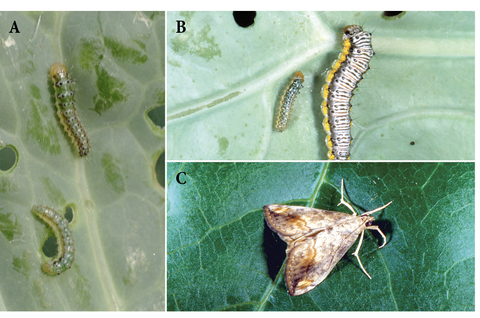
Figure 2. Cross-striped cabbageworm larvae (CSCW). A) Young CSCW larvae. Credit: Clemson University – USDA Cooperative Extension Slide Series, Bugwood.org. B) Side-by-side CSCW larval instars (left, young larva; right, mature larva). Photo by L. Buss, University of Florida/IFAS, Department of Entomology and Nematology. C) Adult CSCW. Photo by J. Capinera, University of Florida/IFAS, Department of Entomology and Nematology.
Eggs are about 0.05 inches (1.2 mm) long by 0.04 inches (0.9 mm) wide, and clusters are yellow, scale-like, and fuzzy in appearance. Larvae emerge from the egg in 2 to 12 days depending on temperature (warm and cool, respectively).
Once emerged, larvae grow up to ¾ inch (19 mm) long across four instars in 2 to 3 weeks (Figures 2A and 2B). Afterward, larvae drop to the ground to pupate just below the soil surface in a tight cocoon. There are at least two to three generations per year in the southern states; however, this insect pest now occurs beyond the traditional southern states.
CSCW populations can occur during the spring and fall when brassicas are typically grown (cole crops/spring greens). In heavy infestations, older caterpillars severely skeletonize/defoliate leaves, feeding on all the tender parts (Figures 3 and 4). CSCW larvae have a strong preference for terminal buds and ultimately destroy them. In some cases, larvae are seen burrowing into the center of developing heads. The most common sign and symptom of CSCW injury is tender young leaves and buds riddled with holes (Figure 3).
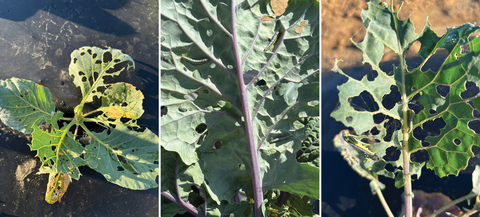
Figure 3. Cross-striped cabbageworm larva feeding.
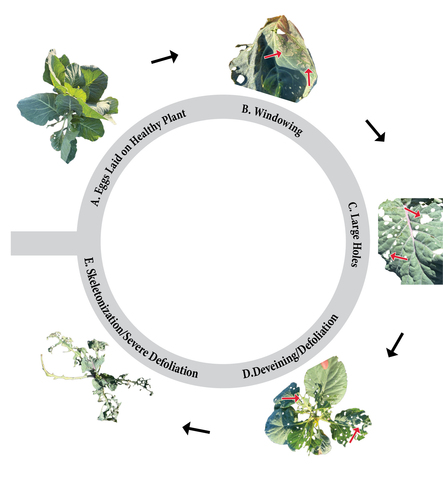
Figure 4. Progression of cross-striped cabbageworm larvae feeding damage on cabbage. A) Healthy plant with hidden eggs. B) Leaf windowing caused by young larvae feeding. C) Developing larvae cause larger feeding holes. D) Mature larvae feeding results in defoliation. E) Severe defoliation from mature larvae feeding.
Foliar insecticides that target caterpillars are often effective. However, other practices, such as overuse of nitrogen fertilizers, should be avoided because they are directly related to increases in larval populations. Increased nitrogen use leads to more leaf growth, which also provides fresher (tender young) leaf tissue for CSCW feeding. Management options are listed in Table 1.
Table 1. Cross-striped cabbageworm management options.
| Management option | Cross-striped cabbageworm life stage | ||
|---|---|---|---|
| Adults | Larvae* | Eggs | |
| Scouting method (weekly to twice weekly) | Light traps at night | • 25 random plants • Check heads and leaves • Look for frass | Check undersides of leaves |
| Row covers | Limits adult oviposition | – | Reduces the number of eggs laid |
| Natural enemies** (parasitoids, predators, parasitic microorganisms) | Attacks life stage | Attacks life stage | Attacks life stage |
| Biopesticides*** (e.g., Bacillus thuringiensis (Bt)) | – | Foliar sprays | – |
| Insecticides*** (lepidoptera/caterpillar-targeting chemistries; e.g., spinosad, diamides, organophosphates, oxadiazines) | – | • Foliar sprays • Soil drench (specific insecticides; check the label) | |
*Recommended life stage target and management method.
**Depends on natural enemy species.
***Use pesticides safely. Always read the label.
Please report and submit any cross-striped cabbageworm samples to the MSU Extension Entomology Insect Identification Laboratory.
References
University of Florida, Institute of Food and Agricultural Sciences, Department of Entomology and Nematology. (2005). Cross-striped cabbageworm, Evergestis rimosalis, in UF/IFAS vegetable pests III, photographs of: Lepidoptera. https://entnemdept.ufl.edu/projex/gallery/dl/Vegetable_Pests_III/text/cross-striped_cabbageworm.htm
University of Massachusetts Amherst, Center for Agriculture, Food, and the Environment. (2013, January 14). Cross-striped cabbageworm. UMass Extension Vegetable Program. https://www.umass.edu/agriculture-food-environment/vegetable/fact-sheets/cross-striped-cabbageworm
Layton, B. (2016). Bug’s eye view: Cross-striped cabbageworm (Vol. 2, No. 2). Mississippi State University Extension Service. https://extension.msstate.edu/newsletters/bugs-eye-view/2016/cross-striped-cabbageworm-vol-2-no-2
Sparks Jr., A., & Riley, D. G. (2017). Cross-striped cabbageworm. University of Georgia Extension. https://extension.uga.edu/content/dam/extension/programs-and-services/integrated-pest-management/documents/insect-pdfs/crosstripedcab.pdf [opens PDF].

This work is supported by Crop Protection and Pest Management, Extension Implementation Program, award no. 2024-70006-43496, from the U.S. Department of Agriculture’s National Institute of Food and Agriculture. Any opinions, findings, conclusions, or recommendations expressed in this publication are those of the author(s) and should not be construed to represent any official USDA or U.S. Government determination or policy.
Publication 4221 (POD-10-26)
By Jermaine Perier, PhD, Assistant Professor, Vegetable, Fruit, and Nut Entomology, Central Mississippi Research and Extension Center.
The Mississippi State University Extension Service is working to ensure all web content is accessible to all users. If you need assistance accessing any of our content, please email the webteam or call 662-325-2262.
Download
4221
Cross-Striped Cabbageworms (Evergestis rimosalis)
416.1 KB
Departments
Authors
-
 Assistant Professor
- Central MS Research & Ext Center