P4197
A Photo Guide to Pecan Insect Pests, Part 1
Insect Pests of Pecans Across the Pecan Belt
Nut Feeders
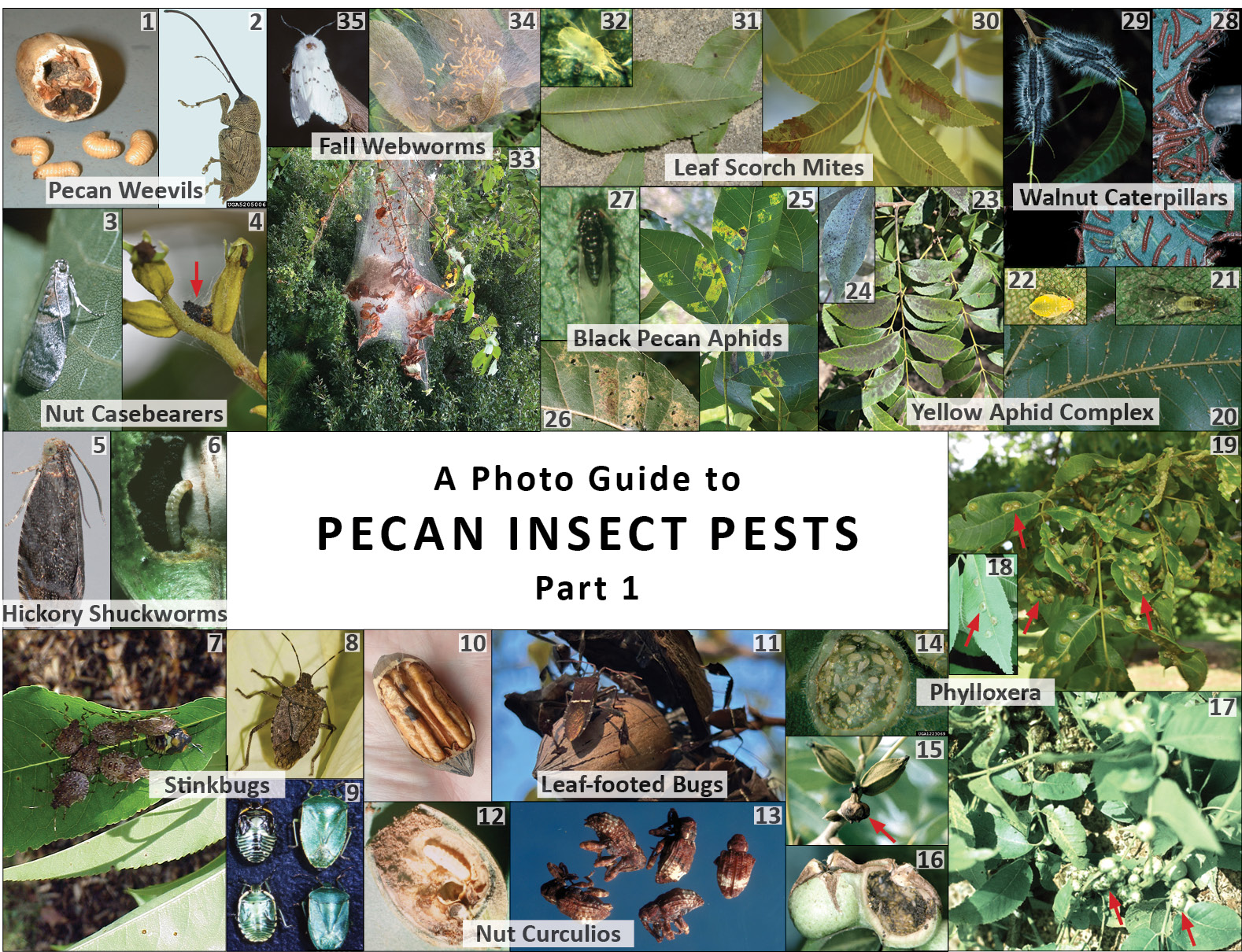
- Pecan weevil (1–2). Mini tanks on legs. Eggs are laid inside the nut, and cream-colored larvae (1) consume the nut meat to grow. Life cycle is 2–3 years with 90% of the population emerging in year 2 and the remaining 10% in year 3. Adults are hard-bodied with long, thin legs and a long snout (2). Adults grow to about three-eighths inch in length and are brownish-gray. The female’s snout is as long as its body; the male’s snout is shorter than its body. Antennae are clubbed and elbowed, sitting about midway the length of the snout.
- Pecan nut casebearer (3–4). Adults (3) grow to about one-third inch in length, are grayish-brown, and have a ridge of scales across the front wing. Full-grown larvae (4) are a half-inch in length and appear olive green to dark green with yellowish-brown heads. Larvae feed on nutlet clusters. There are three to four generations per year, depending on location.
- Hickory shuckworm (5–6). Adults (5) are three-eighths inch long and dark brown to grayish-black with a series of dark and white marks on the outer edges of the wings. Larvae (6) have brown heads and cream bodies and can grow up to a half-inch long. From April to May, the overwintering generation of shuckworms emerge as adults from their pupae; the new adults then mate and lay eggs on hickory or phylloxera galls, which will serve as homes for the first generation. The adults of the first generation are active from June to July and will oviposit eggs on developed pecan nuts. Larval feeding before shell hardening causes nut drop, while feeding after shell hardening causes shell scarring and sticking of the shuck to the nut (“sticktights”).
- Stinkbugs and leaf-footed bugs (7–11). Several stinkbug species, including the more common brown marmorated (7–8), brown, and green stinkbugs (9), as well as the leaf-footed bugs (11) frequent pecans during the water filling stage, moving from other crops or weeds into the orchard in the late summer and fall. Feeding after shell hardening results in the formation of a black, round “kernel spot” on the nut meat (10). Injury before the shell hardens can cause nuts to drop. Nymphs bear similar coloration to the adults but lack fully developed features like wings and a pronounced scutellum (7 and 9, left). Infestations are typically greater from September to shuck split.
- Nut curculio (12–13). Severe infestations are more likely in orchards with a history of infestation. Adults (13) are rough-textured and reddish-brown with a tan band across the back, and are about three-sixteenths inch in length. Emergence typically occurs in late spring and can peak from June to July. Eggs are laid in the nuts, and larva (12) are creamy white and grow up to one-fifth inch long. Adult feeding causes shuck scarring, while larval feeding causes nut drop.
Leaf Feeders
- Phylloxera (14–19) are tiny, pale-yellow insects similar in appearance to aphids, typically without pronounced cornicles (small, tube-like structures on the posterior end of their back). Feeding causes the plant to form galls on leaves (18–19), nuts (15), or stems (16–17), in which phylloxera reproduce (14). Three species feed on pecan. Considered an early-season pest, with the “stem mother” (first adult female of the season) emerging from hiding as soon as leaves unfold (bud break).
- Yellow aphid complex (20–24). Aphids produce a sticky excrement called honeydew. In large populations, large amounts of honeydew coats leaves and facilitates sooty mold growth (23–24). Yellow aphid (20–22) adults and nymphs are pale yellow to yellow and typically have no obvious body markings on the alates (winged adults). Blackmargined aphids (21) are similar in appearance to yellow aphids, except they have distinct thick, black margins along the front edge of the front wings and black margins running from the head to thorax in alates. Females have dark bands on the body segments. Early-season treatment for yellow aphids is often unnecessary unless the population is extremely large.
- Black pecan aphid (25–27) adults are black (27), and nymphs are olive green. Winged adult forms (alates) have transparent wings with white speckles along the back. Several generations occur each year. Severe infestations can affect return blooms the following season. Feeding causes chlorosis of the leaf (bright yellow spots; 25–26), leading to death and eventually leaf drop.
- Walnut caterpillar (28–29) larvae can grow up to 2 inches long when mature (29). Larvae are dark red when young (28) and turn black with silver hairs when mature. Larvae stay together in large groups (gregarious) and feed on leaves in a similar fashion. Unlike fall webworms, larvae do not spin silk (28–29) around the leaves on which they feed. Emergence may occur twice, first from May to June and again from July to August. Larvae feeding typically occurs from June to July and August to October.
- Pecan leaf scorch mites (30–32) are a type of spider mite and have small, pale-yellow bodies (32). They have a quick turnaround in generations that generally occur within 5–15 days or faster depending on weather conditions. When present, the mites congregate along the main vein of leaflets. Feeding injury causes irregular brown spots on the leaf (scorch marks; 30–31) and is often confused with symptoms of pecan bacterial leaf scorch.
- Fall webworm (33–35) adults (35) are white, and wings can be marked with black spots. First-generation adults emerge from late April to May and lay eggs quickly after emergence. Larvae are pale yellow, green, or orange with two rows of black spots on the back. Larvae spin large silken webs in the canopy of trees (33). Each web may contain 100 or more larvae (34) and protects the larvae while they feed on the leaves within the web. Young trees may be defoliated when heavily infested. There can be two to four generations per year.
Note: Many insect pests are similar in appearance. Images alone often cannot be used to obtain an accurate species identification. For more information on pecan insect management, see Disease and Insect Management for Pecans in Home Landscapes (P3967), Managing Insect and Mite Pests of Commercial Pecans in Texas, Pecans (UGA), and the MyIPM app for Fruits and Nuts.
Photo credits: (1) B. Ree, Texas A&M, Bugwood.org; (2) N. Wright, Braman Termite & Pest Elimination, Bugwood.org; (35) G.J. Lenhard, LSU, Bugwood.org; (34) R.D. Wallace, UGA, Bugwood.org; (33) K. Oten, NC State, Bugwood.org; (32, 3, 15, 16, 17, 26) J.A. Payne, USDA-ARS, Bugwood.org; (31) W. Hudson, UGA; (29) L.L. Hyche, Auburn Uni., Bugwood.org; (28) L.L. Hyche, Auburn Uni., Bugwood.org; (4) A. Barman, UGA; (10) J.J. Hamann, UFSM, Bugwood.org; (6, 14, 18, 21, 27, 20, 12) L. Tedders, USDA-ARS, Bugwood.org; (24) R. Melanson, MSU Extension, Bugwood.org; (5) M. Dreiling, Bugwood.org; (7) G. Bernon, USDA-APHIS, Bugwood.org; (8) S. Elliss, Bugwood.org; (9) J.C. French Sr., Auburn Uni., Clemson, U of MO, Bugwood.org; (13) J. Solomon, USDA Forest Service. Bugwood.org; (23, 25, 30) S. Veerlapati, UGA; (19, 22) R. Acharya, UGA; (11) J. Perier, MSU.
This work is supported by the Southern IPM Center (Grant S26-068) as part of the Crop Protection and Pest Management Regional Coordination Program, project award no. 2022-70006-38002), from the U.S. Department of Agriculture’s National Institute of Food and Agriculture. Any opinions, findings, conclusions, or recommendations expressed in this publication are those of the author(s) and should not be construed to represent any official USDA or U.S. Government determination or policy.

Publication 4197 (05-26)
By Jermaine D. Perier, Assistant Professor, Central Mississippi Research and Extension Center; E. Kyle Slusher, Assistant Professor, Texas A&M AgriLife; and Apurba Barman, Assistant Professor, University of Georgia.

The Mississippi State University Extension Service is working to ensure all web content is accessible to all users. If you need assistance accessing any of our content, please email the webteam or call 662-325-2262.
Download
P4197
A Photo Guide to Pecan Insect Pests, Part 1
2.16 MB
Departments
Authors
-
 Assistant Professor
- Central MS Research & Ext Center