P4196
A Photo Guide to Beneficial Insects in Pecan
Beneficial Insects of Pecans Across the Pecan Belt
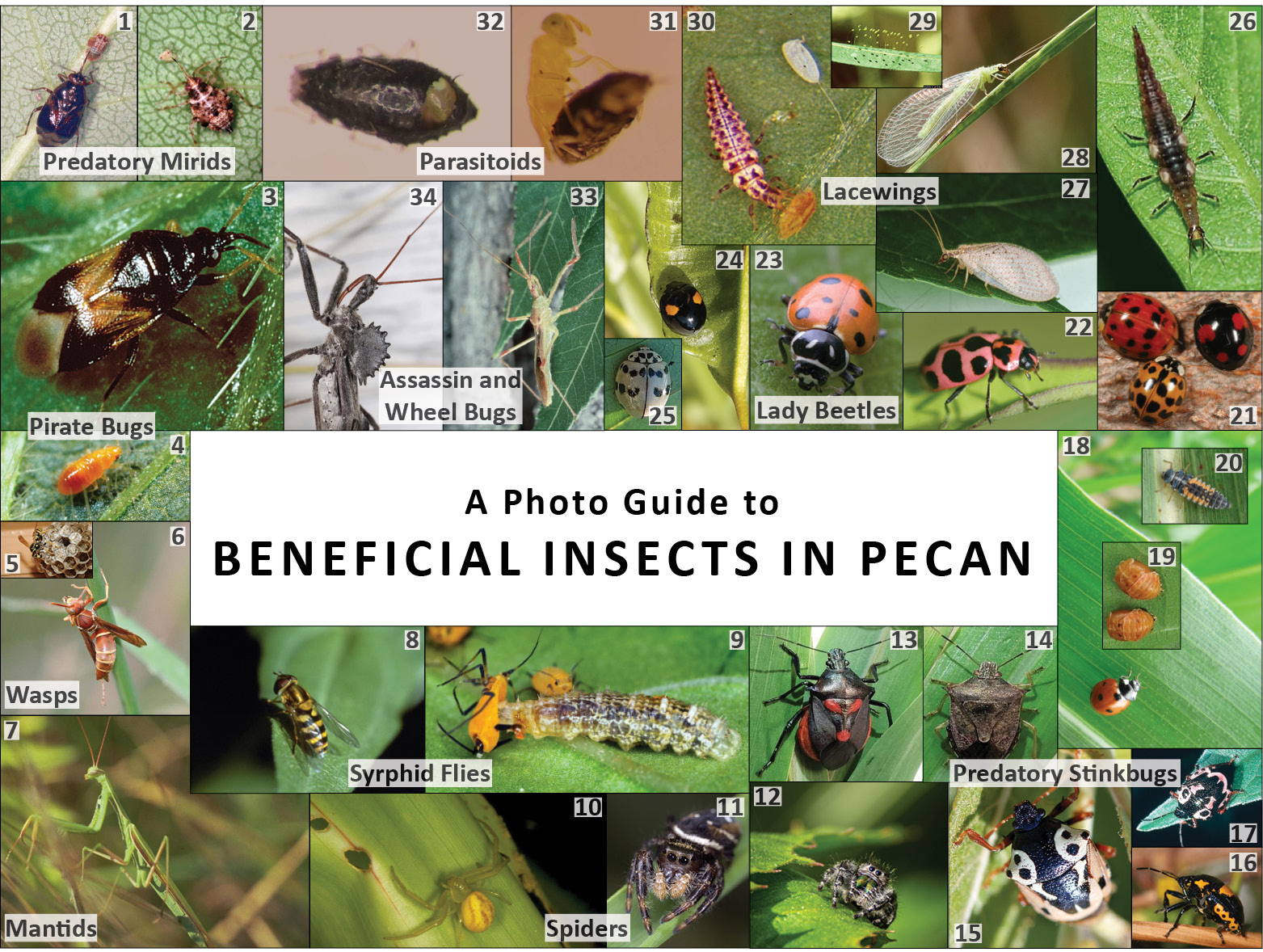
- Predatory mirids (1–2). Adults (1) are mottled brown with wings, while nymphs (2) are grayish and lack wings. Both adults and nymphs feed on insect pests. Deraeocoris nebulosus is the mirid species commonly found in pecans. D. brevis (shown here, 1–2) is a general predatory mirid found in most landscapes. Common pecan pests and pest life stages preyed upon include soft-bodied insects, aphids, soft-scales, scale crawlers, mites, small caterpillars, and insect eggs.
- Pirate bugs (Orius spp.) (3–4). Adults can be up to one-sixteenth inch long and are usually flat, oval, and black with a “V” shaped mark toward the posterior end where the elytra (wings) overlap on the back (3). Nymphs are pear-shaped and brownish-orange; color darkens as the insect matures (4). Both adults and nymphs feed on insect pests. Common pecan pests and pest life stages preyed upon include aphids, thrips, small caterpillars, and insect eggs.
- Wasps* (5–6). Several species, Vespula spp. and Polistes spp., including paper wasps and hornets, can be commonly found in an orchard. Adults (6) can usually be seen foraging and feeding on other insects to survive. Nests (5) are typically a dull gray to brown, but color can also be influenced by the material used to construct it—with multiple cells in a comb-like shape attached by a petiole to a branch or structure, or within a hollowed trunk or pit. Common pecan pests preyed upon include caterpillars; wasps may also prey upon any other insect present in the orchard, beneficial or pest. *Wasps are very aggressive when disturbed; unless a threat to workers, nests should be left alone.
- Mantids (7). Several species can be found in the orchard and easily identified by their spiny, claw-like arms often held in a prayer-like pose, and bulging eyes on a triangular head (7). Some species are cryptic and have body modifications to blend in with their environment (camouflage). Common pecan pests and pest life stages preyed upon include moths, caterpillars, and grasshoppers; mantids may also prey upon any other insect present in the orchard, beneficial or pest.
- Syrphid flies (8–9). Two main species can be commonly found in the orchard, Allograpta spp. and Metasyrphus spp. Adults (8) are often called “hover flies” due to their hovering behavior in the air. Adults feed on nectar and honey only, but larvae/maggots (9) feed on insects. Common pecan pests and pest life stages preyed upon include soft-bodied insects and life stages, aphids, small caterpillars, and insect eggs.
- Spiders (10–12). Over 40 species contribute to some level of insect feeding, including crab spiders (10) and jumping spiders (11 and 12). Common pecan pests preyed upon include aphids, caterpillars, and other insects.
- Predatory stinkbugs (13–17) are stinkbugs with “broad beaks” (mouthpart twice the width of the antennae) that they use to feed on insects. Common types found in the orchard include the Florida predatory stinkbug (Euthyrhynchus floridanus; 13), and the spined soldier bug (Podisus maculiventris; 14). Other predatory stinkbug species, such as the anchor stink bug (Stiretrus anchorago; 15–17), have several color patterns with or without unique markings. Adult anchor stinkbugs are usually differentiated from other predatory stinkbugs by their large scutellum (dorsal plate) that extends to the tip of the abdomen. Both adults and nymphs of predatory stinkbugs feed on insect pests. Common pecan pests and pest life stages preyed upon include soft-bodied life stages, aphids, scales, mites, caterpillars, and insect eggs.
- Lady beetles (18–25). Adults (18) and larvae both feed on insect pests. Pupa (19) are typically shield-like and orange to brownish; some species may have color patterns. Larvae (20) may have a variety of colors, including patterns of orange or yellow usually over a black or dark grayish-brown base. Larvae are alligator-shaped with numerous spikes along the length of their back. Several different species, including the Harmonia spp. multicolored Asian (21), pink-spotted (22), convergent (23), Olla v-nigrum (color morphs: southern two-spotted (24) and ashy gray (25)) lady beetle can be found in the pecan orchard. Common pecan pests and pest life stages preyed upon include aphids, scales*, mites*, small caterpillars*, and insect eggs. *Specific lady beetles.
- Lacewings (26–30). Green lacewing (Chrysopa spp.) larvae (30) are alligator-shaped and grayish-brown. They emerge from eggs laid on stalks (29). Adults (28) are slender, up to three-fourths inch long, and are green with golden eyes, long antennae, and wings at rest that are roof-like over the abdomen. Common pecan pests and pest life stages preyed upon include aphids, mites, small caterpillars, and insect eggs. Note: Chrysoperla sp. adults only feed on honeydew, nectar, and pollen; larvae are insect feeders. Brown lacewing (Hemerobiidae) larvae (26) display a head-wagging behavior while walking. Eggs are often oviposited on the underside of the leaf (not on stalks). Adults are smaller than green lacewings and are brown with black eyes; adults also appear hairier (27). Common pecan pests and pest life stages preyed upon include aphids and insect eggs.
- Aphid parasitoids (31–32) are tiny, yellow wasps capable of laying eggs inside the body of the aphid; hatched larva consume the aphid on the inside to develop. Infested aphids die and turn black or tan-brown due to parasitism forming aphid “mummies” (31). Mature larva pupate inside the aphid, and eventually adults emerge (32) and continue the life cycle. Common hosts of aphid parasitoids include the yellow pecan aphid and the blackmargined aphid.
- Assassin and wheel bugs (33–34). Adult assassin bugs can grow to an average of three-fourths inch in length (33). Wheel bugs (34), although also assassin bugs, can be significantly larger, growing up to one and a half inches in length. Both groups have a long, broad, curved beak held at rest below the body (33 and 34). Adult wheel bugs are easily identified by the large, cog-shaped structure on their back above the wings (34). Common pecan pests preyed upon include caterpillars and aphids.
Note: Many insect pests are similar in appearance. Images alone often cannot be used to obtain an accurate species identification. For more information on pecan insect management, see Disease and Insect Management for Pecans in Home Landscapes (P3967), Managing Insect and Mite Pests of Commercial Pecans in Texas, Pecans (UGA), and the MyIPM app for Fruits and Nuts.
Photo credits: (1, 2) Bradley Higbee, Paramount Farming, Bugwood.org; (3) Phil Sloderbeck, KSU, Bugwood.org; (4) Adam Sisson, ISU, Bugwood.org; (5, 27, 34) Joseph Berger, Bugwood.org; (6, 7, 8, 10, 28, 29, 30) Whitney Cranshaw, CSU, Bugwood.org; (9, 11, 15, 22, 23) David Cappaert, Bugwood.org; (12) John Fawcett, Bugwood.org; (13, 14) Jermaine Perier, MSU; (6, 16) Johnny N. Dell, Bugwood.org; (17) Kansas Dept. Agri., Bugwood.org; (18, 19, 20) Andrew Sawyer, UGA; (21) Gyorgy Csoka, Hungary Forest Res. Inst., Bugwood.org; (24, 25) Rebekah D. Wallace, UGA; (26) Jon Yuschock, Bugwood.org; (31, 32) E. Kyle Slusher, Texas A&M Uni.; (33) Louis Tedders, USDA-ARS, Bugwood.org.

This work is supported by the Southern IPM Center (Grant S26-068) as part of the Crop Protection and Pest Management Regional Coordination Program, project award no. 2022-70006-38002), from the U.S. Department of Agriculture’s National Institute of Food and Agriculture. Any opinions, findings, conclusions, or recommendations expressed in this publication are those of the author(s) and should not be construed to represent any official USDA or U.S. Government determination or policy.
Publication 4196 (05-26)
By Jermaine D. Perier, Assistant Professor, Central Mississippi Research and Extension Center; E. Kyle Slusher, Assistant Professor, Texas A&M AgriLife; and Apurba Barman, Assistant Professor, University of Georgia.

The Mississippi State University Extension Service is working to ensure all web content is accessible to all users. If you need assistance accessing any of our content, please email the webteam or call 662-325-2262.
Download
P4196
A Photo Guide to Beneficial Insects in Pecan
1.5 MB
Departments
Authors
-
 Assistant Professor
- Central MS Research & Ext Center