P3780
Fruit and Nut Review: Apples and Pears
Apples have long been an important crop for Americans. The settlers brought apple trees from Europe and planted them in the colonies and western frontier. Apples were stored in cellars, dried, and made into apple butter and cider. They were an important source of food for early Americans. Many apple orchards in frontier America were planted by seed. This seed propagation led to a large number of distinct cultivars. Some reports list over 4,000 named cultivars in the United States in the mid-1800s. Only about 10 to 20 cultivars are routinely planted today.
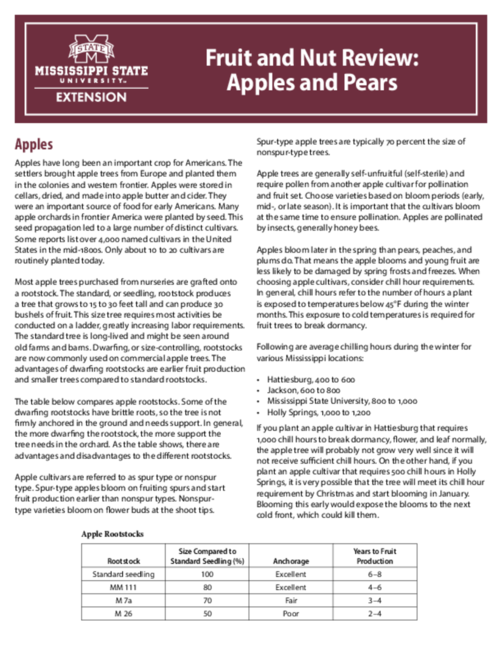
Most apple trees purchased from nurseries are grafted onto a rootstock. The standard, or seedling, rootstock produces a tree that grows to 15 to 30 feet tall and can produce 30 bushels of fruit. This size tree requires most activities be conducted on a ladder, greatly increasing labor requirements. The standard tree is long-lived and might be seen around old farms and barns. Dwarfing, or size-controlling, rootstocks are now commonly used on commercial apple trees. The advantages of dwarfing rootstocks are earlier fruit production and smaller trees compared to standard rootstocks.
Pears grow in most areas of Mississippi. In the southeastern United States, pears grow better if they have some resistance to diseases like fire blight and leaf spot.
Most pear varieties are self-unfruitful (self-sterile). Plant at least two varieties with similar blooming periods (early, mid-, or late season) for cross-pollination. To avoid frost damage, plant low-chill, early-blooming pears only in extreme south Mississippi.
Most pear fruit is better if picked before maturity and allowed to ripen off the tree at 70°F.
Download the PDF of the full publication, which includes recommended cultivars and information on planting, pruning, and training apple and pear trees.
Publication 3780 (POD-02-26)
Distributed by Eric Stafne, PhD, Extension/Research Professor, Coastal Research and Extension Center. Written by John Braswell, PhD, Extension Professor (retired), and R. Crofton Sloan, Assistant Research Professor (retired).
The Mississippi State University Extension Service is working to ensure all web content is accessible to all users. If you need assistance accessing any of our content, please email the webteam or call 662-325-2262.
Download
P3780
Fruit and Nut Review: Apples and Pears
669.07 KB
Departments
Authors
-
 Extension/Research Professor
- CREC-Coastal Research & Ext Center