P4207
Balancing Pest Control and Honey Bee Safety in Mississippi Cotton Production
Key Highlights
- Sustainable pest control with pollinator safety: A new decision tool will help cotton growers select insecticides that balance effective pest control and minimize risk to honey bees, promoting sustainable agricultural practices.
- Insecticides with low acute bee toxicity: Insecticides like novaluron, sulfoxaflor, and chlorantraniliprole offer strong pest control with lower acute toxicity to adult honey bees. Avoid harmful combinations like acephate plus bifenthrin during times of honey bee foraging activity due to their high toxicity risk.
- Optimize application timing and wind direction: To protect bees, apply insecticides during times of low bee activity and with careful attention to wind direction, preventing drift into nearby hives.
- Collaboration with beekeepers: Coordinating with local beekeepers on spraying schedules helps minimize pesticide exposure to honey bee colonies and ensures more effective pest management.
Why This Matters
Cotton production in the southern United States is heavily reliant on foliar insecticides to control key pests such as the tarnished plant bug (TPB) and bollworm (BW), particularly in the Delta. Multiple pesticide applications are often required throughout the growing season to manage these pests effectively. Although insecticides are essential for pest control, they can inadvertently harm non-target organisms, such as honey bees and other pollinators. Integrated pest management (IPM) programs typically prioritize pest control efficacy and cost, often overlooking the potential impact on pollinators. Recognizing this gap, a decision tool was developed for selecting insecticides that balance effective pest control with reduced risks to adult honey bees, promoting both agricultural productivity and environmental sustainability.
Decision Tool
This decision tool combines two factors: pest efficacy and adult honey bee toxicity. Insecticides were ranked based on their effectiveness against tarnished plant bug and bollworm using multi-location field trial data from the mid-southern United States. Toxicity to adult honey bees was evaluated using published acute toxicity values under field-related exposure assumptions, considering lethal concentration values. The final selection score is the product of efficacy and acute toxicity ranks, guiding growers toward insecticides that minimize pest damage to crops and harm to adult pollinating insects.
Key Takeaways and Trade-Offs
Tarnished Plant Bug Management
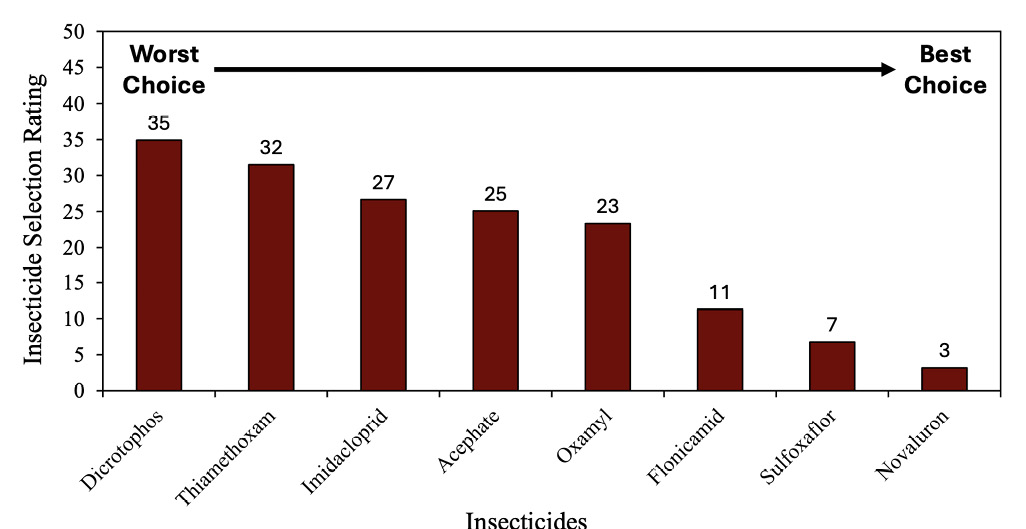
Insecticides such as novaluron and sulfoxaflor offer a good balance between pest control efficacy and reduced toxicity to adult honey bees (Figure 1). Acephate is highly effective against TPB but also highly toxic to adult honey bees. Conversely, flonicamid has low toxicity to adult honey bees but efficacy against TPB is low, making it a less favorable choice when maximum pest control is essential.
Bollworm Management
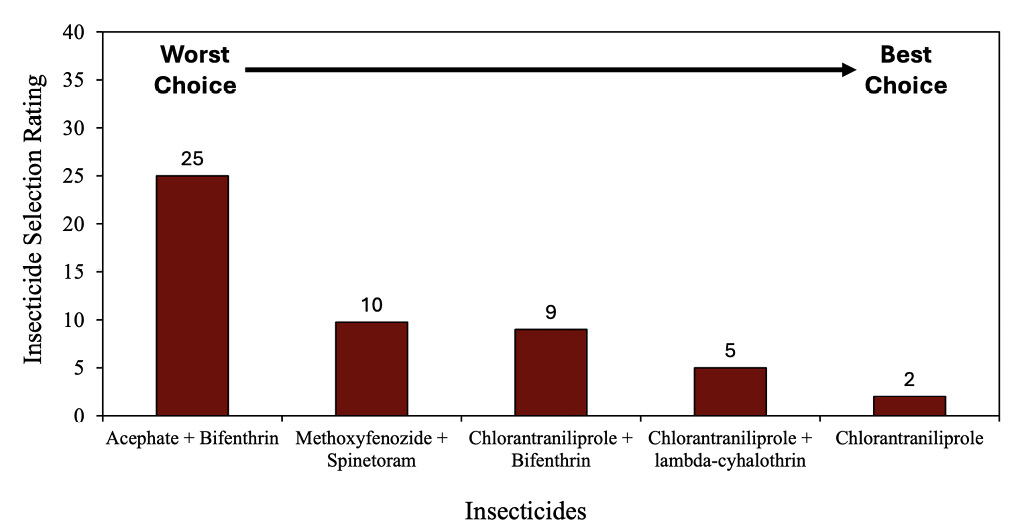
Chlorantraniliprole provides the most favorable balance of bollworm efficacy and reduced acute adult honey bee toxicity, offering both high efficacy and low acute toxicity to adult honey bees (Figure 2). Conversely, the combination of acephate plus bifenthrin was the least favorable option due to its low efficacy and high toxicity to adult honey bees, underscoring the importance of avoiding this combination.
These findings demonstrate that it is possible to incorporate safety of adult pollinating insects into pest management decisions without sacrificing effective pest control.
Practical Implications and Best Management Practices
- Minimize exposure: Most insecticides are toxic to honey bees, so minimizing exposure is the best strategy to protect pollinators.
- Spray thresholds: Only apply insecticides when economic thresholds are met to minimize unnecessary pesticide use and reduce risks to pollinators.
- Timing: Avoid spraying during peak bee activity (especially midday) when bees are most active, although aerial applications are often limited by weather and operational timing beyond a grower’s control. This approach supports both sustainable pest control for growers and reduced risk to pollinators.
- Insecticide selection: Select insecticides with high efficacy ratings against pests and low acute toxicity to honey bees, while adhering to label guidelines. Rotation of insecticide classes provides both ecological and economic benefits. It reduces repeated exposure of honey bees to the same active ingredients, lowering sublethal effects and overall stress on pollinators. At the same time, rotation slows the development of insecticide resistance in TPB populations, helping maintain long-term product effectiveness. This approach also reduces costs by avoiding frequent applications and delaying the need for more expensive alternatives. Overall, using effective insecticides with lower toxicity to bees supports sustainable pest control, stable input costs, and protection of beneficial insects.
- Communicate with beekeepers: Coordination with applicators and beekeepers is beneficial. Alert beekeepers on your farm when insecticides are scheduled to be sprayed.
- Minimize broad-spectrum insecticides: Reduce the use of broad-spectrum insecticides when practical.
- Application timing and pollinator-smart insecticide use:
- Early season: Prioritize pest control to protect yield, but exercise caution with neonicotinoid insecticides, which are systemic and highly toxic to bees.
- Midseason: Rotate insecticide classes, such as insect growth regulators (IGRs), flonicamid, and sulfoxaflor, to help preserve efficacy. Avoid overreliance on one chemistry as it increases insecticide resistance, exposure risk, and long-term cost.
- Late season: Late-season applications may demand greater emphasis on pollinator protection as flowering intensity and bee activity increase exposure risks during this period. Insecticide decisions should be guided by economic thresholds, resistance management principles, and pollinator risk awareness rather than reliance on any single chemistry or approach.
Bottom Line
Incorporating pollinator safety into pest management decisions is feasible without sacrificing pest control. By using a balanced insecticide selection approach, cotton growers can protect their crops while reducing damage to adult bees. This strategy promotes sustainable pest management practices, ensuring the long-term viability of agricultural productivity.
The information given here is for educational purposes only. References to commercial products, trade names, or suppliers are made with the understanding that no endorsement is implied and that no discrimination against other products or suppliers is intended.
Publication 4207 (POD-07-26)
By George Awuni, PhD, Extension Instructor, Delta Research and Extension Center; Angus Catchot III, Extension Associate I, Agricultural Science and Crop
Protection; Esmaeil Amiri, PhD, Assistant Extension/Research Professor, Delta Research and Extension Center; and Jeff Gore, PhD, Professor and Head, Delta
Research and Extension Center.
The Mississippi State University Extension Service is working to ensure all web content is accessible to all users. If you need assistance accessing any of our content, please email the webteam or call 662-325-2262.
Download
P4207
Balancing Pest Control and Honey Bee Safety in Mississippi Cotton Production
233.99 KB
Authors
-
 Extension Instructor
- Delta Research and Extension Center
-
 Asst Extension/Research Prof
- Delta Research and Extension Center
-
 Professor and Head
- Delta Research and Extension Center