P4228
Minimizing and Evaluating Harvest Losses on Your Operation
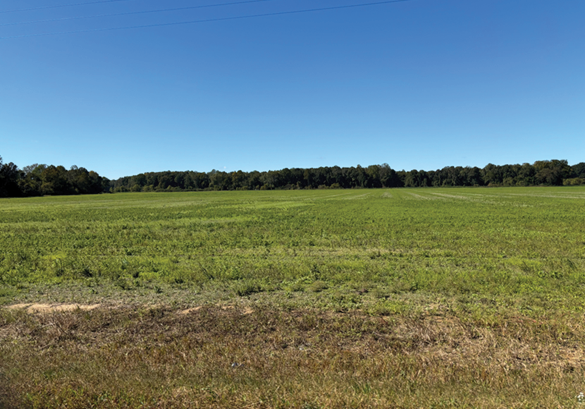
Across the state of Mississippi, fields of green begin reappearing in the fall. These are likely volunteer corn and soybean plants, the results of unsuccessful combine performance during harvest (Figure 1). Springtime volunteer plants can lead to reduced crop yields and can require additional herbicide or tillage passes to remove them. One springtime volunteer corn plant per square meter can reduce soybean yield by 22 percent. This publication provides information on how to reduce volunteer crops in your field and explains how leaving grain behind costs Mississippi farmers millions of dollars every year.
What Is Harvest Loss?
There are three main types of harvest loss: pre-harvest loss, header loss, and separator loss (Figure 2). Pre-harvest loss occurs before the combine enters the field. This can be a result of wildlife damage, weather, shattering, or mechanical loss created by machinery in the field during the growing season. Pre-harvest loss can easily be evaluated by walking into the field moments before harvesting and analyzing the ground for grain.
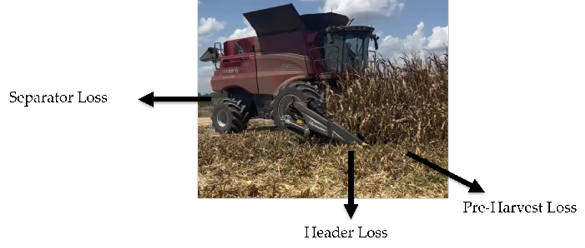
Once the combine enters the field, header loss and separator loss can both occur from the combine. Header loss can be caused by a wide range of issues occurring when the crop meets the header. One example is the sound of soybeans pinging off the combine’s windshield when harvesting. Once grain has entered the combine, separator loss can happen during the separation of grain from other crop materials and residues due to settings within the combine. Header losses are typically greater than separator losses.
Minimizing Harvest Loss
When harvesting, there are many settings within the combine and header that can reduce harvest loss. These settings should be adjusted for each variety and as crop conditions change within and between fields (e.g., changes in variety, moisture, maturity, and crop performance). Be sure to read combine operator’s manuals for useful information on changing the settings. However, these are only starting points; all settings should be adjusted based on the conditions in each field.
Corn Head Loss
- Gathering chain speed – Match the gathering chain speed to the ground speed to control the flow of material into the header. This will prevent the stalks from being pushed forward or pulled backward or sideways, which may result in ear losses. Corn headers can also be modified by adding brushes, impact pads, or sweeps onto the gathering chain to capture dislodged corn kernels.
- Header and row alignment – Adjust the header to match the variation in row spacing. Careful planting and autosteer technologies can help minimize stalk disturbance by keeping the header aligned with the crop.
- Gathering snouts – Snouts should be adjusted so they can capture lower ears and direct them into the combine. If plants are lodged, let snouts float on the ground while reducing ground speed to allow the stalks to be pulled into the header without losing the ear.
- Deck plates – Ensure deck plates are positioned properly. The plates should be spaced as wide as possible without losing ears or shelling corn off the ear. Common deck plate spacing suggested by operator’s manuals are an initial spacing of one and one-eighth inches at the bottom and one and one-quarter inches at the top. If kernels are smaller than normal, consider narrowing this spacing to limit shelling losses. If spacing is too wide, butt shelling may occur where the butt end of the ear contacts the stalk rolls, resulting in kernel loss. After adjusting deck plate spacing, be sure the adjustment is working as intended and readjust as necessary.
- Cross auger and feederhouse – The cross auger moves the ears to the center of the head where it enters the feederhouse. Reducing the space from the auger to the feederhouse drum may minimize crop buildup, helping to prevent backfeeding losses.
Draper Head Loss
- Cutter bar height – When harvesting soybean, cutter bar height can be critical in reducing harvest loss. Set the header position so that the cutter bar is below the lowest pods on the plant. Ideally, the cutter bar should be slightly above the soil surface to prevent damage and reduce wear to the sickle bar teeth.
- Reel speed – The reel axle should be 6 to 12 inches in front of the cutter bar and run about 1.25 times faster than the ground speed to reduce shattering.
- Sickle bar – Be sure that all sickles are sharp and that none are broken or missing. Inspect the bar for excessive wear, cracks, or breaks. Consult operator’s manuals for bar thickness and replace bars worn below specification.
- Belt RPM – It is important to keep material flowing evenly across the gathering belts as you are harvesting. A belt RPM set too fast can cause bunching of the harvested material, leading to issues with feeding into the machine or pod shatter from loose beans in the header that are not ingested into the combine, which can lead to additional harvest losses.
Separator Loss
- Rotor/cylinder – Follow manufacturer recommendations for speed and use the lowest possible setting to achieve the best total threshing, making small changes to these speeds according to crop conditions. Increasing the rotor or cylinder speed can decrease threshing losses but may also increase damage to the kernels and introduce foreign material into the grain. Speed adjustment is a balance between minimizing grain damage and loss with excluding foreign material from the grain.
- Concave clearance – In corn, adjust clearances so cobs split into halves or thirds. Avoid breaking the cobs into many pieces to lessen threshing losses and damaged kernels. In soybean, open concave clearances to reduce un-threshed pods; once rotor loss occurs, slightly close the concave clearances for optimum performance.
- Fan speed – Consult the operator’s manual for a starting point and adjust fan speed based on experienced crop conditions. If it’s set too low, foreign material will remain with the grain. If it’s set too high, kernels may be blown out the back of the combine, resulting in loss.
- Sieve openings – Check the operator’s manual for the recommended sieve openings. Set sieve to the widest recommended setting and change as needed to allow grain to filter through while the chaff is blown off. Adjust as needed based on changing crop conditions to minimize harvest losses.
Evaluating Harvest Loss
Harvest loss can be measured using a grid-based or drop-pan-based approach. Either method will allow for header and separator losses to be determined separately. Without measuring these losses, it is impossible to pinpoint where harvest losses occur in the combine and make adjustments or identify components in need of repair to improve harvest performance.
Grid-Based Method
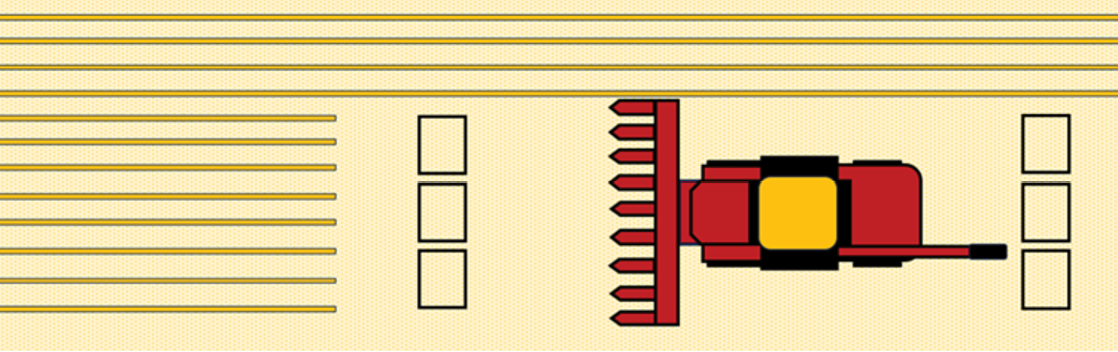
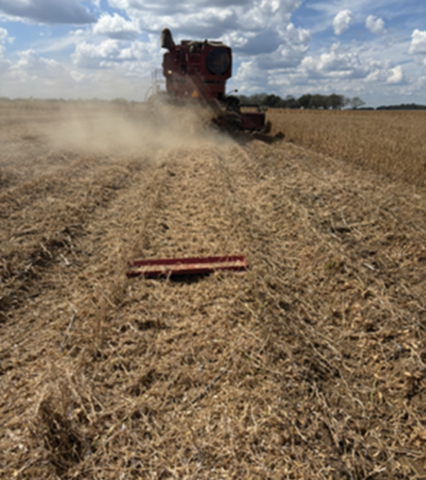
For grid-based methods, all the grain within a known area is collected and weighed to determine the loss. The width of the frame should be a multiple of the row spacing. For 30-inch row spacing, we recommend 60 inches wide, and for 38-inch row spacing, we recommend 76 inches wide. The longer the grid the better the variability will be captured but the longer it will take to collect the sample. PVC pipe is a lightweight and affordable option to create the perimeter. To determine header loss, the combine would begin harvesting until it was at normal operating speeds, then the combine would stop and wait until the separation process was completed. Once complete, the combine backs out of the pass, exposing the header footprint on the ground in front of the machine for loss sampling (Figure 3).
Within the perimeters, sift through the material and collect all the grain, taking care not to miss kernels as they can easily be raked away. Once the grain is collected in each location, it is weighed. Using the weight and grid area, the loss in bushels per acre (BU/A) can be calculated (refer to the accompanying Harvest Loss Calculator spreadsheet). Header loss can be evaluated by placing the PVC perimeter in front of the combine and separator losses can be calculated by placing the PVC perimeter behind the combine (Figure 3). Multiple perimeters across the width of the header and combine can allow you to check for localized issues.
It is important to remember that when analyzing separator loss, header loss will also be included in the sample. You must subtract the header loss from the sample if you want to evaluate them separately. Often, this information will allow you to pinpoint exact locations on the header or combine where grain loss may be occurring. This method is inexpensive and versatile, but sifting through the chaff to find grain is time-consuming.
Drop-Pan-Based Method
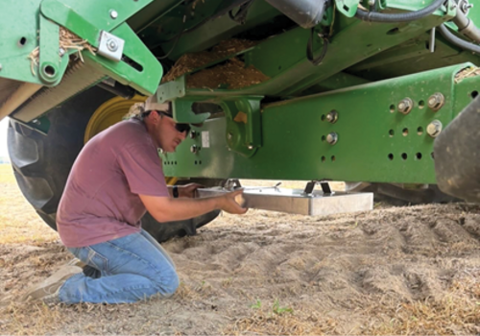
Another method uses a commercially available drop pan. The drop pan can be attached to the front or rear axle of the combine or anywhere behind the head. The pan uses a wireless connection to a smartphone, tablet, or other device to trigger deployment. To use this method, operate the combine at normal harvesting speed and use the app to trigger the pan drop remotely, allowing the combine to continue harvesting.
Once the combine has cleared, the drop pan can be retrieved. The contents within the pan represent the separator loss, and the grain found underneath the pan represents the header loss. Grain samples from each fraction are weighed and then entered into an app provided by the pan manufacturer, calculating the harvest loss for each. This method is much quicker and less prone to missing grain. However, it is costly to purchase multiple drop pans to assess loss across the header and separator. Since the sample area is small, it may reduce the accuracy over a larger grid. Also, in tall corn stubble, the pan may be prone to tipping.
Survey of Harvest Loss in Mississippi
During the 2025 harvest season, harvest losses were evaluated on farms of four corn producers and six soybean producers in Leflore and Washington counties. Of these producers, three different brands of combines, three different brands of corn headers, and three different brands of soybean headers for a total of 8 combines and 11 headers were evaluated. At all locations, a 76-inch-wide by 38-inch-long grid was used for loss sampling. Three sample locations along the swath width were evaluated: one at the center and one on each side. While not fully representative, these initial results provide insight into current harvest loss conditions experienced by Mississippi producers.
Results
In both corn and soybean, the header was identified as the primary source of harvest loss. In corn, header loss ranged from 0.03 BU/A to 6 BU/A. The average loss was 1.5 BU/A with 25 percent of the headers analyzed exceeding 2.5 BU/A loss.
| Yield loss (BU/A) | $4 per bushel | $4.50 per bushel | $5 per bushel | $5.50 per bushel |
|---|---|---|---|---|
| 0.5 | $2,000 | $2,250 | $2,500 | $2,750 |
| 1 | $4,000 | $4,500 | $5,000 | $5,500 |
| 2 | $8,000 | $9,000 | $10,000 | $11,000 |
| 3 | $12,000 | $13,500 | $15,000 | $16,500 |
| 4 | $16,000 | $18,000 | $20,000 | $22,000 |
| 5 | $20,000 | $22,500 | $25,000 | $27,500 |
In soybean, header loss ranged from 0.17 BU/A to 4.6 BU/A. The headers resulting in higher losses often had a draper belt or reel speeds that were observed to be too fast for harvesting conditions. The average loss was 1.2 BU/A.
| Yield loss BU/A) | $10 per bushel | $11 per bushel | $12 per bushel | $13 per bushel |
|---|---|---|---|---|
| 0.5 | $5,000 | $5,500 | $6,000 | $6,500 |
| 1 | $10,000 | $11,000 | $12,000 | $13,000 |
| 2 | $20,000 | $22,000 | $24,000 | $26,000 |
| 3 | $30,000 | $33,000 | $36,000 | $39,000 |
| 4 | $40,000 | $44,000 | $48,000 | $52,000 |
| 5 | $50,000 | $55,000 | $60,000 | $65,000 |
Overall, most of the combines assessed fell within the reported value range. However, several combines/headers were sampled with high rates of harvest loss. To compare, for 1,000 acres of corn, the harvest loss difference between the best- and worst-performing combines/headers resulted in just over $25,000 in economic losses at a market price of $4.25 per bushel. For 1,000 acres of soybean, these differences between the best and worst losses sampled resulted in just over $47,000 in economic losses at $10.25 per bushel.
Considerations
While harvest loss cannot be eliminated, it is important to minimize these losses by monitoring combine performance to avoid leaving grain in the field. Time spent adjusting settings before and during harvest could result in increased return and reduced expenses in dealing with volunteer plants the following year. Evaluate losses throughout the harvest season as crops, fields, and conditions change, so you can identify needed combine adjustments and mechanical failures. Taking these actions will help increase economic return for Mississippi grain producers.
References
Buschermohle, M., & McNeill, S. (2023). Harvesting, drying, handling and storing soybeans. University of Tennessee Institute of Agriculture.
Isaacson, A., Mazzone, T. R., & Curtis, Z. (2025). Combine adjustments to minimize corn harvest losses. Penn State Extension.
Stephens, T., Kumar, V., Rees, J., & Jhala, A. J. (2024). Harvest loss in corn and implication for volunteerism. Weed Technology, 38, e48.
Turner, A. P., Jackson, J. J., Sama, M. P., & Montross, M. D. (2021). Impact of delayed harvest on corn yield and harvest losses. Applied Engineering in Agriculture, 37(4), 595–604.
Publication 4228 (POD-10-26)
By Mack Cihal, former Graduate Student, Jessica Drewry, PhD, Assistant Professor, Agricultural and Biological Engineering, Wes Lowe, PhD, Assistant Professor, Agricultural and Biological Engineering, and Corey Bryant, PhD, Assistant Professor, Delta Research and Extension Center.
The Mississippi State University Extension Service is working to ensure all web content is accessible to all users. If you need assistance accessing any of our content, please email the webteam or call 662-325-2262.
Download
P4228
Minimizing and Evaluating Harvest Losses on Your Operation
592.82 KB
Authors
-
 Assistant Professor
- Ag & Bio Engineering