Seafood Economics
Mississippi Seafood Processing
Seafood Processing Businesses
Seafood processing primarily corresponds to "seafood canning" and "fresh and frozen seafood processing." It involves plants engaged in the primary wholesale and processing of seafood products.
An online directory of Mississippi seafood dealers is available on the Mississippi Department of Marine Resources website.
Seafood Processing Long-Term Sales and Employment Contributions
The major seafood species processed in Mississippi include catfish, shrimp, oysters, and blue crabs. In addition, menhaden are processed into fish meal and oil.
The economic contributions of Mississippi seafood processing since 2014 are shown below. Output or sales are businesses' gross sales within the economic region affected by an activity. The total economic contribution consists of direct, indirect, and induced effects. The Mississippi seafood processing industry generated an average of more than $81.6 million in sales contribution from 2014 to 2018 (Fig. 1). Overall, the industry's sales contribution has not yet fully recovered from the 2019 disaster and the global pandemic.
Employment or job contributions are measured as a mix of full-time and part-time jobs. The total economic contribution is the sum of direct, indirect, and induced effects. The Mississippi seafood processing industry created an average of 1,023 jobs from 2014 to 2018 (Fig. 1). Overall, the industry's job contribution has recovered from the 2019 disaster and the global pandemic.
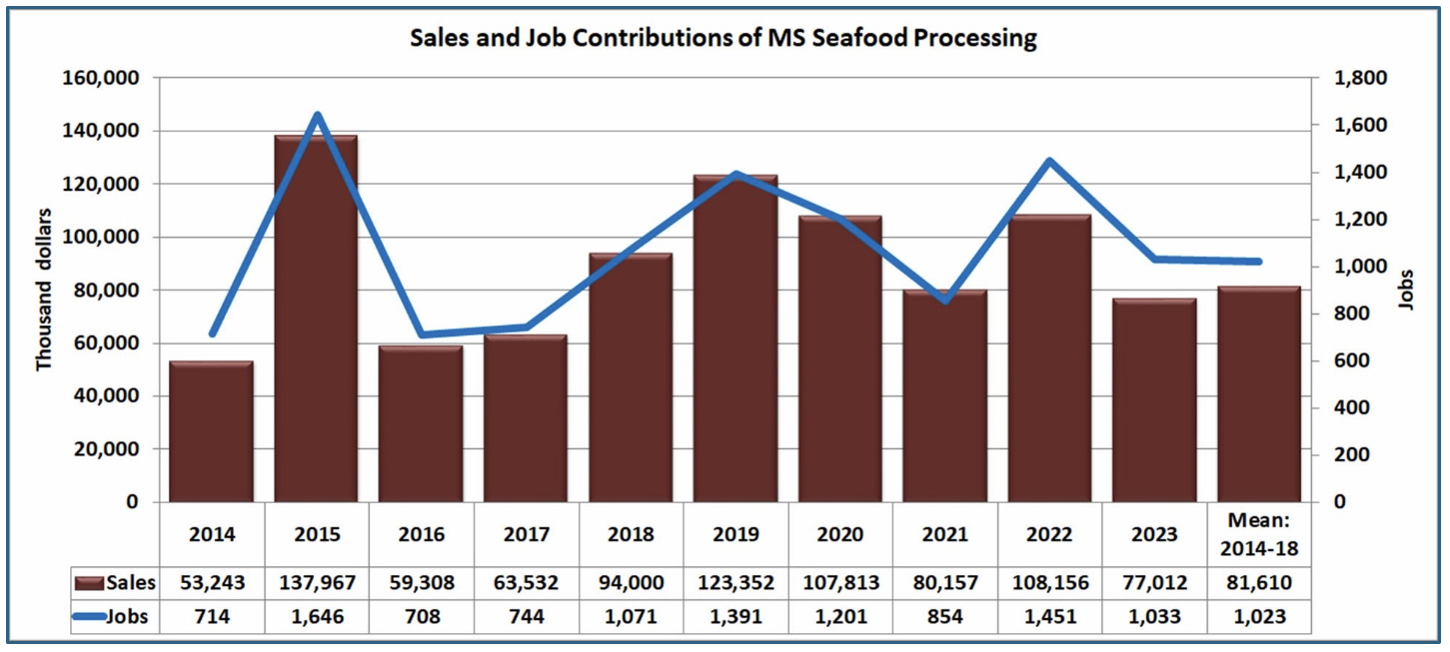
The average productivity of workers in the seafood processing industry in Mississippi can be measured by dividing total sales contributions by total job contributions. Over the past five years, seafood processing in Mississippi generated an average annual productivity of more than $87,000 per job.
Seafood Processing Economic Contributions in 2023
Seafood processing generated economic activities and provided jobs. Output or sales are the gross sales by businesses within the economic region affected by an activity. The total economic impact is the sum of direct, indirect, and induced impacts. Direct effects reflect the economic impacts within the sector where the expenditure was initially incurred. Indirect impacts result from changes in the economic activity of other industrial sectors that supply goods or services to the sector being evaluated. Induced impacts result from industry employees' personal consumption expenditures (IMPLAN, 2026).
The economic contributions of Mississippi seafood processing in 2023 are shown in Fig. 2. The sales contribution of the seafood processing industry was more than $77.0 million, representing about 33.6 percent of the entire seafood industry's sales contribution to the state's economy.
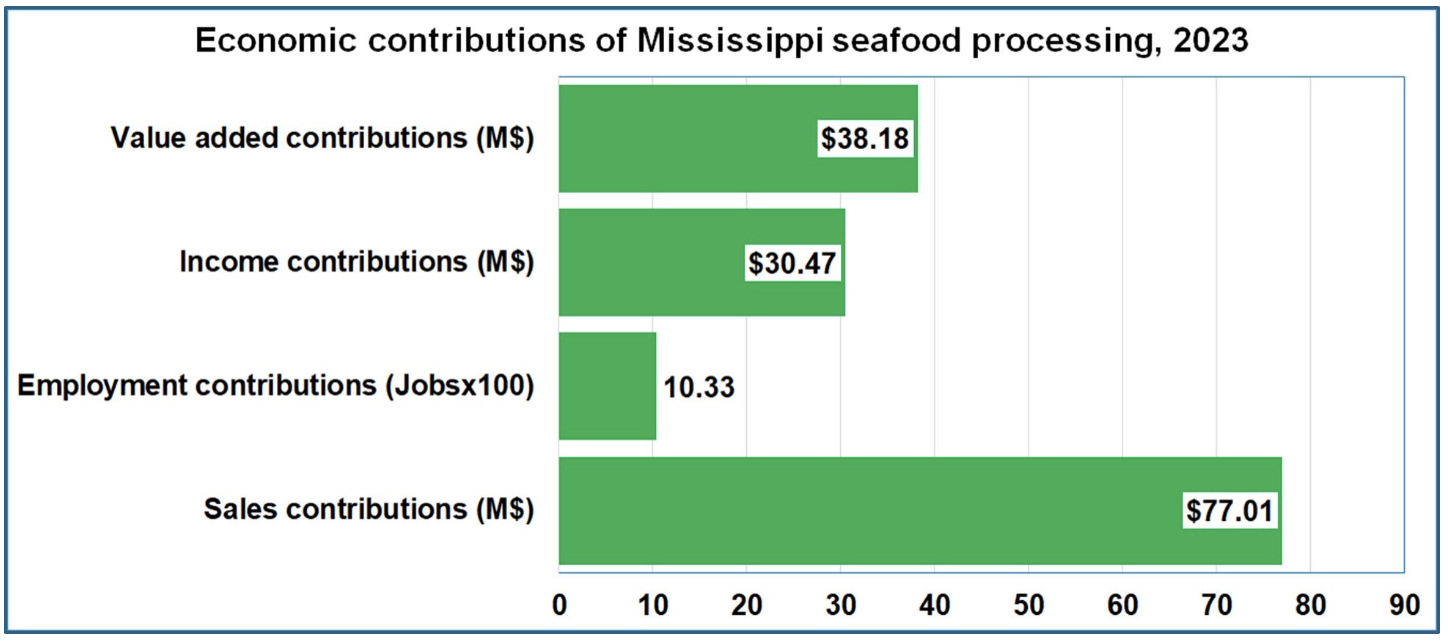
Employment or job contributions are expressed in a mix of full-time and part-time jobs. The industry created 1,033 full-time and part-time jobs, representing about 21.2 percent of the seafood industry's total job contribution in Mississippi.
Value-added contribution measures an industry's contribution to the gross domestic product. It is the difference between an Industry's total output and the costs of its intermediate inputs (IMPLAN, 2026). The value-added contribution of seafood processing exceeded $38.2 million, or 33.1 percent of total value-added contribution.
The income contribution from seafood processing reached $30.5 million, or 34.2 percent of total income contribution. Labor income consists of all forms of employment income, including employee compensation (wages, salaries, and benefits), as well as proprietor income (IMPLAN, 2026).
Seafood Economics
- Commercial Fishing Industry
- Commercial Shrimp Industry
- Mississippi Commercial Crab Industry
- Mississippi Commercial Finfish Industry
- Mississippi Commercial Oyster Industry
- Mississippi Seafood and Fish Markets
- Mississippi Seafood Importing
- Mississippi Seafood Marketing
- Mississippi Seafood Processing
- Mississippi Seafood Restaurants
- Mississippi Seafood Wholesaling