Seafood Economics
Mississippi Commercial Finfish Industry
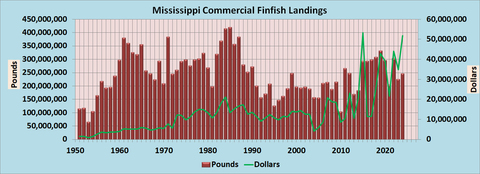
Mississippi Commercial Finfish Landings
The primary food fish species harvested include red snapper, redfish, spotted seatrout, flounder, mullet, and sheepshead. The bulk of finfish collected for industrial uses consists of menhaden. The annual finfish commercial landings averaged 268 million pounds in the past six years, valued at $38 million.
Commercial finfish landings contributed 97% of Mississippi commercial landings from 2019 to 2024. In dockside values, finfish landings added 75% to Mississippi commercial dockside values during the past six years. Menhaden accounted for 97 percent of all the commercial landings during the last six years. About 74 percent of the commercial dockside values are from the menhaden harvest during the same period.
Economic Contributions by Major Species
In response to requests by state regulatory agencies and seafood organizations, the 2009 (and later) economic contributions of the Mississippi seafood industry by major species were imputed from state estimates published by NOAA Fisheries. Extension and research publications were developed to document the economic contributions of Mississippi's major seafood species that landed, processed, sold, and consumed.
This report includes four types of economic impacts: sales, jobs, income, and value-added. These impacts are not additive. Each type represents a specific economic activity reported. Income, value-added, and sales impacts are expressed in dollars for the year specified by the user. Sales are the gross sales of businesses within the economic region affected by an activity. Labor income includes personal income, such as wages and salaries, and proprietors' income, or income from self-employment.
Mississippi Finfish Industry in 2009
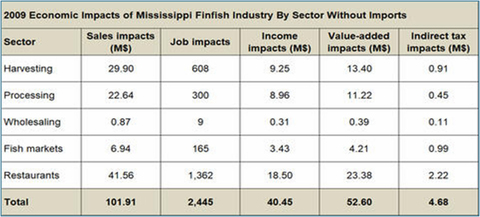
The economic contributions of the state finfish industry in 2009 are shown in Table 1 below. Sales contributions reached $101.9 million in 2009, generating 2,445 full-time and part-time jobs. The income contribution was more than $40.4 million, and the value-added created was about $52.6 million. The industry-added tax impact reached about $4.7 million.
Mississippi Finfish Industry in 2011
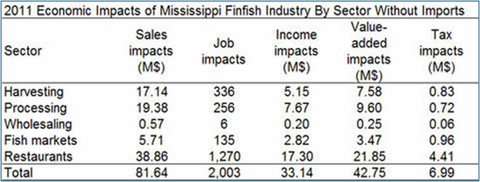
Table 2 below shows the Mississippi finfish industry's lower estimated 2011 economic contributions. The sector's sales contributions fell to $81.6 million, which generated 2,003 full-time and part-time jobs. Income contribution reached $33.1 million, and value added was $42.8 million. The industry made tax impacts totaling $6.9 million. The reduction in these values is associated with the 2010 Deepwater Horizon Oil Spill and the 2011 Bonnet Carré Spillway disaster.
Mississippi Finfish Industry in 2015
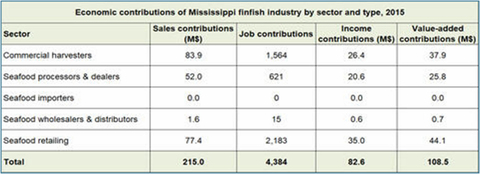
Table 3 below shows the higher estimates of the finfish industry's 2015 economic contributions in Mississippi. The industry's sales contribution reached $215 million, and its value-added contribution reached over $108.5 million. The industry generated more than 4,300 full-time and part-time jobs and $82.8 million in income contributions.
Mississippi Finfish Industry in 2020
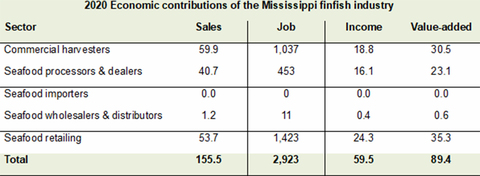
Table 4 illustrates the breakdown of the Mississippi commercial-finfish industry's contributions to the state economy in 2020. The entire finfish industry contributed $155.5 million, created 2,923 jobs, generated a total personal income of $59.5 million, and added value-added of $89.4 million to the state gross regional product. Harvesting (38.5%), retailing (34.6%), and processing (26.2%) were the largest sectors of the state finfish industry in 2020. The reduced estimates are attributable to the 2019 Bonnet Carré Spillway disaster and the global pandemic.
Mississippi Finfish Industry in 2023
Table 5 illustrates the breakdown of the Mississippi commercial-finfish industry's contributions to the state economy in 2023. The entire finfish industry contributed $119.8 million in sales, created 1,819 jobs, generated a total personal income of $45.5 million, and added $59.7 million in value-added contributions to the state economy. Harvesting (39.2%), retailing (25.3%), and processing (34.7%) were the largest sectors of the state finfish industry in 2023.
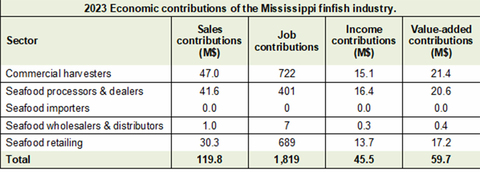
Overall, the entire Mississippi finfish industry has not yet fully recovered from the damages associated with recent disasters, especially the 2019 Bonnet Carré Spillway disaster and the global pandemic. These estimates are not additive. Separate measures like sales, output, and value-added track the same underlying dollars through different lenses, meaning they overlap rather than stack. Combining separate event estimates counts the same transactions more than once, i.e., double counting.
Seafood Economics
- Commercial Fishing Industry
- Commercial Shrimp Industry
- Mississippi Commercial Crab Industry
- Mississippi Commercial Finfish Industry
- Mississippi Commercial Oyster Industry
- Mississippi Seafood and Fish Markets
- Mississippi Seafood Importing
- Mississippi Seafood Marketing
- Mississippi Seafood Processing
- Mississippi Seafood Restaurants
- Mississippi Seafood Wholesaling