Seafood Economics
Commercial Fishing Industry
Mississippi Commercial Fishing
Commercial fishing corresponds to finfish and shellfish fishing in the North American Industrial Classification System (NAICS). Finfish fishing comprises establishments primarily engaged in the commercial catching or taking finfish (e.g., menhaden, redfish, snapper, seatrout, flounder, mullet, and sheepshead) from their natural habitat. Shellfish fishing comprises establishments primarily engaged in the commercial catching or taking shellfish (e.g., blue crab, oyster, shrimp) from their natural habitat.
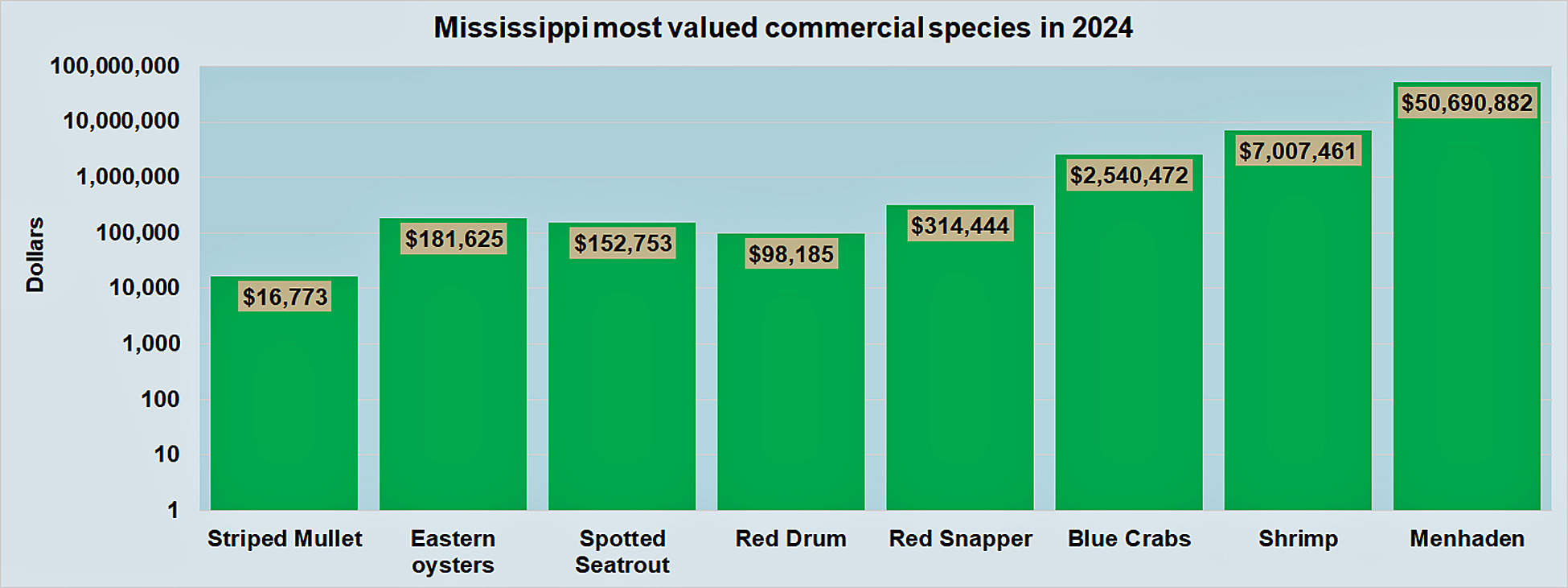
Fig. 1 shows the most valued species landed by Mississippi commercial fishermen in 2024. Menhaden was the most valuable species, accounting for $50.7 million, or 82.4 percent of the total landing value. Brown and white shrimp added $7.0 million, or 11.4 percent. Blue crabs ranked third among the most valuable species, with $2.5 million in dockside sales, or 4.2 percent. Oysters, red snapper, red drum, spotted seatrout, and striped mullet added 1.3 percent to the total dockside values in 2024.
Total Commercial Landings
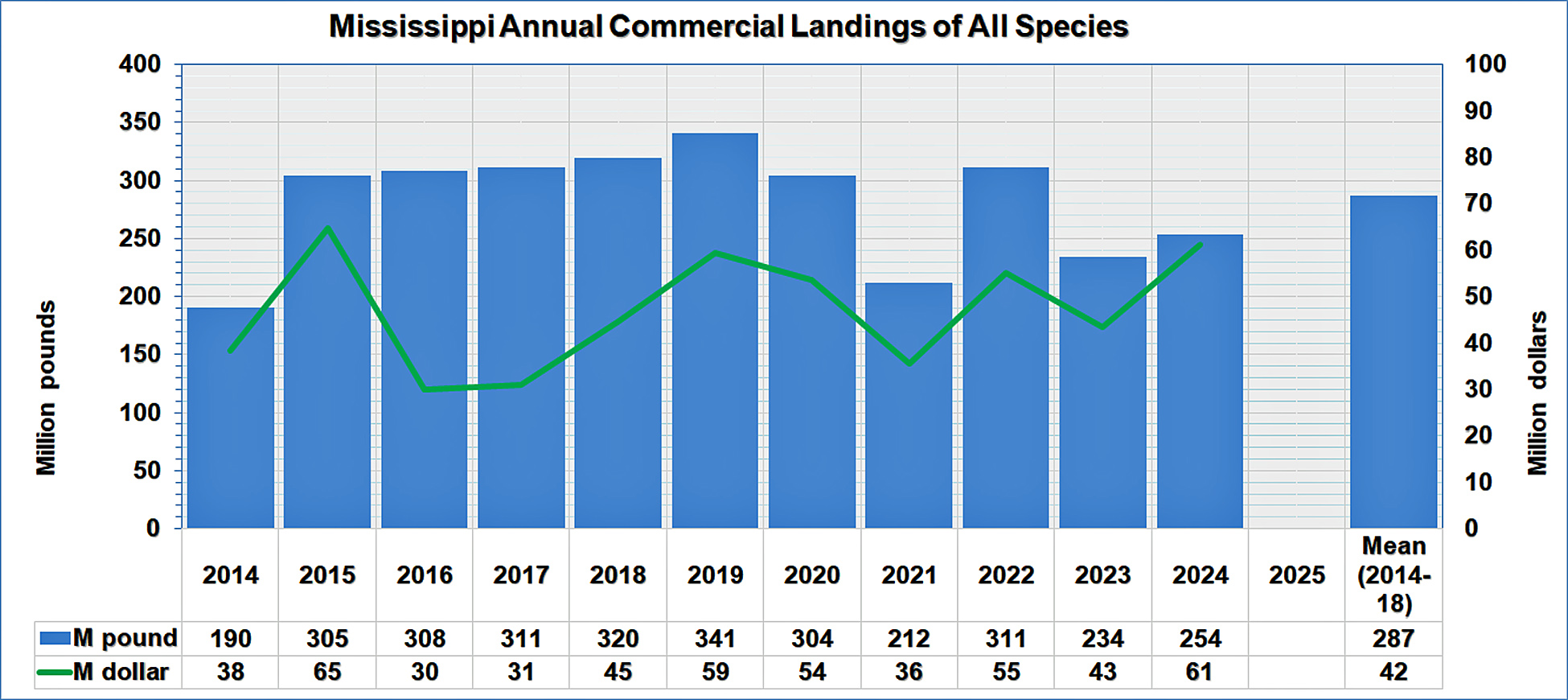
Commercial landings averaged 287 million pounds during the selected benchmark period and were valued at $42 million (Fig. 2). Total commercial landings in 2021, 2023, and 2024 were significantly lower than the benchmark values in 2014-18. Overall, the entire Mississippi commercial fisheries have not yet fully recovered from the negative impacts of the recent disasters.
Economic Impacts
Commercial fishing generated economic activities and provided jobs in the coastal counties. Output or sales are the gross sales by businesses within the economic region affected by an activity.
The total economic impact is the sum of direct, indirect, and induced impacts. Direct effects express the economic impacts in the sector where the expenditure was initially made. Indirect impacts result from changes in the economic activity of other industrial sectors that supply goods or services to the sector being evaluated. Induced impacts result from industry employees' personal consumption expenditures (IMPLAN, 2026).
The economic contributions of Mississippi commercial fishing are shown in Fig. 3. The sales contribution of the commercial fishery was about $57.2 million, representing about 25.0 percent of the entire seafood industry's sales contribution to the state's economy.
Employment or job contributions are expressed in a mix of full-time and part-time jobs. The industry created more than 1,223 full-time and part-time jobs, representing about 25.0 percent of the seafood industry's total economic contribution in Mississippi.
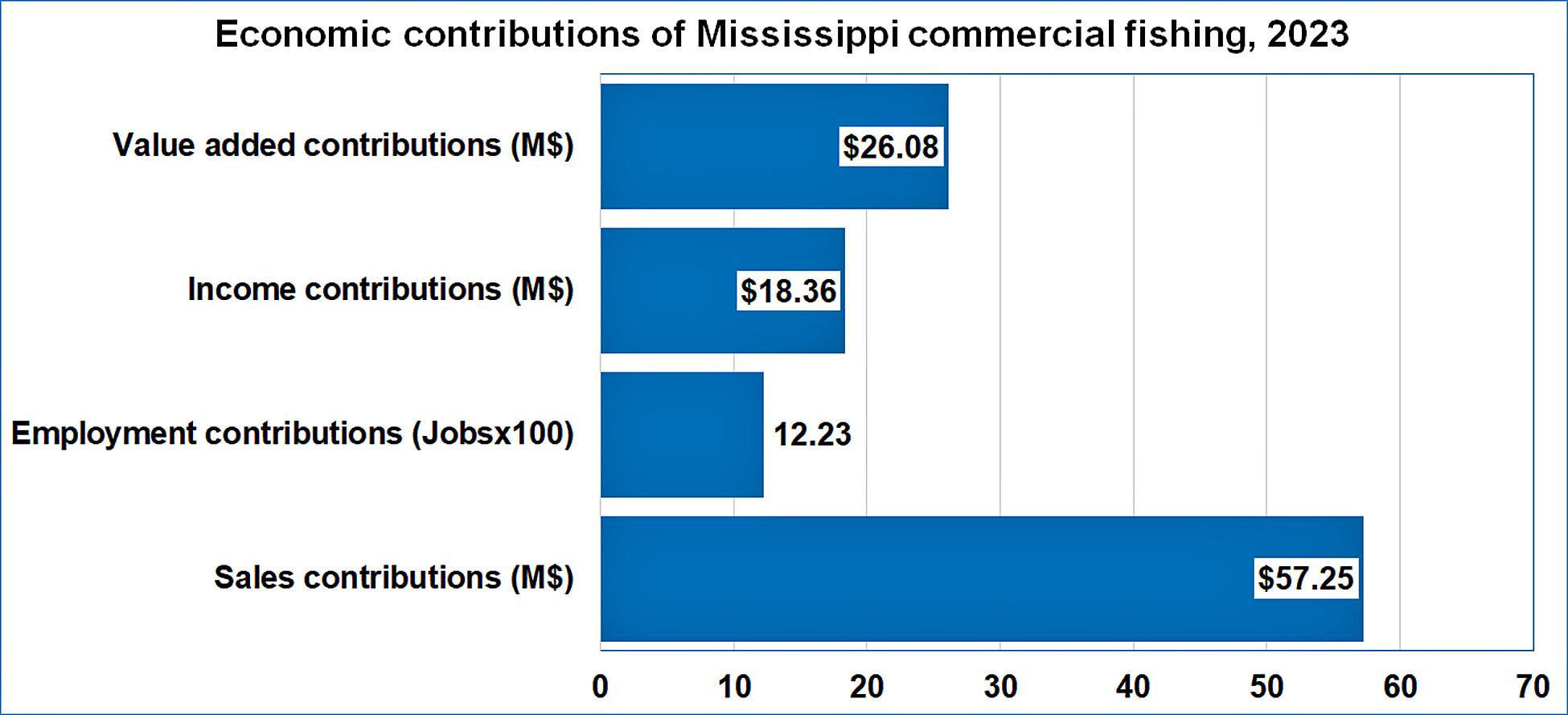
Value-added contribution measures an industry's contribution to the gross domestic product. It is the difference between an Industry's total output and the costs of its intermediate inputs (IMPLAN, 2026). The value-added contribution of commercial fishing reached $26.0 million.
The income contribution of commercial fishing reached $18.3 million. Labor income consists of all forms of employment income, including employee compensation (wages, salaries, and benefits), as well as proprietor income (IMPLAN, 2026).
Commercial Fishermen and Owners
Annual data from Lightcast (2026) indicate more than 1,300 Mississippi commercial fishermen and owners. About 4.3 percent are women. Three-fourths are White, 10.4 percent are African American, 7.5 percent are Hispanic, 3.7 percent are Asian, and 1.9 percent are two or more races. The rest are American Indians and Native Hawaiians.
The average age of Mississippi commercial fishermen and owners was 43. About 24 percent were less than 34 years old. About 54 percent were between 35 and 54 years old. The 55-year-old and higher commercial fishermen and owners comprised 22 percent.
Commercial Fishing Licenses
The total number of commercial fishing licenses issued by the Mississippi Department of Marine Resources to commercial vessels fishing for crabs, shrimp, oysters, hook and line, and menhaden is shown in Fig. 4. These commercial licenses for fishing vessels are sold to residents and non-residents.
Natural and man-made disasters, as well as the global pandemic, adversely affected commercial fishing, which appeared to decline considerably during the pandemic years. The total number of commercial fishing vessel licenses fell significantly after Hurricane Katrina in 2005 and remained low in subsequent years.
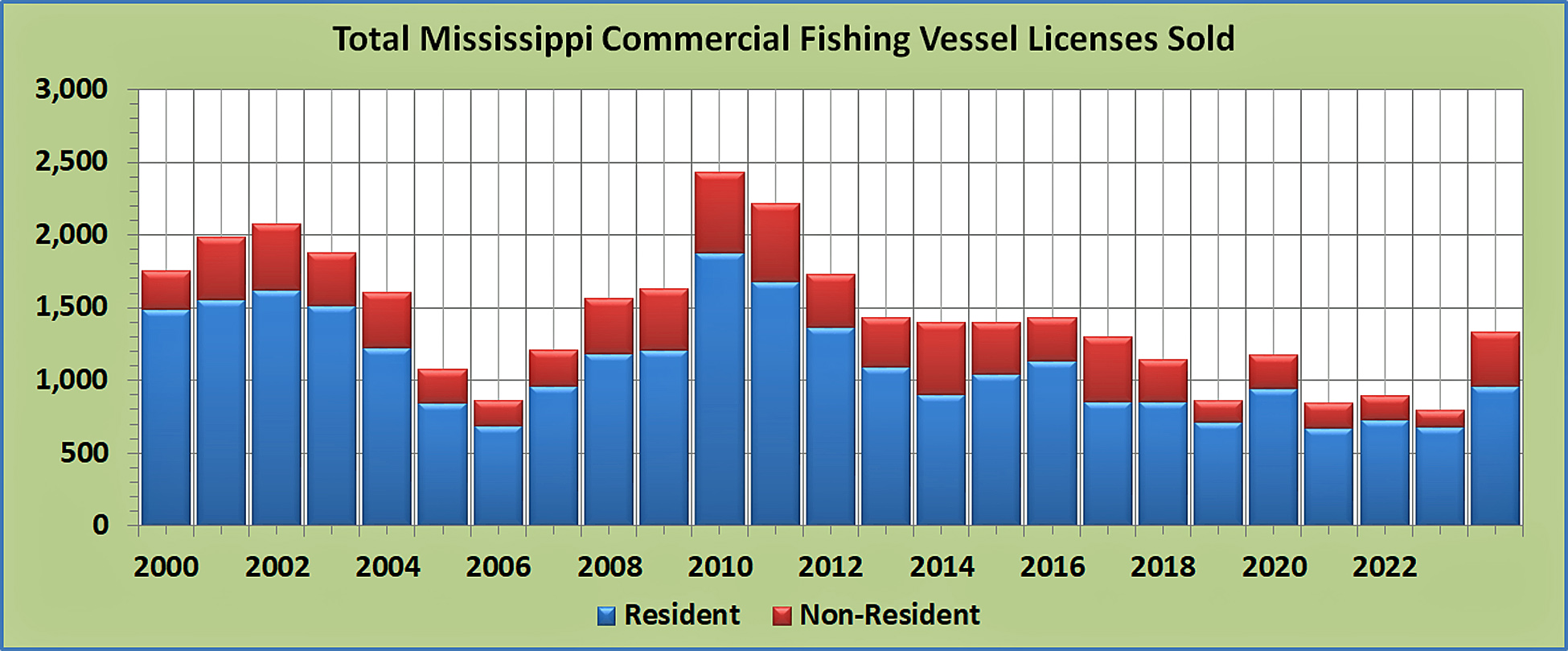
The surge in the total number of commercial fishing vessel licenses in 2010, despite the disastrous Deepwater Horizon oil spill in the Gulf of Mexico (now the Gulf of America), was driven by the opportunity to participate in the Vessel of Opportunity (VOO) program. The VOO program became available to boat owners who could not fish or use large parts of the Gulf due to the oil spill. Boat owners were compensated for their participation in the cleanup by skimming, booming, and transporting supplies.
A noticeable decline was observed after the opening of the Bonnet Carre Spillway in 2011, and again in 2019. Overall, the number of commercial fishing vessel licenses sold in recent years remained below levels in the early 2000s.
Seafood Economics
- Commercial Fishing Industry
- Commercial Shrimp Industry
- Mississippi Commercial Crab Industry
- Mississippi Commercial Finfish Industry
- Mississippi Commercial Oyster Industry
- Mississippi Seafood and Fish Markets
- Mississippi Seafood Importing
- Mississippi Seafood Marketing
- Mississippi Seafood Processing
- Mississippi Seafood Restaurants
- Mississippi Seafood Wholesaling