P3860
Properly Raise Young Horses to Avoid Costly Injuries
The best age to begin training young horses is a heated debate within the equine industry. While many believe that horses should be skeletally mature when training begins, others believe this is unnecessary. An online poll by an equine feed company indicated that 79 percent of their followers felt horses should begin training around the age of skeletal maturity (more than 4 years old), and 21 percent felt that horses should begin training before 2 years of age.
The common opinion that horses need to be fully mature to begin training is based on equine welfare concerns and a fear that early training is to blame for high rates of lameness and breakdown in performance horses. In addition to being a welfare concern, lameness is also very costly. A 1998 estimate found that equine lameness costs the U.S. equine industry $678,000 to $1 million per year. When adjusted for inflation, the estimated cost of lameness to the 2022 U.S. equine industry was $1.2 million to $1.8 million each year.
While advances have been made in veterinary medicine to improve lameness recovery, these solutions are costly. An economical solution to this problem is to prevent lameness before it happens through improved training and maintenance practices. Practicing a proactive approach to lameness prevention, rather than a reactive approach, can improve horse welfare as well as prevent a costly recovery.
Contrary to popular opinion, research has shown that exercising young horses in mindful moderation decreases the probability of lameness and improves the musculoskeletal development of bone, cartilage, tendons, and ligaments. In fact, horses exercised before 2 years of age have lower lameness rates than horses started at 3 or 4 years of age.
Additionally, easily changed management practices, such as providing pasture access, have been shown to decrease instances of lameness and facilitate musculoskeletal development. Allowing pasture access and incorporating moderate amounts of high-impact exercise can minimize the risk of lameness and promote proper musculoskeletal development.
The benefits of early training are clear, but owners and trainers must avoid the following four mistakes when starting horses.
Mistake 1: Stalling Young Horses in Training
Stalling Decreases Bone Density
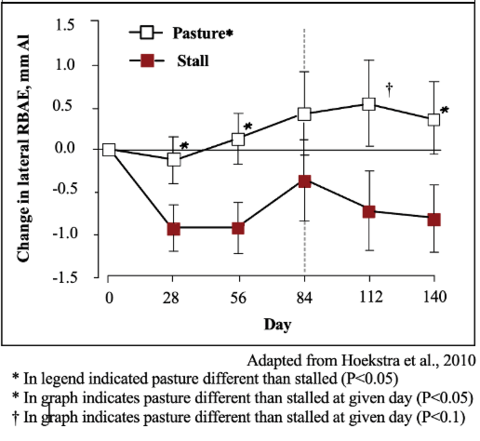
Horses that are stalled for long periods of time experience weakened, less dense bones that leave them susceptible to catastrophic injury. When young horses are given pasture access, they are likely to run, and high-velocity strides cause the bone to become stronger. Conversely, when horses are kept in stalls and undergo training that does not include high-impact exercise, bones lose strength very quickly.
Figure 1 shows that bone density of stalled horses is significantly and consistently lower than that of horses kept in pastures. Pastured horses show an overall increase in lateral radiographic bone aluminum equivalence (RBAE, a measure of bone density) from approximately zero at day zero to positive values ranging from 0.1 to 0.55 between days 56 and 140. Stalled horses show a decline from approximately zero at day zero to negative values ranging from −0.4 to −0.95 throughout the study. Error bars indicate variability. Pastured horses had significantly higher lateral RBAE than stalled horses on days 28, 56, and 140 (P<0.05), with a tendency toward significance on day 112 (P<0.1). The overall pattern indicates greater lateral RBAE in pastured horses compared with stalled horses over time.
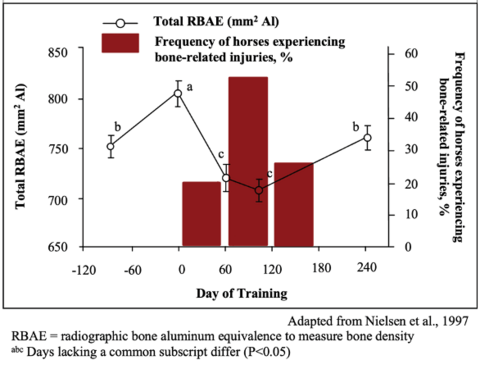
Figure 2 shows that decreased bone density caused by keeping horses in stalls is associated with high rates of injury in training. Bone density increased from approximately 750 at day −90 to a peak of 805 at day zero, then declined to approximately 720 at day 60 and 710 at day 120 before recovering to approximately 760 at day 240. The percentage of horses experiencing bone-related injuries increased from approximately 20 percent near day 30 to 50 percent near day 90, then declined to approximately 28percent near day 150. Differences in bone density among time points were statistically significant (P<0.05) when points did not share a common letter. Overall, the graph demonstrates that bone density initially decreases during training while the frequency of bone-related injuries increases, followed by a gradual recovery in bone density.
Stalling Degrades Cartilage
Stalling horses introduces a level of inactivity that negatively impacts cartilage maintenance. The deterioration of cartilage impacts joints, causing pain during exercise and leading to costly treatments such as hock injections. Horses kept in pastures have thicker cartilage than horses that were stalled. Thicker cartilage provides horses more comfort in movement. It is especially important to preserve cartilage health, as cartilage deterioration is difficult to combat.
Stalling Increases Susceptibility to Tendon and Ligament Injuries
Tendon and ligament injuries are two of the most common types of equine injuries. Recovery times range from 6 months to a year, with some horses taking even longer to return to their full potential. Lack of exercise and mobility can impair tendon structure and function, leaving horses susceptible to injury.
Mistake 2: Starting Horses Too Late
Although horse skeletons don’t fully mature until age 6, suggesting they shouldn’t undergo any training until this point is akin to suggesting children should not exercise until they are adults. In fact, exercise at a young age actually strengthens horses’ musculoskeletal structures.
Exercising horses in moderation during growth strengthens bones, joints, tendons, and ligaments in a way that is not possible after maturity. Bone formation is an important period in which minerals are either added or removed from bone. This happens in the early years of the horse’s life. After it ends, the bone cannot change the net amount of minerals within it. Exercising horses early encourages mineralization of the bone, resulting in increased strength at maturity.
Moderate levels of work while young promote cartilage and tendon health and maintenance. Exercising horses at a young age improves tendon quality, the adaptation of which is lost after 19 months of age. While the common digital extensor tendon and deep digital flexor tendons fully mature later in life, horses must be exercised while these tendons are growing (at 2 to 3 years of age) for optimal strength in maturity. Horses that are not exercised before 3 years of age risk cartilage deterioration, diminished bone strength, and weak tendons.
Mistake 3: Overexercising Young Horses
While there are clear benefits to starting horses at a young age to optimize musculoskeletal development, it is important to avoid overtraining. Overtraining horses has the potential to cause as much damage as underworking them. Overtraining occurs when horses are worked without the opportunity for their bodies to recover. Overtraining symptoms include:
- Fatigue and depression
- Diminished performance
- Sickness
- Mineral deficiencies
- Decreased healing rate
Overtraining can also cause horses to experience serious injuries resulting from missteps and improper pressure loading.
Young horses are especially susceptible to overtraining syndrome. Many symptoms of overtraining are attributed to heightened cortisol levels, and young horses naturally have higher baseline levels of this hormone compared to mature horses. In chronically high levels, this “stress hormone” is responsible for immune system suppression, which contributes to increased susceptibility to illness.
Overtraining syndrome can be prevented by giving horses an appropriate amount of time to recover from exercise. Recovery can take up to 48 hours, even after short spurts of activity. Longer training sessions or strenuous competitions can increase recovery times. While many trainers are hesitant to compromise their training timeline by offering horses time to recover, allowing horses rest after training ultimately saves time and money and keeps horses healthy.
Mistake 4: Training at Low Speeds and Long Distances
It is important that young horses are trained in a way that optimizes their structural development. Short sessions of high-impact work, such as sprinting, cause bones and tendons to adapt and strengthen in response to the exercise. This work is very important before the age of 3—the age at which bones and tendons begin to lose developmental potential.
After the bones and tendons are strengthened through short, high-impact work, horses are better prepared for muscle and cardiovascular development. Without first preparing bones and tendons, muscular and cardiovascular training through low-speed work over long distances will diminish bone and tendon strength, leaving horses susceptible to costly injury.
Summary
Research shows that training horses before their musculoskeletal structure is fully mature actually strengthens their bones and ligaments, preventing injuries later in life. Horses that are not trained before maturity miss this crucial development and are more likely to become injured in exercise.
Horses that are trained at moderate levels in short bouts of high-impact exercises are better prepared for the future strain of performance exercise and, therefore, have lower lameness rates and higher earnings. However, stalling horses during this period negates the musculoskeletal improvements seen with exercise. Stalling young horses in training results in weak bones and diminished joint, cartilage, and tendon development. These factors predispose horses to serious injuries and early breakdown.
While exercise that strengthens the musculoskeletal system is important, owners and trainers must allow recovery time to prevent detrimental effects of overtraining. Young horses can be started safely before maturity if they are not stalled for long periods of time, if they are trained in moderate, short bouts of high-impact exercise, and if they are allowed time to recover from exercise.
References
- Cappelli, K., Felicetti, M., Capomaccio, S., Nocelli, C., Silvestrelli, M., & Verini-Supplizi, A. (2013). Effect of training status on immune defence-related gene expression in Thoroughbreds: Are genes ready for the sprint? Veterinary Journal, 195(3), 373–376.
- Cherdchutham, W., Becker, C., Smith, R. K., Barneveld, A., & van Weeren, P. R. (1999). Age-related changes and effect of exercise on the molecular composition of immature equine superficial digital flexor tendons. Equine Veterinary Journal [supplement], 31, 86–94.
- Dowling, B. A., & Dart, A. J. (2005). Mechanical and functional properties of the equine superficial digital flexor tendon. Veterinary Journal, 170(2), 184–192.
- Feed XL Horse Nutrition Calculator. (2019, June 11). I would like your opinion … when do you think a horse should start work? [Poll]. Facebook.
- Firth, E. C. (2006). The response of bone, articular cartilage and tendon to exercise in the horse. Journal of Anatomy, 208(4), 513–526.
- Hiney, K. M., Nielsen, B. D., Rosenstein, D., Orth, M. W., & Marks, B. P. (2004). High-intensity exercise of short duration alters bovine bone density and shape. Journal of Animal Science, 82(6), 1612–1620.
- Hitchens, P. L., Morrice-West, A. V., Stevenson, M. A., & Whitton, R. C. (2019). Meta-analysis of risk factors for racehorse catastrophic musculoskeletal injury in flat racing. Veterinary Journal, 245, 29–40.
- Hoekstra, K., Nielsen, B. D., Orth, M. W., Rosenstein, D. S., Schott, H. C., & Shelle, J. E. (1999). Comparison of bone mineral content and biochemical markers of bone metabolism in stall- versus pasture-reared horses. Equine Veterinary Journal, 30, 601–604.
- José-Cunilleras, E., & Hinchcliff, K. W. (2004). Carbohydrate metabolism in exercising horses. Equine and Comparative Exercise Physiology, 1(1), 23–32.
- Mirtz, T. A., Chandler, J. P., & Eyers, C. M. (2011). The effects of physical activity on the epiphyseal growth plates: A review of the literature on normal physiology and clinical implications. Journal of Clinical Medicine Research, 3(1), 1–7.
- Murray, R. C., Birch, H. L., Lakhani, K., & Goodship, A. E. (2001). Biochemical composition of equine carpal articular cartilage is influenced by short-term exercise in a site-specific manner. Osteoarthritis and Cartilage, 9(7), 625–632.
- Nielsen, B. D., Potter, G. D., Morris, E. L., Odom, T. W., Senor, D. M., Reynolds, J. A., Smith, W. B., & Martin, M. T. (1997). Changes in the third metacarpal bone and frequency of bone injuries in young Quarter Horses during race training: Observations and theoretical considerations. Journal of Equine Veterinary Science, 17(10), 541–549.
- Patterson-Kane, J. C., Becker, D. L., & Rich, T. (2012). The pathogenesis of tendon microdamage in athletes: The horse as a natural model for basic cellular research. Journal of Comparative Pathology, 147(2–3), 227–247.
- Seitzinger, A., Traub-Dargatz, J., Kane, A., Kopral, C., Morley, P., Garber, L., Losinger, W., & Hill, G. (2000). A comparison of the economic costs of equine lameness, colic, and equine protozoal myeloencephalitis (EPM). In Proceedings of the 9th Symposium of the International Society for Veterinary Epidemiology and Economics, Breckenridge, Colorado.
- Smith, L. L. (2003). Overtraining, excessive exercise, and altered immunity. Sports Medicine, 33(5), 347–364.
- Smith, R. K., Birch, H., Patterson-Kane, J., Firth, E. C., Williams, L., Cherdchutham, W., van Weeren, W. R., & Goodship, A. E. (1999). Should equine athletes commence training during skeletal development? Changes in tendon matrix associated with development, ageing, function, and exercise. Equine Veterinary Journal [supplement], 31, 201–209.
- The Jockey Club. (2018). Supplemental tables of Equine Injury Database statistics for Thoroughbreds.
- van de Lest, C. H. A., Brama, P. A. J., & van Weeren, P. R. (2002). The influence of exercise on the composition of developing equine joints. Biorheology, 39(1–2), 183–191.
Publication 3860 (POD-09-26)
By Molly Friend, former graduate student, and Clay Cavinder, PhD, Professor, Animal and Dairy Sciences.
The Mississippi State University Extension Service is working to ensure all web content is accessible to all users. If you need assistance accessing any of our content, please email the webteam or call 662-325-2262.
Download

P3860
Properly Raise Young Horses to Avoid Costly Injuries
212.05 KB
Departments
Authors
-
 Professor
- Animal & Dairy Science