P3050
Natural Resource Conservation in Agriculture: A Landowner’s Guide for Environmental Stewardship in Mississippi
To address looming environmental issues and move agricultural production in the U.S. toward sustainability while also increasing productivity, conservation practices will need to be effective and properly implemented. Moreover, greater adoption at large scale will be necessary, especially throughout intensely farmed agricultural areas, to conserve soil, water, and habitat resources.
Strategies to reduce the environmental impacts of agriculture often focus on three complementary approaches—avoid, control, and trap—implemented through best management practices applied in-field, edge-of-field, and across the broader landscape. The U.S. Department of Agriculture’s Natural Resources Conservation Service (NRCS) commonly groups conservation practices into these three broad strategies based on how they reduce risk and protect soil, water, and habitat resources. Many of the practices used to control and trap potential pollutants also provide meaningful benefits for upland and aquatic species.
Download the PDF for the full publication.
Publication 3050 (POD-04-26)
Revised by Beth Baker, PhD, Associate Extension Professor and Assistant Director, Wildlife, Fisheries, and Aquaculture; James Callicutt, Extension Instructor I, Wildlife, Fisheries, and Aquaculture; Brendan Zurweller, PhD, Associate Professor, Plant and Soil Sciences; and Mark J. Hill, Extension Associate, Wildlife, Fisheries, and Aquaculture; from an earlier version by Beth Baker; Austin Omer, former Extension Associate, Wildlife, Fisheries, and Aquaculture; Larry Oldham, PhD, Extension Professor (retired), Plant and Soil Sciences; and Leslie Burger, PhD, Associate Teaching Professor, Wildlife, Fisheries, and Aquaculture.
The Mississippi State University Extension Service is working to ensure all web content is accessible to all users. If you need assistance accessing any of our content, please email the webteam or call 662-325-2262.
Download
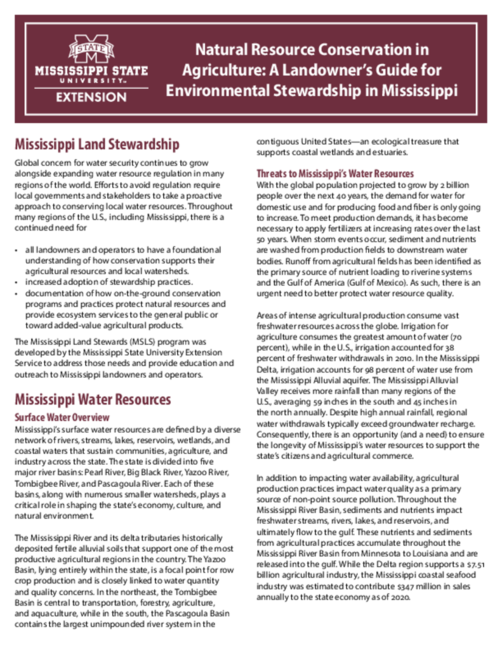
P3050
Natural Resource Conservation in Agriculture: A Landowner’s Guide for Environmental Stewardship in Mississippi
3.03 MB
Departments
Authors
-
 Assoc Professor & Assistant Di
- Wildlife, Fisheries & Aquaculture
-
 Extension Instructor I
- Wildlife, Fisheries & Aquaculture
-
 Associate Professor
- Plant and Soil Sciences
-
 Extension Associate I
- Wildlife, Fisheries & Aquaculture