P3425
Cover Crops: Seeding Rates and Planting Depths for Cool-Season Species
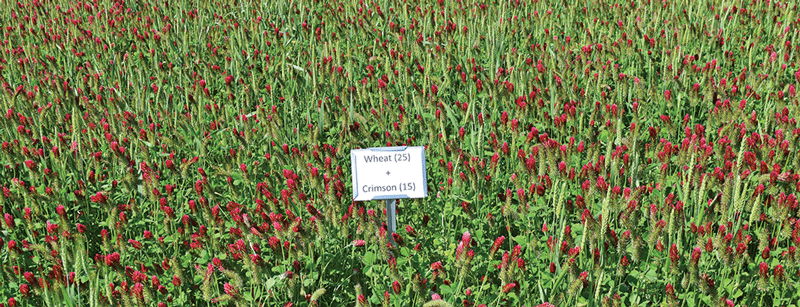
Cover crops are regaining the popularity they held in past years as a result of multiple factors, such as their ability to improve water quality and soil health, recycle nutrients from below the rooting zone, add organic matter and nitrogen into the soil, and reduce soil erosion.
To optimize benefits and positive returns on the investment, producers should manage several factors under their control:
- Plant high quality seed.
- Use the correct rhizobium inoculant on legumes.
- Decide on conventional or no-till system.
- Decide on broadcast or drill seeding method.
Always plant high quality seed. The seed label should indicate a recent test date and high germination percent, high pure seed percent, and few weed seeds. Poor seed quality will result in uneven stands, stunted growth, and limited benefits. Legumes require rhizobium bacteria to convert atmospheric nitrogen gas (N2) into the ammonia form (NH3) that plants can use. Some legume seeds are pretreated with adequate inoculant, while others have no inoculant. Inoculants are species-specific, so be sure to purchase the correct strain.
Cover crops must be planted at the correct seeding rates and depths for proper growth. Planting at a seeding rate that is too high increases seed costs and wastes money. Competition between individual plants will stunt growth and lead to poor performance. Seeding rates that are too low allow weeds to escape and compete with the cover crop for water, nutrients, and sunlight.
Improper planting depth is a common error. Planting too deeply may lead to seedlings dying before they emerge because they depleted their energy reserves before reaching sunlight. Weakened plants that do emerge will be stunted for the entire season and reduce the benefits. Shallow planting may lead to seedling death from desiccation if roots run out of moisture before becoming established. Shallow-rooted plants often remain stunted throughout the entire growing season and fail to achieve desired goals. A general rule is the smaller the seed, the shallower the planting depth.
You should consider the effects of any planting method, whether for cash or cover crop. The most common decisions are whether to plant into a conventional tillage or no-till seedbed and whether to broadcast or drill seed. Conventional tillage uses a prepared seedbed to increase the likelihood of successful establishment but increases land preparation, implement needs, and labor costs. No-till offers a wider planting window but requires an expensive drill. Weed control failures are more common in no-till systems, and seeding rates are increased slightly to compensate for weed competition.
Broadcast seeding uses a whirlwind-type seeder and is commonly used in conventional tillage because it allows seed to be covered with soil or pressed into the soil. Proper calibration is difficult. Increase seeding rates to compensate for poor seed-to-soil contact and poor uniformity of seed distribution. Broadcasting is not recommended when planting mixtures of species that require different planting depths. In this situation, drill seeding is preferred because it allows precise equipment calibration, allows proper seed depth and spacing, requires a lower seeding rate, and offers the highest probability of success.
Conventional tillage and no-till drills are often available for rent from local Natural Resource Conservation Service offices. For more information on cover crops or for help with calibration, contact your local MSU Extension office.
| Grasses | Single Species Seeding Rate (lb/acre) | Blend Seeding Rate (lb/acre) | Seeding Depth (inches) | Main Benefits |
|---|---|---|---|---|
| Cereal rye | 60–90 | 25–40 | 0.75–2 | Controls erosion, suppresses weeds, reduces compaction, builds organic matter, captures nutrients, has microbe activity |
| Oat | 70–110 | 30–50 | 0.5–1.5 | Controls erosion, suppresses weeds, reduces compaction, builds organic matter, captures nutrients, has microbe activity |
| Black oat | 50–70 | 20–40 | 0.75–1.5 | Controls erosion, suppresses weeds, builds organic matter, captures nutrients, suppresses nematodes, has microbe activity |
| Barley | 50–90 | 30–50 | 0.75–1.5 | Controls erosion, suppresses weeds, builds organic matter, captures nutrients, suppresses disease, has microbe activity |
| Wheat | 60–100 | 25–50 | 0.5–1.5 | Controls erosion, suppresses weeds, reduces compaction, builds organic matter, captures nutrients, has microbe activity |
| Legumes | Single Species Seeding Rate (lb/acre) | Blend Seeding Rate (lb/acre) | Seeding Depth (inches) | Main Benefits |
| Crimson clover | 20–30 PLS | 12–16 PLS | .25–0.5 | Suppresses weeds, fixes nitrogen, has microbe activity |
| Persian clover | 3–6 PLS | 3–5 PLS | 0.25–0.5 | Fixes nitrogen, has microbe activity |
| Subclover | 10–20 PLS | 8 PLS | 0.25–0.5 | Controls erosion, fixes nitrogen, has microbe activity |
| Hairy vetch | 25–30 | 20–25 | 0.5–1.5 | Controls erosion, suppresses weeds, fixes nitrogen, has microbe activity |
| Austrian winter pea | 60–90 | 30–40 | 1–3 | Fixes nitrogen, has microbe activity |
| Broadleaf | Single Species Seeding Rate (lb/acre) | Blend Seeding Rate (lb/acre) | Seeding Depth (inches) | Main Benefits |
| Oilseed and tillage radish | 8–12 | 3–6 | 0.25–0.5 | Controls erosion, reduces compaction, captures nutrients, suppresses nematodes, suppresses disease, has microbe activity |
| Brassica (rape, turnip, kale) | 8–14 | 3–6 | 0.25–0.75 | Controls erosion, reduces compaction, captures nutrients, suppresses nematodes, suppresses disease, has microbe activity |
Table notes:
- Single-species seeding rates are for broadcast; use lower rates in conventional tillage and higher in no-tillage systems. Rates can be reduced by 20 to 30 percent when using a seed drill. Source: Managing Cover Crops Profitably
- Species blends have lower seeding rates.
- Legume rates are for PLS (pure live seed). Legume seed pretreated with fungicide or inoculant will be approximately 50% seed and 50% treatment.

This work is supported by the Southern Sustainable Agriculture Research and Education program, award number rd309-137/s001396, subaward number 20163864025382, from the U.S. Department of Agriculture’s National Institute of Food and Agriculture. Any opinions, findings, conclusions, or recommendations expressed in this publication are those of the author(s) and should not be construed to represent any official USDA or U.S. Government determination or policy.
Publication 3425 (POD-04-26)
Reviewed by Amee Bumguardner, PhD, Assistant Professor, North Mississippi Research and Extension Center. Written by Bill Burdine, PhD, former Extension Specialist, Agronomic Crops.
The Mississippi State University Extension Service is working to ensure all web content is accessible to all users. If you need assistance accessing any of our content, please email the webteam or call 662-325-2262.
Download
P3425
Cover Crops: Seeding Rates and Planting Depths for Cool-Season Species
492.13 KB
Departments
Authors
-
 Assistant Professor
- North MS Research and Extension Ctr