P3330
Cover Crops: Benefits and Limitations
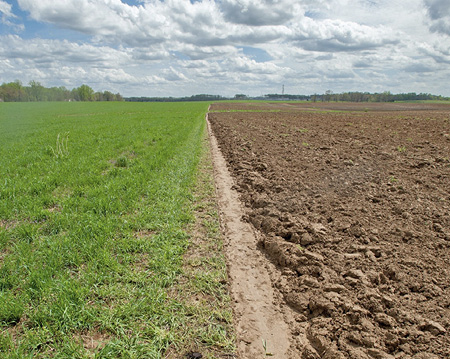
Cover crops are one of many management tactics that can help sustain and improve soil health. The USDA Natural Resources Conservation Service defines soil health or soil quality as the continued capacity of soil to function as a vital living ecosystem that sustains plants, animals, and humans. Protecting soils from degradation and runoff losses is vital to having a sustainable environment for the future.
Cover crops are typically planted during the off season when soils are vulnerable to erosion, compaction, and nutrient leaching. Bare soil is extremely susceptible to erosion because there are no root systems to hold soil in place. Bare fields also have no plant foliage to intercept raindrops. These raindrops act like miniature explosions each time they hit the soil surface, breaking apart soil aggregates (Figure 1).

In addition, the absence of living roots reduces food sources for earthworms and soil microorganisms such as nematodes, bacteria, fungi, and protozoa, which are responsible for decomposing organic matter, recycling nutrients, improving soil aggregation, and fixing nitrogen. With no living roots as a food source, microbe populations decline and reach an annual low just as cash crops are being planted. The low microbe population throws the natural cycle out of balance. Cash crops such as corn, cotton, and soybean lose valuable time for growth and yield as microbe populations take time to reestablish. Bare soil is undesirable for soil health. Having a living cover crop, even winter annual weeds, can prevent these issues and provide other benefits.
Winter cover crops are the most common cover used in the Midsouth. They are planted in the fall and terminated in spring. This allows fields to be protected in winter and early spring, then terminated just before planting of traditional cash crops. Summer cover crops are rare in Mississippi but can be useful in some situations. They can be used on fallow fields or recently land-formed fields to provide erosion protection, increase organic matter, and scavenge for lost nutrients. Newly land-formed fields often perform poorly for one or two years. Planting a cover crop can repopulate soil microbe levels and provide visual proof of areas needing additional improvements.
Every plant used as a cover has specific benefits and limitations. Success depends on having the right plant in the right place at the right time to get the desired benefits. Some cover crops excel at reducing erosion and breaking through hardpan soil areas but fall short in capturing atmospheric nitrogen. Most nitrogen-capturing plants are weak at weed and pest suppression and have a difficult time fracturing hardpan soil layers. Choosing the right plants is crucial.
Benefits
Grass species (rye, wheat, barley, oats, black oats, triticale) are typically a core component in a cover crop system because of their fibrous root systems that can be extensive in width and depth. They germinate fairly rapidly, and the foliage protects against raindrops that would dislodge soil particles. The fibrous roots intertwine to create a protective zone (similar to rebar or wire in concrete) that holds soil particles together and reduces erosion. Grass roots grow to depths of 2–4 feet, recycling nutrients that have leached below the root zone of many cash crops. These “lost” nutrients are stored in the grass and released to the cash crop after soil microbes have broken down the organic matter. Grasses have a place in almost all cover crop schemes.
Legume species (vetch, crimson clover, Persian clover, Austrian winter peas) can be a substantial addition to a cover crop program. These species are beneficial because they capture nitrogen gas from the atmosphere and convert it into soil nitrogen, thereby reducing the amount of nitrogen fertilizer that must be applied for the cash crop. Nitrogen assimilation rates vary by species, but most legumes will provide 50–150 pounds per acre of nitrogen. The total acquired depends on the environment, planting date, and termination date. The later they are terminated, the more nitrogen is accumulated. Legume seeds are more expensive than most plants, and proper inoculation is critical for success.
Inoculation (with the correct strain of rhizobium bacteria) allows the plant to furnish its own nitrogen and accumulate nitrogen for the future cash crop. If the legume has not been grown for 3 years, inoculation is highly recommended. Inoculants are species-specific, living organisms that must be protected from heat and sunlight. Most legume failures are the result of not inoculating. Many retail suppliers no longer carry inoculant, so plan ahead and find a reliable source.
Other broadleaf plants (radish, mustard, turnip, kale, rape) commonly used are from the Brassica genus. These plants reduce soil erosion through quick germination and establishment. The ability of these broadleaf plants to scavenge for nitrogen, phosphorus, and potassium is very high and can reduce future fertilizer needs. Some brassicas can penetrate compacted soil, enabling future cash crop roots to reach leached nutrients and access deep moisture during droughty periods. Brassicas also provide some benefits that grasses and legumes cannot offer. They are allelopathic, meaning they release chemical compounds that harm some organisms. Some species of brassicas have been documented to suppress weed germination, lower nematode populations, and even show toxicity to some disease fungi.
Limitations
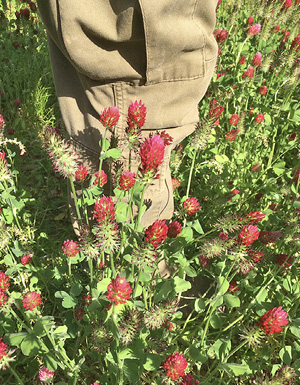
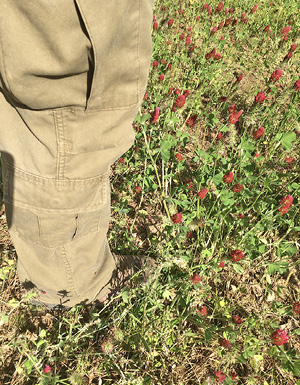
All cover crops have limitations, as no plant can provide every desired benefit. Major limitations include the cost to establish cover crops, the time required to plant during the busy harvest season, and required additional management/planning. Establishment costs can be offset through NRCS cost-share programs. Planting cover crops during harvest can be frustrating when harvest is the top priority. Keeping in mind the long-term goals of the cover crop can help reduce this stress. Additionally, soil characteristics can affect cover crop performance. Poor drainage can restrict growth and potential benefits, as shown by the crimson clover in Figure 2. Producers must know their field characteristics, optimum planting dates, when the majority of N is accumulated, and what expenses can be justified. Knowing the limitations will prevent many disappointments along the way.
Summary
Cover crops were widely accepted years ago, but the practice declined over time. Recent trends in no-till and conservation-till systems are bringing more attention back to this practice. While they have some limitations, cover crops should be considered by anyone wishing to improve overall soil health and ensure a sustainable environment.

This work is supported by the Southern Sustainable Agriculture Research and Education program, award number rd309-137/s001396, subaward number 20163864025382, from the U.S. Department of Agriculture’s National Institute of Food and Agriculture. Any opinions, findings, conclusions, or recommendations expressed in this publication are those of the author(s) and should not be construed to represent any official USDA or U.S. Government determination or policy.
Publication 3330 (POD-03-26)
Reviewed by Amee Bumguardner, PhD, Assistant Professor, North Mississippi Research and Extension Center. Written by Bill Burdine, PhD, former Extension Specialist, Agronomic Crops.
The Mississippi State University Extension Service is working to ensure all web content is accessible to all users. If you need assistance accessing any of our content, please email the webteam or call 662-325-2262.
Download
P3330
Cover Crops: Benefits and Limitations
510.87 KB
Departments
Authors
-
 Assistant Professor
- North MS Research and Extension Ctr