P4186
Cover Crop Seeding Methods for Midsouth Cropping Systems
Cover crops can be seeded in agricultural fields using various methods used to plant small grains or forages. These seeding methods commonly range from using a grain drill to broadcasting. Using a drill offers more control of seeding rate, distribution, and placement, including the ability to cover seed with soil and improve contact with moisture. However, not everyone has a drill, and there are some complications that may limit results of drilling cover crop seed. On the other hand, broadcast seeding is a simple and efficient method that can also be used to establish cover crops in Mississippi agricultural fields.
Row crops are commonly grown on raised beds in the Midsouth. Raised beds are created using tillage in the fall and lay undisturbed over the winter to facilitate spring planting and improve drainage. This is a critical component of stale seedbed systems, which promote early planting and improve row crop productivity. Raised beds help alleviate detrimental effects of soil saturation and often facilitate supplemental irrigation, but they present challenges for seeding cover crops. The asymmetrical soil surface of raised beds makes it difficult for a drill to attain uniform seeding depth in this system. However, drills do offer an opportunity to manipulate the lateral placement of seed. Alternatively, broadcast seeding is a practical seeding method for raised bed systems.
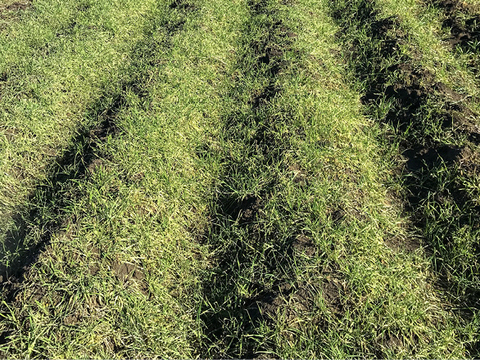
Cover crops normally consist of a mixture of cereal grain species, legumes, and brassicas, which may differ dramatically in seed size and emergence capability. Therefore, you will likely need to adapt practices to establish multiple species. Small-seeded legumes are suited to emerge from very shallow soil depth (less than 0.25 inches), while the optimum seeding depth for cereals is considerably deeper (1 inch). Accordingly, a grain drill’s objective of placing cereal grain seed at a moderate depth may hamper emergence success of clovers by placing them too deep, particularly in conventional-tilled seedbeds. Therefore, we suggest using shallow seed placement if you plant a cover crop mixture with a drill. Broadcasting is a viable compromise that can also be used to seed cover crop blends.
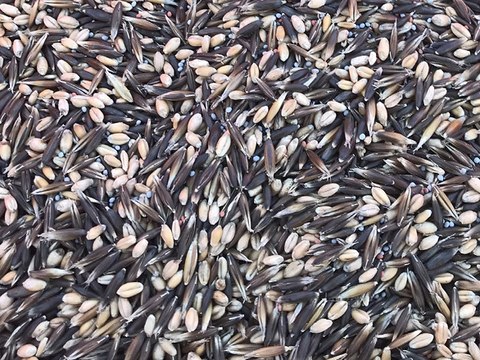
Broadcast seeding on freshly tilled soil enhances seed-to-soil contact and typically produces successful cover crop establishment. Of course, seed germination depends on sufficient fall rainfall, but our high-rainfall climate is normally conducive for successful cover crop establishment. Hard-packed soil or no- tillage systems may limit seed-to-soil contact and make germination more reliant upon ample rainfall and moist soil. For instance, using a bedder-roller, which packs beds, or receiving a hard rain, which compacts soil, before seeding will limit cover crop establishment. Thus, it is reasonable to increase seeding rates for no-tillage or other difficult conditions.
The purpose of cover crops is to provide sufficient soil coverage and generate beneficial plant biomass during fallow periods. Thus, typical cover crop seeding rates are more modest than rates for grain or forage production. Furthermore, high seeding rates increase expense and reduce profitability. Since cover crops are usually comprised of a blend of cereals and legumes, seeding rates of each species are reduced relative to their proportion of the mixture (50 percent for a 1:1 blend), compared to a standard monoculture rate.
Normal seeding rates for various cover crop species. The seeding rate for a blend is for a 1:1 mixture where each species comprises 50 percent of the blend. Adjust rates according to the number of species desired and the proportion of each.
| Cover Crop | Seeding Rate Alone (lb/a) | Seeding Rate in a Blend (lb/a) |
|---|---|---|
| Cereal rye | 30–40 | 15–25 |
| Wheat | 40–60 | 20–30 |
| Oats | 30–50 | 15–25 |
| Triticale | 35–55 | 18–28 |
| Crimson clover | 12–20 | 6–10 |
| Hairy vetch | 12–20 | 6–10 |
| Berseem clover | 10–18 | 5–9 |
| Persian clover | 8–10 | 4–5 |
| Balansa clover | 6–8 | 3–4 |
| Tillage radish | 5–10 | 1 |
| Rape | 3–4 | 0.25–0.5 |
| Turnips | 2–3 | 0.25–0.5 |
Publication 4186 (POD-04-26)
By Erick Larson, PhD, Professor and Extension Corn Specialist, Plant and Soil Sciences; Jason Krutz, PhD, Vice President of Research and Sustainability, Chicot Irrigation; Rocky Lemus, PhD, Extension/Research Professor, Plant and Soil Sciences; Jason Bond, PhD, Extension/Research Professor, Delta Research and Extension Center; Will Maples, PhD, Associate Professor, Agricultural Economics; and Dave Spencer, PhD, Assistant Professor, Water Resources Research Institute.
The Mississippi State University Extension Service is working to ensure all web content is accessible to all users. If you need assistance accessing any of our content, please email the webteam or call 662-325-2262.
Download
P4186
Cover Crop Seeding Methods for Midsouth Cropping Systems
1013.48 KB
Departments
Authors
-
 Extension/Research Professor
- Plant and Soil Sciences
-
 Associate Professor
- Water Resources Research Institute
-
 Extension/Research Professor
- Delta Research and Extension Center
-
 Extension/Research Professor
- Plant and Soil Sciences
-
 Associate Professor
- Agricultural Economics