P4184
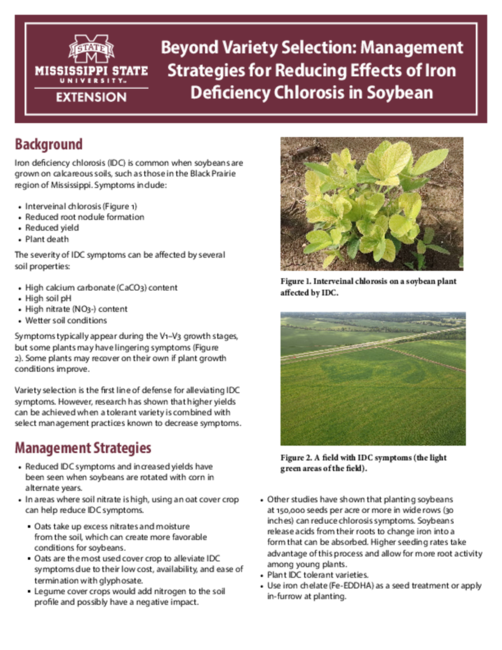
Beyond Variety Selection: Management Strategies for Reducing Effects of Iron Deficiency Chlorosis in Soybean
Background
Iron deficiency chlorosis (IDC) is common when soybeans are grown on calcareous soils, such as those in the Black Prairie region of Mississippi. Symptoms include:
- Interveinal chlorosis (Figure 1)
- Reduced root nodule formation
- Reduced yield
- Plant death
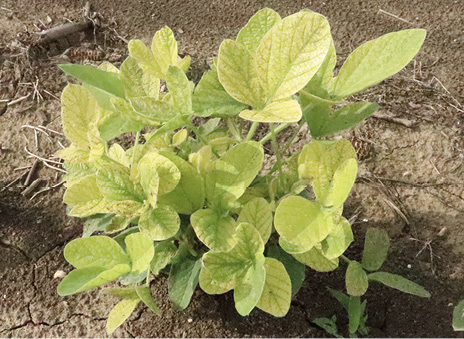
The severity of IDC symptoms can be affected by several soil properties:
- High calcium carbonate (CaCO3) content
- High soil pH
- High nitrate (NO3-) content
- Wetter soil conditions
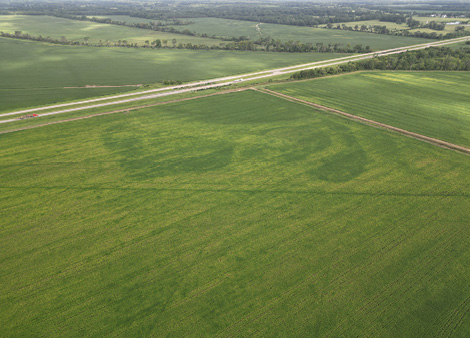
Symptoms typically appear during the V1–V3 growth stages, but some plants may have lingering symptoms (Figure 2). Some plants may recover on their own if plant growth conditions improve.
Variety selection is the first line of defense for alleviating IDC symptoms. However, research has shown that higher yields can be achieved when a tolerant variety is combined with select management practices known to decrease symptoms.
Management Strategies
- Reduced IDC symptoms and increased yields have been seen when soybeans are rotated with corn in alternate years.
- In areas where soil nitrate is high, using an oat cover crop can help reduce IDC symptoms.
- Oats take up excess nitrates and moisture from the soil, which can create more favorable conditions for soybeans.
- Oats are the most used cover crop to alleviate IDC symptoms due to their low cost, availability, and ease of termination with glyphosate.
- Legume cover crops would add nitrogen to the soil profile and possibly have a negative impact.
- Other studies have shown that planting soybeans at 150,000 seeds per acre or more in wide rows (30 inches) can reduce chlorosis symptoms. Soybeans release acids from their roots to change iron into a form that can be absorbed. Higher seeding rates take advantage of this process and allow for more root activity among young plants.
- Plant IDC tolerant varieties.
- Use iron chelate (Fe-EDDHA) as a seed treatment or apply in-furrow at planting.
Plot Study
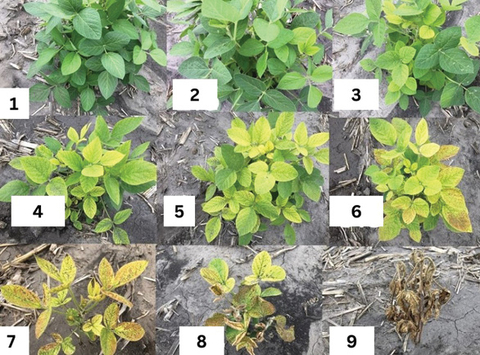
From 2019 to 2022, seven different cropping systems were tested, along with two seeding rates (160,000 and 120,000 seeds per acre) and six selected varieties (three more-IDC tolerant and three less-IDC tolerant) (Table 1). Visual ratings were taken weekly throughout the growing season starting at V2 growth stage (Figure 3). Less severe IDC symptoms resulted in a lower rating, while more severe symptoms resulted in a higher rating. Grain yield was harvested for each plot.
| System | Seeds per acre |
|---|---|
| Planting after corn | 160,000 |
| Planting after corn + oat cover | 160,000 |
| Planting after soybean + oat cover | 160,000 |
| Planting after soybean + oat cover + roller | 160,000 |
| Planting after soybean + roller | 160,000 |
| Planting after soybean + roller | 120,000 |
| Planting after soybean | 160,000 |
Results
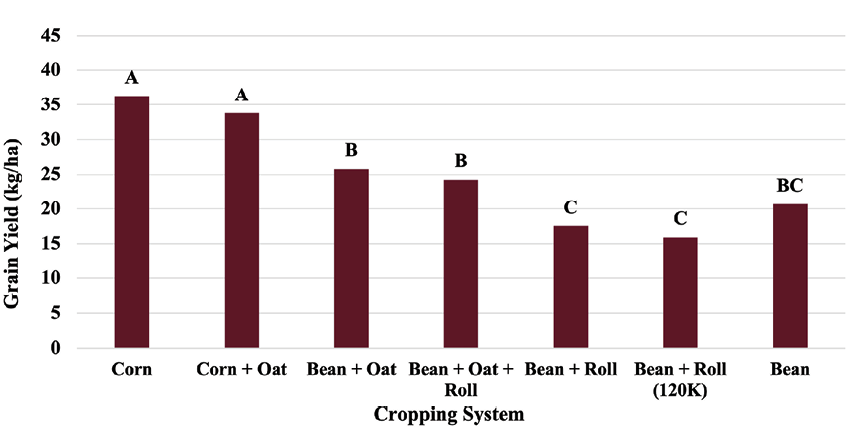
- Cropping systems containing a corn rotation in alternate years produced significantly higher grain yield than the other five systems (Figure 4).
- Cropping systems planted in continuous soybeans yielded significantly higher with an oat cover crop than continuous soybeans with no cover crop and simulated compaction.
- Symptoms still occurred in corn rotation, but cropping systems containing a corn rotation had lower IDC ratings than cropping systems in continuous soybeans (Figure 5).
| Cropping System | Yield (bu/ac) | Tukey Group |
|---|---|---|
| Corn | 32.6 | A |
| Corn + Oat | 30.5 | A |
| Bean + Oat | 22.0 | B |
| Bean + Oat + Roll | 21.2 | B |
| Bean + Roll | 12.7 | C |
| Bean + Roll (120K) | 11.6 | C |
| Bean | 16.6 | BC |
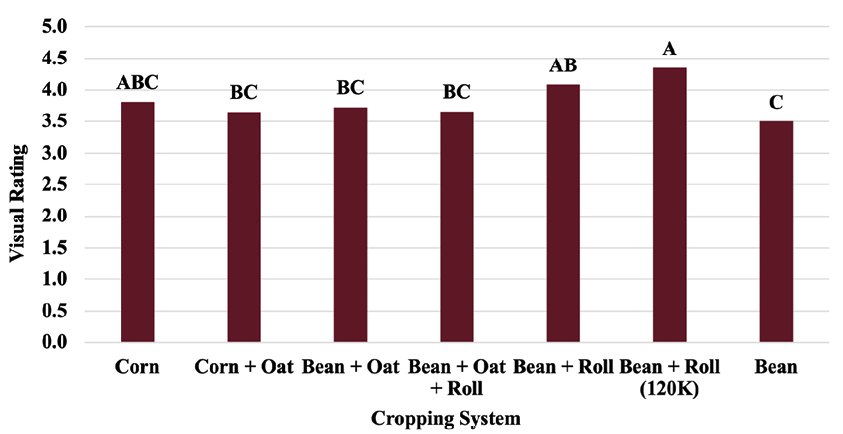
| Cropping System | Rating | Tukey Group |
|---|---|---|
| Corn | 3.8 | ABC |
| Corn + Oat | 3.7 | BC |
| Bean + Oat | 3.7 | BC |
| Bean + Oat + Roll | 3.7 | BC |
| Bean + Roll | 4.1 | AB |
| Bean + Roll (120K) | 4.3 | A |
| Bean | 3.5 | C |
Recommendations
- Plant IDC tolerant varieties.
- Rotate corn and soybeans in alternate years.
- Incorporate an oat cover crop in fields planted in continuous soybeans.
- Reduce saturated soil conditions if possible.
- Identify areas historically prone to IDC for management.
References
Bloom, P. R., Rehm, G. W., Lamb, J. A., & Scobbie, A. J. (2011). Soil nitrate is a causative factor in iron deficiency chlorosis in soybeans. Soil Science Society of America Journal, 75(6), 2233–2241.
Kaiser, D. E., Lamb, J. A., Bloom, P. R., & Hernandez, J. A. (2014). Comparison of field management strategies for preventing iron deficiency chlorosis in soybean. Agronomy Journal, 106(6), 1963–1974.
Merry, R., Dobbels, A. A., Sadok, W., Naeve, S., Stupar, R. M., & Lorenz, A. J. (2022). Iron deficiency in soybean. Crop Science, 62, 36–52.
Naeve, S. L. (2006). Iron deficiency chlorosis in soybean: Soybean seeding rate and companion crop effects. Agronomy Journal, 98(6), 1575–1581.
Rout, G. R., & Sahoo, S. (2015). Role of iron in plant growth and metabolism. Reviews in Agricultural Science, 3(0), 1–24.
Waldrep, K. S., Tagert, M. L. M., Reginelli, D. B., and McCoy, J. M. (2025). Using a cropping system approach to manage iron deficiency chlorosis in soybean. Field Crops Research, 322(1), 109731.
Wiersma, J. V. (2007). Iron acquisition of three soybean varieties grown at five seeding densities and five rates of Fe–EDDHA. Agronomy Journal, 99(4), 1018–1028.

The Mississippi Soybean Promotion Board provided funding for this project.
Publication 4184 (POD-04-26)
By John Cooper Little, Graduate Student, Mary Love Tagert, PhD, Extension Professor, and Katelin Waldrep, Master’s Student, Agricultural and Biological Engineering; Amee Bumguardner, PhD, Assistant Professor, North Mississippi Research and Extension Center; and Nuwan Wijewardane, PhD, Assistant Professor, Agricultural and Biological Engineering.
The Mississippi State University Extension Service is working to ensure all web content is accessible to all users. If you need assistance accessing any of our content, please email the webteam or call 662-325-2262.
Download
P4184
Beyond Variety Selection: Management Strategies for Reducing Effects of Iron Deficiency Chlorosis in Soybean
869.14 KB
Departments
Authors
-
 Extension Professor
- Ag & Bio Engineering
-
 Assistant Professor
- North MS Research and Extension Ctr