P4189
Strengthening On-Farm Experimentation Through Collaborative, Place-Based Approaches
Why On-Farm Experimentation Matters
Farmers make critical decisions each growing season to optimize yields, manage costs, and maintain their business, while also stewarding their land and water resources for future generations. These decisions are informed by multiple sources, including Extension agents, agricultural consultants, fellow producers, on-farm trials, and research conducted by land-grant universities. Access to timely, relevant, and reliable information is essential as environmental, economic, and management pressures continue to change. In this context, on-farm experimentation (OFE) has become an important approach for evaluating practices under real-world conditions.
Allowing technologies and management strategies to be tested on working farms, OFE aims to capture differences across fields, seasons, and management systems while supporting learning and decision-making at the farm level. Instead of replacing experiment station research, OFE complements it by contributing equally important evidence through insights based on varied farm conditions and locations (Table 1).
| Experiment Station Research | On-Farm Experimentation |
|---|---|
| Controlled research settings | Working farm conditions |
| Standardized designs | Flexible designs for working farm conditions |
| Controlled variability | Field-level variability |
| Hypothesis-driven research | Decision-driven, farm-relevant questions |
| Strong evidence through controlled replication | Strong evidence through combining data across farms |
Recognizing the value of OFE, Mississippi State University (MSU) researchers implemented the project Partners in Success: Expanding the Intersection Between Producer Experimentation and University Research, funded by the U.S. Department of Agriculture National Institute of Food and Agriculture (USDA-NIFA). This Extension brief draws from project evaluation and learning activities to share practical insights and lessons learned that inform future OFE efforts.
On-Farm Experimentation in Practice
OFE is conducted within and across working farms that vary widely in crops and rotations, equipment and labor availability, and management systems. Producers also differ in their ability to tolerate risk and adjust practices due to input costs, timing pressures (e.g., weather), planting windows, and harvest schedules. As a result, OFE does not look the same across operations; instead, a key advantage is its ability to accommodate differences.
Flexibility in trial design, data collection, and implementation allows experimentation to remain relevant and adaptable to farm operations. Building on this shared understanding, the Partners in Success project recognized that the wide range of existing OFE guides reflects differences in producer experience, skill levels, and farm capacities, making one-size-fits-all approaches difficult to apply in practice.
To support experimentation across this range of conditions, Partners in Success developed practical tools intended to reduce difficulty while maintaining usefulness for both producers and researchers. These include the Mississippi State University Extension Publication 3930 Adding RIGOR to On-Farm Trials: Simple Steps to Data-Driven Decision Making, a practical resource guide designed to help structure and implement on-farm experiments in ways that are possible within working farm operations, and the use of visual fishbone models to help clarify differences and overlaps between researcher-driven experimental designs and producer-driven approaches to data collection. These resources are part of a growing body of tools used by researchers to support OFE.
Public-Private Collaborations Are Key Ingredients for On-Farm Experimentation Success
In practice, OFE is typically organized around a shared goal of testing management questions under real-world conditions. While specific designs and levels of formality vary, successful OFE efforts depend on coordination among multiple actors—including producers, researchers, Extension professionals, and private sector partners—who contribute different but complementary forms of expertise. Together, these actors help ensure that experiments remain relevant to producer decision-making, adoptable within working farming systems, and helpful beyond a single operation. In the Partners in Success project, “translators” were intended to play a key role in bridging research and producer contexts, supporting communication, implementation, and learning across partners.
Roles That Support Effective On-Farm Experimentation
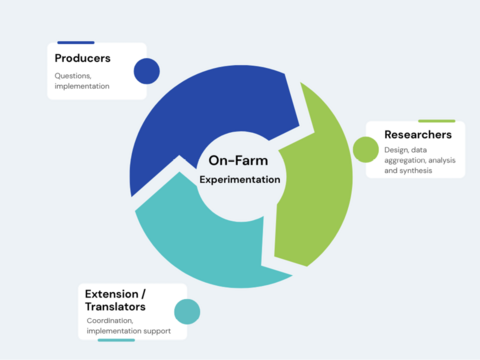
Within OFE, producers identify practical questions and implement trials within their operations’ limits, contributing essential background and experiential knowledge to make sense of the results. Researchers provide methodological guidance, support experimental design and data analysis, and help position findings within a broader evidence base. Extension professionals and other translators bridge these perspectives by aligning research objectives with on-farm realities, supporting implementation and communication throughout the life of a trial. Here, this bridge function was facilitated by Extension professionals.
However, in other OFE settings, this role can be filled by crop consultants, retail agronomists, conservation professionals, or even experienced producers who facilitate peer learning. Engaging these three distinct but complementary roles forms an interconnected system that supports farm-level learning and broader research and Extension goals. These roles function as part of an iterative, multi-actor process in which responsibilities are distinct but complementary (Figure 1).
Lessons from Practice: What Supports On-Farm Experimentation
This section draws on interviews with producers, researchers, and translators involved in OFE to highlight practical lessons that support effective implementation. While many OFE principles are well-documented, interviews conducted for the evaluation and learning of the Partners in Success project illustrate how such principles are interpreted and applied within Mississippi’s production and Extension.
Lesson 1: Clarifying Farm-Relevant Questions Early
Interviews across stakeholder groups emphasized the importance of clearly defining on-farm experiments in ways that connect clearly with farm-level decision-making. While researchers may begin with specific research objectives, producers are more likely to engage when questions address feasibility, risk, and day-to-day management within a growing season. Early conversations (before trials are implemented) were described as critical for aligning expectations around timelines, data collection requirements, and how results would be used. When research questions were framed in ways that related directly to farm operations, producers were more likely to remain engaged throughout the season and, in some cases, across multiple years.
“You’ve really got to understand what the farmers’ needs are. Needs identification always comes first. Farms are very dynamic, and every farmer faces a different set of challenges and constraints.”
— Interview with Translator
Lesson 2: Keep Data Collection Practical and Supported
Interviews across stakeholder groups (including researchers, translators, and producers) emphasized that the success of OFE depends not only on the relevance of the research question, but also on whether data collection approaches fit within day-to-day farm operations. Even well-designed experiments were described as difficult to implement when data collection requirements are not clearly defined or do not align with seasonal farm workflows. On the other hand, when data collection does not align with the original experimental design, results may have limited value beyond an individual operation.
“The equipment farmers use now captures so much data. They’re not doing anything extra—they’re just getting in their equipment and logging what they already do. That makes it a lot easier to do these trials.”
— Interview with Translator
Across the interviews, participants highlighted the importance of practical, low-burden data collection approaches that build on information already generated by farmers as part of routine operations (e.g., yield data, remote sensing), instead of introducing new or complex requirements. Researchers from other states noted that using recognizable formats made it easier for Extension professionals to support data entry, standardization, and quality checks, while allowing researchers to handle data cleaning, aggregation, and analysis. In this context, the Partners in Success project contributed to a broader body of low-burden tools and design approaches that emphasize simplicity and feasibility as core design principles. For this project, tools like the RIGOR guide and fishbone models were designed to document research design considerations, help clarify assumptions, and support alignment between research objectives and farm data needs.
Interviews also highlighted the critical role that Extension professionals and other translators play in supporting data collection for OFE. By helping interpret data requirements, providing hands-on support, and troubleshooting challenges as they arise, these actors help ensure that data collection remains possible at the farm level while maintaining consistency across sites. When practical approaches were paired with active support from translators or Extension personnel, experimentation felt more achievable and better connected to both farm decision-making and broader research and Extension goals.
“Our role is to take what farmers are already generating and make it usable at scale. The farmer shouldn’t have to worry about cleaning or analyzing data—that’s on us.”
— Interview with Researcher
Lesson 3: Communication Is Ongoing, Not One-Time
During interviews, participants highlighted that effective OFE depends on ongoing communication throughout the life of a trial, instead of a single planning conversation. While early agreement on research questions and data collection is important, regular check-ins during the growing season were described as essential for responding to changing conditions, clarifying expectations, adjusting data collection approaches, and interpreting emerging observations before the end of the season. These feedback loops helped ensure that experiments remained relevant and responsive to real-world conditions.
“Dialogue is important. It’s about having a place where people with questions and people with answers can keep talking.”
— Interview with Producer
Extension professionals and other translators were frequently identified as key facilitators of this ongoing communication. By serving as consistent points of contact, these actors help bridge research and farm contexts, support troubleshooting, and reinforce shared understanding among partners. Interviewees suggested that when communication was maintained throughout implementation, producers were more likely to stay engaged and view experimentation as a collaborative learning process instead of a one-time activity.
Lesson 4: Relationships Take Time
Interviews highlighted that trust and effective collaboration develop gradually through repeated interactions, shared experience, and follow-through across seasons. Producers describe feeling more comfortable adjusting trials, discussing challenges, and continuing experimentation when working relationships—with researchers, Extension professionals, or other partners like private sector consultants—were familiar and reliable.
“If you have a grower that others trust and see doing well, that helps bring other growers in. That’s how you build your pool over time.”
— Interview with Researcher/Translator
Researchers and translators both emphasized that sustained engagement supported clearer communication, stronger interpretation of results, and a deeper understanding of farm contexts. Over time, these relationships reduced barriers to participation and strengthened the long-term value of OFE efforts for all actors involved.
These lessons suggest that effective OFE depends on clear and complementary roles, practical tools, ongoing communication, and sustained relationships tailored to local contexts and nurtured over time.
Practical Considerations for Extension and Research Teams
Insights from the Partners in Success evaluation and learning suggest the following considerations for Extension professionals, researchers, and partners to support effective OFE:
Connect Research Goals with Farm Realities
While research priorities are often shaped by funding opportunities and institutional goals, early engagement with producers can help ensure that proposed questions connect meaningfully to farm-level decision-making within a growing season.
Provide Clarity About Trial Participation
Communicate upfront about time commitments, data collection expectations, and how results will be used. Clarity reduces uncertainty and supports sustained engagement.
Design for Farm Realities
Develop trials that align with existing farm workflows, labor limits, and seasonal changes. Plan data collection and management approaches before the season begins to support feasibility and consistency.
Keep Data Collection Practical
Build on information farmers already generate (e.g., yield data, routine field records). Use structured yet simple tools that reduce additional burden while supporting data quality and comparability.
Share Results in Usable Format
Provide summaries that highlight management implications and local relevance. Clear, accessible reporting reinforces the value of participation and supports continued interest in OFE.

This work is supported by the Critical Agriculture Research and Extension Program, project award no. 2022-68008-36356, from the U.S. Department of Agriculture’s National Institute of Food and Agriculture.
Any opinions, findings, conclusions, or recommendations expressed in this publication are those of the author(s) and should not be construed to represent any official USDA or U.S. Government determination or policy.
Publication 4189 (POD-04-26)
By Gina Rico Mendez, PhD, Assistant Research Professor, Social Science Research Center, Beth Baker, PhD, Associate Extension Professor and Assistant Director, Wildlife, Fisheries, and Aquaculture, Joby M. Prince Czarnecki, PhD, Associate Research Professor, Geosystems Research Institute.
The Mississippi State University Extension Service is working to ensure all web content is accessible to all users. If you need assistance accessing any of our content, please email the webteam or call 662-325-2262.
Download
P4189
Strengthening On-Farm Experimentation Through Collaborative, Place-Based Approaches
208.91 KB
Authors
-
 Assoc Professor & Assistant Di
- Wildlife, Fisheries & Aquaculture
-
 Associate Research Professor
- Geosystems Research Institute