P4230
Planting Date and ThryvOn Cotton: Reducing Tarnished Plant Bug Pressure in Mississippi
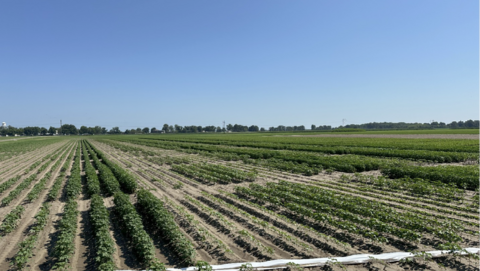
Why Planting Date Matters
The tarnished plant bug (TPB) remains the most costly insect pest of cotton in the Mid-South. Mississippi growers commonly make five insecticide applications each year for TPB management, although that number can range from three to seven depending on the year and location.
One of the easiest ways to reduce TPB pressure is to plant cotton earlier. Earlier-planted cotton reaches its most vulnerable growth stages before plant bug populations reach their seasonal peak. More recently, growers have also gained another management tool with the introduction of ThryvOn cotton, which supresses tarnished plant bugs and helps reduce insecticide requirements.
This study evaluated how planting date and ThryvOn technology work together to influence TPB pressure, insecticide use, and cotton yield in the Mississippi Delta.
Field Trials
Research was conducted at the Delta Research and Extension Center in Stoneville, Mississippi, during the 2024 and 2025 growing seasons. Multiple planting dates were evaluated using both ThryvOn and non-ThryvOn cotton. Plots were managed using current Mississippi tarnished plant bug thresholds, and both insecticide-treated and untreated plots were included to evaluate yield protection.
What We Found
Earlier Planting Reduced Insecticide Applications
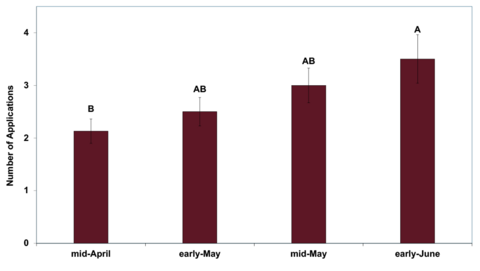
Cotton planted in mid-April or early May required fewer insecticide applications than cotton planted later in the season (Figure 1).
On average:
- Mid-April planted cotton required about 2.1 applications for TPB.
- Early-June planted cotton required about 3.5 applications.
Earlier planting allowed cotton to set and retain more fruit before plant bug populations increased later in the summer.
ThryvOn Reduced TPB Pressure
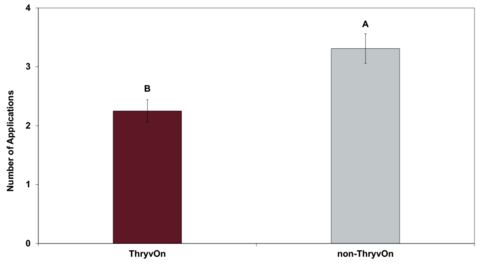
Across every planting date, ThryvOn cotton had fewer tarnished plant bugs than non-ThryvOn cotton. As a result, fewer foliar insecticide applications were needed to maintain plant bug populations below threshold (Figure 2).
Across all planting dates:
- ThryvOn cotton averaged 2.25 insecticide applications.
- Non-ThryvOn cotton averaged 3.31 insecticide applications.
This represents roughly one fewer insecticide application per season when using ThryvOn technology.
Earlier Planting Delayed TPB Outbreaks
Planting date also influenced when plant bugs became a problem. For cotton planted from mid-April through early May, treatment thresholds generally were not reached until the third week of bloom.
When planting was delayed until mid-May or early June, thresholds were exceeded much earlier, between the second and third week of squaring. Generally, earlier-planted cotton escaped much of the early-season plant bug pressure.
Yield Response
ThryvOn cotton produced its highest lint yields when planted during the early- to mid-May planting window (Figure 3).
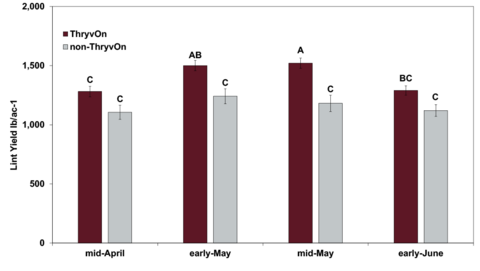
Across all planting dates, insecticide-treated plots yielded more than untreated plots in both cotton technologies. However, untreated ThryvOn cotton yielded similarly to insecticide-treated non-ThryvOn cotton, demonstrating that ThryvOn provides meaningful protection against TPB injury.
These results also suggest that current TPB thresholds for ThryvOn cotton would need further study. While supplemental insecticide applications are still needed when thresholds are exceeded, future research may identify opportunities to further reduce insecticide use without sacrificing yield.
Take-Home Messages
Planting cotton earlier reduced tarnished plant bug pressure and lowered the number of insecticide applications required.
ThryvOn cotton required fewer insecticide applications than non-ThryvOn cotton.
Earlier planting delayed the timing of TPB infestations, allowing the crop to retain more early fruit before plant bug populations increased.
The best yields for ThryvOn cotton occurred when planting was completed during the early- to mid-May window.
ThryvOn does not eliminate the need for scouting or supplemental insecticide applications, but it provides growers with greater flexibility for managing tarnished plant bugs.
Additional research is needed to determine whether economic thresholds can be adjusted specifically for ThryvOn cotton.
The information given here is for educational purposes only. References to commercial products, trade names, or suppliers are made with the understanding that no endorsement is implied and that no discrimination against other products or suppliers is intended.
Publication 4230 (POD-10-26)
By Hunter Lipsey, Graduate Student, Life Sciences; Don Cook, PhD, Associate Research Professor, Delta Research and Extension Center; Whitney Crow, PhD, Associate Professor, Agricultural Science and Plant Protection; Brian Pieralisi, PhD, Associate Professor, Plant and Soil Sciences; Fred Musser, PhD, Professor, Agricultural Science and Plant Protection, Corey Bryant, PhD, Assistant Professor, Delta Research and Extension Center; and Tyler Towles, PhD, Assistant Professor, Delta Research and Extension Center.
The Mississippi State University Extension Service is working to ensure all web content is accessible to all users. If you need assistance accessing any of our content, please email the webteam or call 662-325-2262.
Download
P4230
Planting Date and ThryvOn Cotton: Reducing Tarnished Plant Bug Pressure in Mississippi
332.56 KB
Departments
Authors
-
 Assistant Professor
- Delta Research and Extension Center
-
 Associate Professor
- Agricultural Science & Plant Protec
-
 Associate Professor
- Plant and Soil Sciences