P3368
Environmental Control for Greenhouse-Grown Sweetpotato Slips
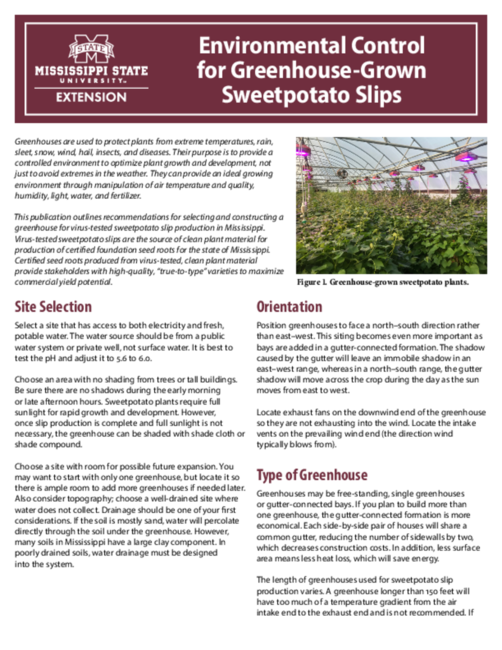
Greenhouses are used to protect plants from extreme temperatures, rain, sleet, snow, wind, hail, insects, and diseases. Their purpose is to provide a controlled environment to optimize plant growth and development, not just to avoid extremes in the weather. They can provide an ideal growing environment through manipulation of air temperature and quality, humidity, light, water, and fertilizer.
This publication outlines recommendations for selecting and constructing a greenhouse for virus-tested sweetpotato slip production in Mississippi. Virus-tested sweetpotato slips are the source of clean plant material for production of certified foundation seed roots for the state of Mississippi. Certified seed roots produced from virus-tested, clean plant material provide stakeholders with high-quality, “true-to-type” varieties to maximize commercial yield potential.
Download the PDF for the full publication.
Publication 3368 (POD-12-25)
Reviewed by Lorin Harvey, PhD, Extension Sweetpotato Specialist and Assistant Professor, Pontotoc Ridge-Flatwoods Branch Experiment Station. Written by Callie J. Morris, Research Associate III, Pontotoc Ridge-Flatwoods Branch Experiment Station; Richard G. Snyder, PhD, Extension/Research Professor (retired); Stephen L. Meyers, PhD, former Assistant Extension/Research Professor; Jeffrey L. Main, former Research Associate; and Mark W. Shankle, PhD, former Research Professor.
The Mississippi State University Extension Service is working to ensure all web content is accessible to all users. If you need assistance accessing any of our content, please email the webteam or call 662-325-2262.
Download
P3368
Environmental Control for Greenhouse-Grown Sweetpotato Slips
935.47 KB
Authors
-
 Assistant Professor
- Pontotoc Ridge-Flatwoods Branch Exp