P3831
Considerations for Replant Decisions in Soybean
Replant decisions typically fall into one of three categories:
- keep the crop as is,
- replant it all, or
- plant a reduced seeding rate into the existing stand.
The decisions to keep the stand or to terminate and start over are generally the simplest. Fields with marginal stands that appear to be thin yet uniform often present more difficult decisions. Usually in these situations, a supplemental planting with a reduced seeding rate is used to bring the total plant population up to the desired level. However, little research has specifically addressed whether the added plants improve soybean yield and profitability.
Research was conducted in Mississippi to evaluate soybean yield at various stands and replanting approaches. The target seeding rate was 130,000 seeds per acre. Several removal and replant treatments were imposed to simulate marginal stands and replant methods commonly used in the field. The treatments listed in Table 1 are expressed as percentage of stand loss relative to the initial planting and replanted density.
| Existing population description | Replant treatment | Percent stand loss from initial planting1 | Percent of target population to replant2 | Percent of target population achieved3 |
|---|---|---|---|---|
| Target population achieved | None | 0 | 0 | 100 |
| Some stand loss | Reduced rate planted into existing stand | 25 | 25 | 100 |
| Some stand loss | Keep as is | 25 | 0 | 75 |
| Moderate stand loss | Reduced rate planted into existing stand | 50 | 50 | 100 |
| Moderate stand loss | Keep as is | 50 | 0 | 50 |
| Severe stand loss | Reduced rate planted into existing stand | 75 | 75 | 100 |
| Severe stand loss | Keep as is | 75 | 0 | 25 |
| Terminate failed stand | Full replant | 100 | 100 | 100 |
1Percent loss from targeted population following initial planting.
2Percent of targeted population to replant into existing soybean stand.
3Percent of overall targeted population achieved either with initial planting alone or between initial planting and one replant attempt.
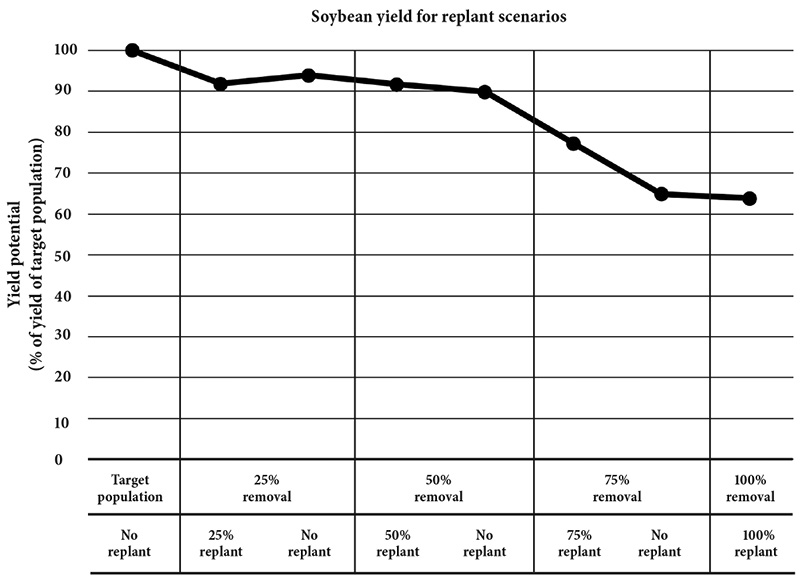
Yield results are displayed in Figure 1. When the soybean stand was 50 percent or more of the intended population, replanting into the existing soybean did not improve grain yield compared to maintaining a reduced stand. However, when 75 percent of the initial soybean stand was lost, replanting into the existing stand improved grain yield 12 percent compared with keeping that level of reduced stand as is. This finding suggests that soybean replanting recommendations should vary depending on the degree of stand failure. Assuming uniformity of the existing soybean, stands reduced less than 50 percent may be maintained without replanting. However, when soybean growers experience a severely reduced stand (75 percent stand loss), the best option is to retain the crop and replant additional seed to supplement the reduced stand. When stand failure is complete or the initial planting is terminated, replanting at a later date will likely reduce soybean yield potential considerably.
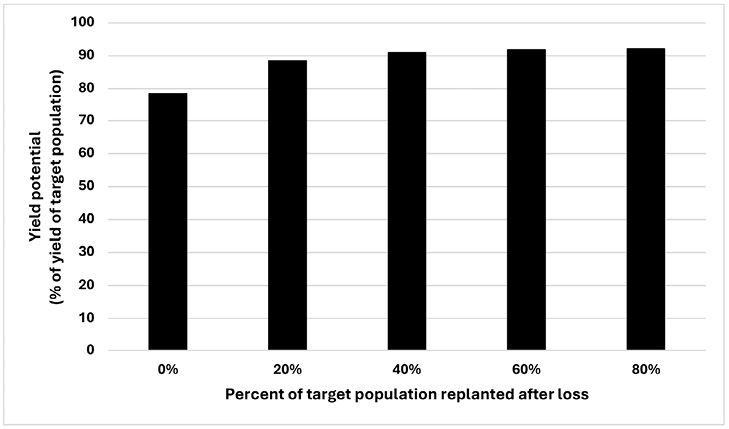
Additional research was conducted in Mississippi to evaluate soybean yield response to varying replanting seeding rates following significant stand loss. Figure 2 shows soybean yield potential at 0, 20, 40, 60, and 80 percent replanting rates after a simulated 80 percent stand loss. Results indicate that when 80 percent of the initial stand was lost, yield potential recovered to nearly 90 percent of the original yield level by replanting only 20 percent of the desired population. Increasing seeding rates beyond 20 percent did not result in further yield improvement. Therefore, when a replant is warranted, using seeding rates as low as 20 percent of the original target may minimize economic impact while maintaining yield potential.
Publication 3831 (POD-01-26)
Revised by Justin Calhoun, PhD, Assistant Professor and Extension Soybean Specialist, and William Paul O’Neal, Extension Technician, Plant and Soil Sciences, from an earlier edition by Trent Irby, PhD, former Extension Soybean Specialist, and Alanna B. Scholtes, former Extension Associate III.
The Mississippi State University Extension Service is working to ensure all web content is accessible to all users. If you need assistance accessing any of our content, please email the webteam or call 662-325-2262.
Download
P3831
Considerations for Replant Decisions in Soybean
222.63 KB
Departments
Authors
-
 Assistant Professor
- Plant and Soil Sciences
-
Extension Technician
- Plant and Soil Sciences