P3082
Watersheds: Role, Importance, and Stewardship
What Is a Watershed?
Anyone who lives on land lives in and interacts with a watershed every day. Because of this, it is important to understand what watersheds are, why they matter, and how we can be good stewards of local water resources.
A watershed is an area of land that drains into a common body of water, such as a river, wetland, reservoir, lake, or ocean. Rain that falls on land flows toward lower elevations and eventually toward a common body of water. As it moves, that water can carry soil particles, nutrients, chemicals, trash, and other pollutants from the land.
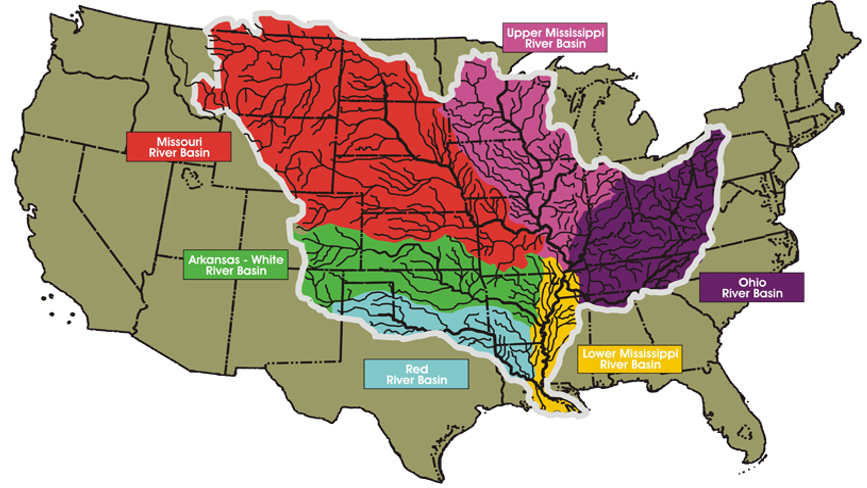
The term watershed is sometimes used interchangeably with drainage basin or catchment. Watersheds can range from a few acres to thousands of square miles, and they are nested inside one another. Smaller watersheds combine to form larger watersheds. For example, smaller watersheds in northwest Mississippi drain into the Mississippi River; together, they are part of the Mississippi River Basin (Figure 1).
Watersheds are connected by the movement of water. While water flows through river and stream channels that bisect landscapes, it also moves below the land surface. Subsurface flow includes water moving slowly through soil and replenishing soil moisture, as well as water percolating to deeper confined and unconfined aquifers.
The diversity of elevations, vegetation, and substrates across Mississippi watersheds creates a range of environments that sustain plants, wildlife, and people. A few feet of elevation can make a large difference in water availability for plants. Many fish, amphibians, reptiles, birds, and mammals also use more than one ecological zone within a watershed during their lives, making the different zones (upland, riparian, and aquatic) of the watershed and seasonal hydrology fluctuations important to their life cycles.
A healthy watershed supports ecosystem function and human well-being. Degraded watersheds may provide lower quality water resources for people, livestock, fish, wildlife, and downstream communities. Because watersheds provide many benefits, protecting local watershed health is an important part of protecting Mississippi’s water resources.
Importance of Healthy Watersheds to the Environment
Biological, physical, and chemical processes within watersheds support plants, animals, and people. These processes help provide nutrient cycling, carbon storage, erosion control, soil formation, biodiversity, wildlife corridors, water storage, water filtration, flood protection, timber, and recreation.
In uplands, forested headwater streams can help filter sediment and pollutants before water reaches larger streams and rivers. Riparian forests, or forested areas next to streams, can act as buffers that help reduce nonpoint source pollution and provide corridors for wildlife. In lowland areas, floodplains store and slowly release water, which can reduce flood risk for people who live near rivers.
Stable soils, low pollutant levels, and a diverse biological community are signs of a healthy watershed. When watersheds are degraded, ecological benefits and services can be reduced or lost.
Runoff moving over land and into waterways can transport sediment, organic material, and pollutants from adjacent landscapes. Pollutants identified in flowing waters may, therefore, indicate upstream land uses. The U.S. Environmental Protection Agency tracks national river, stream, lake, and reservoir conditions through its National Aquatic Resource Surveys, and local water-quality information is available through EPA’s How’s My Waterway tool. In Mississippi, the Mississippi Department of Environmental Quality leads water-quality protection and restoration work for surface waters.
If water bodies can no longer support their designated or natural uses, people, wildlife, and local economies may be affected.
Watersheds and Communities
Watershed health is linked to community well-being. Healthy watersheds can reduce flooding; support recreation; protect drinking-water sources; provide food, shelter, and other resources for wildlife; and help communities avoid more expensive water-treatment or restoration costs.
The cost of restoring lost ecosystem function or replacing it with built infrastructure can be high. For example, communities may invest in protecting forests and natural land cover because those areas help filter and store water. Maintaining healthy watersheds can reduce costs for public services while also protecting natural resources.
Healthy watersheds can also support physical and mental well-being through safe and accessible outdoor recreation opportunities. People are more likely to walk, fish, paddle, exercise, and spend time outdoors when they have access to clean streams, rivers, parks, greenways, and trails. Community planning can play an important role in ensuring public access to healthy local water resources.
Protecting Your Watershed
You can help protect your watershed by being a good steward of the environment at home and in your community. Around the home, small but important actions can help reduce pollution, flood risk, and conserve water.
Simple steps can make a difference:
- Fertilize lawns and gardens based on soil-test results, and avoid applications before heavy rain.
- Keep fertilizer, soil, grass clippings, leaves, pet waste, oil, chemicals, and trash out of storm drains and ditches.
- Always handle, store, and use chemicals according to label instructions.
- Plant and maintain trees, shrubs, and deep-rooted plants where they fit the site.
- Direct roof runoff toward lawns, rain gardens, or other planted areas when site conditions allow.
- Use rain barrels or other rainwater-harvesting practices for garden and lawn irrigation where appropriate.
- Keep natural areas, stream buffers, and drainageways protected when planning development or maintenance work.
Communities can have an even larger impact by protecting natural areas, planning development carefully, maintaining stream buffers, and using best management practices that reduce runoff and pollution. Local ordinances, community plans, and neighborhood projects can help protect downstream neighbors as well as local water resources.
Learning about your property and local watershed is a good first step. Several Mississippi and federal resources can help you learn more and take action.
Resources
Mississippi Department of Environmental Quality – Surface Water
U.S. Environmental Protection Agency – How’s My Waterway
National Wild and Scenic Rivers System – Mississippi
References
- Allan, J. D., & Castillo, M. M. (2007). Stream ecology: Structure and function of running waters. Springer.
- Barnes, M. C., Todd, A. H., Lilja, R. W., & Barten, P. K. (2009). Drinking water supply and forest lands in the northeast and midwest United States forests. United States Department of Agriculture Forest Service, Northeastern Area State and Private Forestry. NA-FR-01-08.
- Clipp, H. L., & Anderson, J. T. (2014). Environmental and anthropogenic factors influencing salamanders in riparian forests: A review. Forests, 5, 2679-2702.
- Costanza, R., de Groot, R., Sutton, P., van der Ploeg, S., Anderson, S. J., Kubiszewski, I., Farber, S., & Turner, R. K. (2014). Changes in the global value of ecosystem services. Global Environmental Change, 26(1), 152–158.
- Mississippi Department of Environmental Quality. Surface water.
- Mississippi State University Extension Service. Mississippi Water Stewards.
- Pearl Riverkeeper.
- National Wild and Scenic Rivers System. Mississippi.
- United States Environmental Protection Agency. How’s my waterway.
- United States Environmental Protection Agency. National aquatic resource surveys.
Publication 3082 (POD-09-26)
Revised by Beth Baker, PhD, Associate Professor, and Mark Hill, Extension Associate, Wildlife, Fisheries, and Aquaculture, from an earlier edition by Beth Baker and Caleb Aldridge, former Research Associate.
The Mississippi State University Extension Service is working to ensure all web content is accessible to all users. If you need assistance accessing any of our content, please email the webteam or call 662-325-2262.
Download
P3082
Watersheds: Role, Importance, and Stewardship
206.68 KB
Departments
Authors
-
 Assoc Professor & Assistant Di
- Wildlife, Fisheries & Aquaculture
-
 Extension Associate I
- Wildlife, Fisheries & Aquaculture