P3918
Watch Out for Ticks!
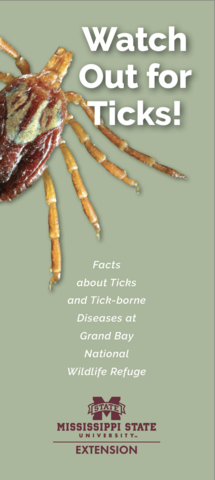
Facts about Ticks and Tick-borne Diseases at Grand Bay National Wildlife Refuge
Tick Biology
Ticks are arthropods in the Class Arachnida that feed exclusively on blood from various hosts such as mammals, birds, and even reptiles. Humans, and especially those who work or recreate outdoors, are often bitten by ticks. Not all ticks are infected with disease agents such as Lyme disease and Rocky Mountain spotted fever.
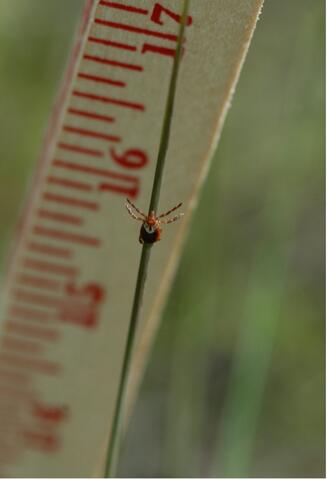
Several tick species occur at Grand Bay National Wildlife Refuge, but one is by far the most predominant—the Gulf Coast tick, Amblyomma maculatum, which is most common in late summer. As is the case with other hard ticks, Gulf Coast ticks have three mobile life stages: larvae, nymphs, and adults. Each of these stages is progressively larger. They get on their hosts by crawling up on grass and weeds to “quest” for a passing animal. Animal hosts for the larval and nymphal stages of the Gulf Coast tick include birds and certain wild rodents, such as cotton rats. Adults feed on large animals such as cattle, goats, horses, and deer—but will readily bite people.
Disease Transmission
The Gulf Coast tick produces a painful bite. Some Gulf Coast ticks are infected with Rickettsia parkeri, a spotted fever group bacteria that causes an illness similar to but milder than Rocky Mountain spotted fever. A key characteristic of infection with R. parkeri is a spot of dead tissue on the skin at the place where the tick was attached. The illness is treatable with certain antibiotics, especially if recognized and treated early in the infection.
Gulf Coast Tick Seasonality
As part of a Mississippi State University Extension Master Naturalist project, the authors collected ticks every two weeks with a drag cloth along a 1.5-mile section of the Pine Savannah Trail at GBNWR. We divided the trail into 23 roughly equal segments and stopped to examine the cloth for ticks about four times per segment. Identifications of all tick specimens were confirmed by an expert, and voucher specimens are deposited in the Mississippi Entomological Museum at MSU.
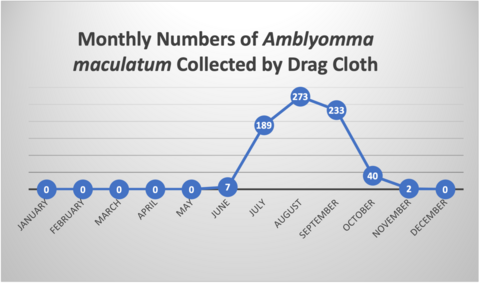
During the year-long surveillance project, we collected 744 adult Gulf Coast ticks, 14 adult American dog ticks, four adult deer ticks, and one nymphal stage Gulf Coast tick. Deer ticks were collected only in winter or early spring. Dog ticks were collected in June, July, and September. Overall, ticks were rarely collected in the pine savannah until July when Gulf Coast ticks began to emerge. The peak of activity was early August when hundreds of Gulf Coast ticks were collected upon each visit. During that time, the drag cloth would often have 5–15 specimens on it each time it was turned over for inspection. Numbers of Gulf Coast ticks began to decrease in late September, but a few specimens were collected as late as early November.
| Date | Number Collected |
|---|---|
| January | 0 |
| February | 0 |
| March | 0 |
| April | 0 |
| May | 0 |
| June | 7 |
| July | 189 |
| August | 273 |
| September | 233 |
| October | 40 |
| November | 2 |
| December | 0 |
What to Do about Gulf Coast Ticks at GBNWR
Protect yourself from ticks!
- Avoid tick-infested woods during peak tick activity.
- Wear boots with pant legs tucked into them.
- Use repellents on pant legs, socks, and/or boots.
- Find and remove attached ticks as soon as possible after being outdoors.
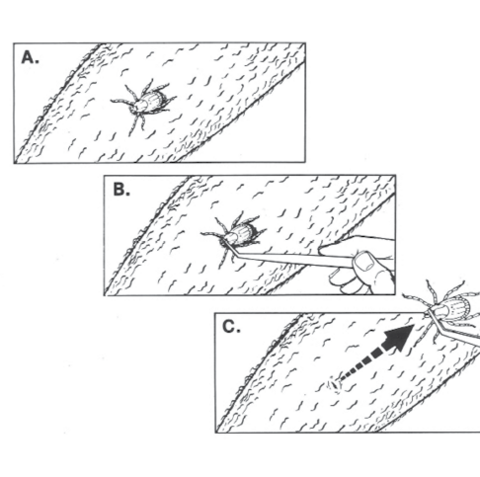
Ticks remain attached to a person for several days and may be difficult to remove. The best way to remove them is to pull them straight off with blunt forceps/tweezers. Any person experiencing unexplained fever, headache, body aches, and/or rash within 2–3 weeks of a tick bite should consult a physician.
Publication 3918 (07-23)
By James Rigney, Master Naturalist, and Jerome Goddard, PhD, Extension Professor of Medical Entomology.
The Mississippi State University Extension Service is working to ensure all web content is accessible to all users. If you need assistance accessing any of our content, please email the webteam or call 662-325-2262.
Departments
Authors
-
 Extension Professor
- Agricultural Science & Plant Protec