P2443
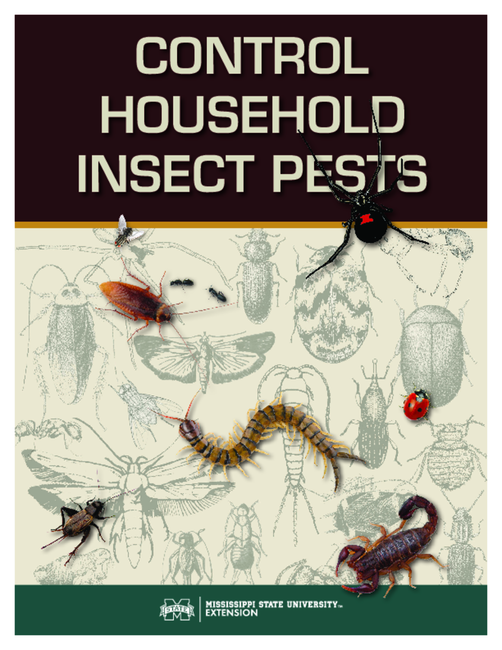
Control Household Insect Pests
Managing Household Insect Pests
Before reading about a specific insect pest, consider some of the general principles of managing household insects and spiders: exclusion, sanitation, proper identification, and understanding pest biology and habits. Don’t underestimate the value of these basic principles.
Exclusion
Exclusion is the most important part of household insect control. Don’t let pests get into your home in the first place, and you won’t have a pest problem. Sure, insects are small and can crawl through tiny cracks, but hardware and home-improvement stores sell a variety of screens, weather stripping, caulking, sealants, and other supplies you can use to seal even the smallest cracks. Time spent making sure your home is as “bug tight” as possible reduces the number of insects that get inside and saves money by conserving energy. Just don’t be overzealous. Be sure to maintain adequate ventilation for health and safety.
You can also use exclusion on a smaller scale. Keep food products like cereals, flour, and grains in insect-proof containers and you are much less likely to have problems with stored-product pests. Store your wool suits and sweaters properly and they are less likely to be infested with clothes moths or carpet beetles.
Another, often overlooked, aspect of exclusion is being careful about what items you bring into your home. German cockroaches like to hide in radios, TVs, and other electrical appliances—like that computer monitor your cousin has offered to give you. Used mattresses and box springs can harbor bed bugs. Those boxes of old books from Aunt Emma’s estate may contain silverfish or brown recluse spiders. You don’t need to be paranoid about bringing second-hand items into your home, but you do need to be informed and act wisely.
Sanitation
Sanitation is another cornerstone of household pest management. Deprive pests of a food source and they won’t become established in your home. Good sanitation is especially important in controlling pests such as cockroaches. Regular cleaning and vacuuming, combined with other good sanitation practices, are more useful than insecticide sprays when it comes to discouraging roaches. Decluttering is another powerful pest-management tool that goes hand in hand with sanitation. Cluttered, crowded storage areas provide shelter for spiders and insect pests and interfere with other treatment efforts.
Identify the Pest
Know your enemy! Sometimes it’s not enough to know whether it is a cockroach or an ant. You need to know which cockroach or which species of ant. Management and treatment strategies can vary greatly depending on species. If you aren’t sure, collect some specimens, place them in a small, leak-proof bottle of alcohol, and take them to your county Extension office. Extension personnel can send the specimens to a specialist for identification.
Understand Pest Biology
Once you’ve identified the pest you are trying to control, it’s important to learn about its biology and habits. Where does this pest spend most of its time? Where do the immature stages feed, and what do they look like? What does it eat? Knowing the answers to these and other questions can help you plan an effective control strategy.
Buying and Using Insecticides Inside the Home
Insecticides can be useful tools for controlling indoor insect pests, but they are not substitutes for exclusion and sanitation. If you rely solely on insecticides to manage your indoor insect problems, you are going to use a lot of insecticide, and you still may not succeed. Still, sometimes you may need to use an insecticide.
Choosing and Purchasing Insecticides
The number of different insecticide products labeled and sold for indoor pest control is huge, and it is easy to become confused or overwhelmed when shopping for the right product for a particular pest problem. Just because a product has a picture of an ant or roach on the label or is called “ant and roach spray” does not necessarily mean it is the best solution for your particular ant or roach problem.
The first step in choosing a pesticide is to decide what type of formulation you want. Do you want a ready-to-use spray? Do you want an insecticide concentrate to mix and apply using your hand pump sprayer? Or do you need a bait?
Once you have decided on a formulation, you need to think about the active ingredient. The brand names of household insecticides are sometimes long and confusing and often don’t provide a lot of useful information about what the product is really good for. Learn to choose insecticides based on their active ingredients. The names of insecticide active ingredients do sound somewhat technical (such as cyfluthrin, fipronil, and hydramethylnon), but they aren’t nearly as long and confusing as most of the brand names.
The most important step in purchasing a household insecticide is to read the label carefully—before you buy it! Take your glasses, take your time, and read it right there in the store. Be sure it contains the active ingredient you want and is the formulation you need. Be sure it is labeled to control the pest(s) you need to control, and read how to use and apply the product. Be sure it is labeled for indoor use in the site you plan to treat. If you need to use it in your kitchen cabinets, be sure it is labeled for use in kitchen cabinets, and read how to apply the product safely. Read the label again once you get home—just before you treat.
Using Insecticides Safely and Effectively
Insecticides are like fire or automobiles. When used properly, they are safe, useful tools, but they can be dangerous if misused. The most important step in safe insecticide use is to read the label and do what it says. Be sure you know what you are using and how to use it safely.
Use common sense when applying insecticides. You want to put them where they will contact the pests, and you want to avoid putting them where they will contact you, family members, or pets. Be especially careful when treating in kitchens and dining areas. Remove or cover all food items before spraying, and don’t let spray drops or mist contaminate cooking utensils or food preparation surfaces. If you are using a liquid spray, avoid spraying electrical outlets and other electrical sources.
The keys to effective insecticide use are to prepare the area properly before you start treating, target your treatment to the areas where the pest lives, and be thorough. Note that being thorough does not mean applying large amounts of insecticide; it means being sure to identify and treat all the places the pest occurs.
Start by cleaning and removing clutter if necessary. You will often need to empty storage cabinets or closets to be able to treat thoroughly. You may even have to drill small access holes to allow treatment of voids where pests may be hiding, like the space beneath most floor-level cabinets, which is a good hiding place for roaches.
Think about where the pest hides, and place your treatment in those areas. Try to find and treat all the areas that might harbor pests. Remember, insecticides aren’t magic potions that cause pests to disappear just because you apply a little spray or dust. If the pest doesn’t contact the insecticide, it won’t be controlled.
Insecticide Formulations
Ready-to-Use Sprays
Many indoor insecticides are sold as prediluted, ready-to-use sprays. Often, they are sold in small, trigger-pump spray bottles, but some are sold in gallon containers that have hand-pressurized, or even battery-powered, pumps. Most of the insecticides sold in this way give broad-spectrum control, and they are convenient to keep on hand for occasional pest problems.
Aerosol Sprays
Aerosol sprays are ready-to-use insecticide sprays sold in pressurized cans. They are quick and convenient for small jobs, but they are costly. Some come with a small “straw” or extension tube that lets you inject spray into cracks, crevices, and wall voids. Be especially sure to read the label when purchasing aerosol sprays. Some contain active ingredients, like pyrethrins, that provide quick kill but give no residual control; others contain active ingredients that provide quick kill and long-term residual control. Some are labeled for use as space sprays to control flying insect pests; others are not.
Insecticide Concentrates
Insecticide concentrates have to be diluted in water before you can apply them. Liquid concentrates are the most common form, but some insecticides are sold as wettable powders or wettable granules, and some are even sold in premeasured, water-soluble packets. Read the label to find out how much product to mix, and don’t be tempted to use more than the label indicates. If the label says to dilute 1 teaspoon in a gallon of water, just use 1 teaspoon. Increasing the rate of an insecticide spray above the labeled rate won’t improve control. Increasing the care and thoroughness with which you apply that spray will.
Total-Release Aerosol Foggers
These are simply aerosol sprays that release all of their contents at once. The spray button locks into place when you push it down, and the contents of the can empty into the room. These are most often sold for flea or roach control. While they can be useful when dealing with especially heavy infestations, they are usually not the best formulation for flea or roach control. This is because most of the insecticide ends up on surfaces that don’t really need to be treated, and the spray does not penetrate well into the cracks and crevices where many pests hide.
Baits
Baits usually contain a small amount of insecticide diluted in a product that the target pests readily eat. They are most often used to control ants or cockroaches, and baits are very effective tools for controlling these pests. Baits are especially useful against German cockroaches. The active ingredients used in baits are usually slow-acting insecticides or insect growth regulators. Baits are formulated as pastes or gels that come in small, syringe-like tubes, as liquids, or granules. Most of the baits sold for home use come in small bait stations that allow the target pests to access the bait but prevent access by children or pets.
Dusts
A few household insecticides are formulated as dusts. These are best applied using a handheld bulb duster to puff the dust into cracks, crevices, and voids that harbor pests. The main advantage of dusts is they usually provide long-lasting control in the areas where they are applied. Do not apply dusts to exposed areas. Dusts belong in out-of-the-way places where family members or pets can’t come in contact with them.
Download the PDF for the full publication, which includes detailed information about imported fire ants, carpenter ants, carpenter bees, fabric pests, stored food pests, spiders, Asian lady beetles, occasional invaders, millipedes, scorpions, paper wasps, silverfish, springtails, house flies and other large flies, and fruit flies, drain flies, and other small flies.

This work is supported by Crop Protection and Pest Management, Extension Implementation Program, award no. 2021-70006-35580, from the U.S. Department of Agriculture’s National Institute of Food and Agriculture. Any opinions, findings, conclusions, or recommendations expressed in this publication are those of the author(s) and should not be construed to represent any official USDA or U.S. Government determination or policy.
The information given here is for educational purposes only. References to commercial products or trade names are made with the understanding that no discrimination is intended against other products that may also be suitable. Always read and follow the current label directions of any insecticide you choose to use.
Publication 2443 (POD-05-26)
Reviewed by Santos Portugal, PhD, Assistant Professor, Agricultural Science and Plant Protection. Written by Blake Layton, PhD, Extension Professor (retired), Entomology.
The Mississippi State University Extension Service is working to ensure all web content is accessible to all users. If you need assistance accessing any of our content, please email the webteam or call 662-325-2262.
Download
P2443
Control Household Insect Pests
6.06 MB
Departments
Authors
-
 Assistant Professor
- Agricultural Science & Plant Protec