P4187
The Many Faces of Fire Forests: A Guide to Longleaf Pine Habitats for Better Stewardship
Download the full publication by selecting the publication image in the right column.
Longleaf pine (Pinus palustris) once covered nearly 92 million acres across the Southeast, stretching from Virginia to Texas. Today, less than 3 percent of that forest remains, and most of it exists in scattered, isolated patches. Historically, longleaf pine grew on various types of land, from dry, sandy ridges to wet, grassy savannas and flatwoods. What these places had in common was frequent fire. What made them different were their soils, drainage, and landscape position.
Understanding the type of longleaf site you have is one of the most important steps in successful management. A dry sandhill behaves very differently from a moist upland or a flatwood. Fire spreads differently, trees grow differently, and wildlife use the land differently. Restoration works best when it matches the land. That means understanding where longleaf historically occurred, what conditions it preferred, and how those conditions vary across Mississippi and the broader Southeast.
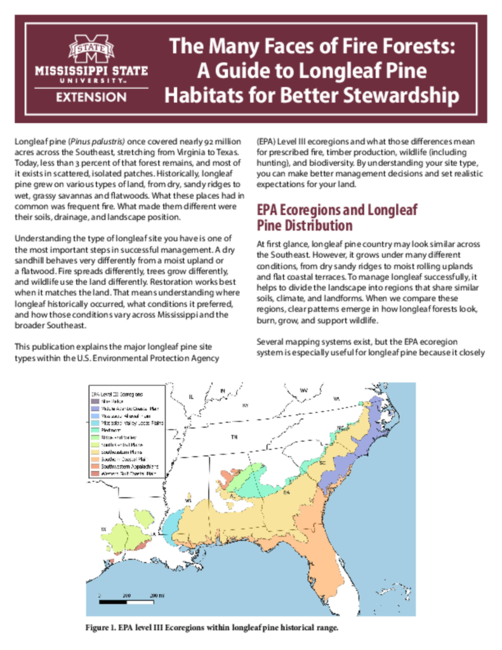
This publication explains the major longleaf pine site types within the U.S. Environmental Protection Agency (EPA) Level III ecoregions and what those differences mean for prescribed fire, timber production, wildlife (including hunting), and biodiversity. By understanding your site type, you can make better management decisions and set realistic expectations for your land.
For answers to specific questions, please contact state Extension specialists or your local Extension office.
Publication 4187 (POD-04-26)
By Andrea De Stefano, PhD, Assistant Professor, Coastal Research and Extension Center.
The Mississippi State University Extension Service is working to ensure all web content is accessible to all users. If you need assistance accessing any of our content, please email the webteam or call 662-325-2262.
Download
P4187
The Many Faces of Fire Forests: A Guide to Longleaf Pine Habitats for Better Stewardship
1.86 MB
Departments
Authors
-
 Assistant Professor
- CREC-Coastal Research & Ext Center