P3141
Reading On-Farm Bacteriological Culture Results
Download the full publication by selecting the publication image in the right column.
Mastitis, or inflammation of the mammary gland, is usually caused by bacteria (or another pathogen) invading the udder through the teat end. The severity of mastitis depends on the pathogen involved and the cow’s immune response. Producers must be able to identify the causative pathogen to make educated treatment decisions. Some treatment options include intramammary antibiotic treatment, close monitoring without antibiotic treatment, early dry off, and systemic support.
Mastitis is the most costly infectious disease and the most frequent reason for antibiotic use on commercial dairy farms. Therefore, management tools that reduce mastitis costs and promote prudent use of antibiotics on dairy farms could be beneficial. The Minnesota Easy Culture System (University of Minnesota, Saint Paul) is an on-farm bacteriological culturing system that can help veterinarians and producers make strategic treatment decisions based on the pathogen involved in clinical mastitis cases. Cases that yield no bacterial growth when cultured and cases where Gram-negative bacteria are isolated may not benefit from intramammary antibiotics.
On the other hand, intramammary antibiotics are often recommended for mastitis caused by Gram-positive organisms. Some examples of Gram-negative pathogens include Escherichia coli, Enterobacter, and Klebsiella species. Some examples of Gram-positive pathogens include Staphyloccus aureus, coagulase-negative staphylococci, and environmental streptococci (including Strep uberis and Strep dysgalactia).
A major benefit of on-farm milk bacteriological culture systems is that results can be obtained within 24 hours compared to a week or more for samples sent off to a lab. Withholding intramammary antibiotics for 24 hours after sampling and selectively treating based on the results of the culture has shown no differences in long-term treatment outcomes, including recurrence of clinical mastitis in the same quarter, somatic cell count, milk production, and cow survival for the rest of the lactation after clinical mastitis. Selectively treating cows with antibiotics based on on-farm culture results can decrease antibiotic use by half and tends to decrease milk withholding time without negatively affecting cure rates.
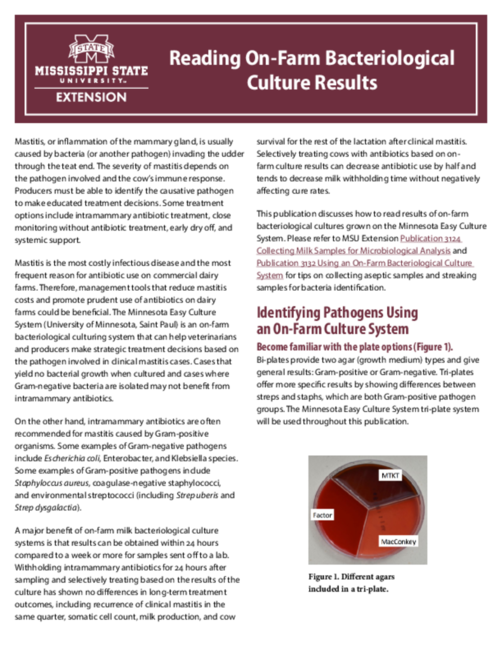
This publication discusses how to read results of on-farm bacteriological cultures grown on the Minnesota Easy Culture System. Please refer to MSU Extension Publication 3124 Collecting Milk Samples for Microbiological Analysis and Publication 3132 Using an On-Farm Bacteriological Culture System for tips on collecting aseptic samples and streaking samples for bacteria identification.
You can also contact state Extension specialists or your local Extension office for answers to specific questions.
The information given here is for educational purposes only. References to commercial products, trade names, or suppliers are made with the understanding that no endorsement is implied and that no discrimination against other products or suppliers is intended.
Publication 3141 (POD-04-26)
Reviewed by Francieli Dell’Osbel, Graduate Research Assistant, and Jessica Halfen, PhD, Assistant Extension/Research Professor, Animal and Dairy Sciences. Written by Brittany Bowman, former Extension Undergraduate Apprentice, and Amanda Stone, PhD, former Associate Professor, Animal and Dairy Sciences.
The Mississippi State University Extension Service is working to ensure all web content is accessible to all users. If you need assistance accessing any of our content, please email the webteam or call 662-325-2262.
Download
P3141
Reading On-Farm Bacteriological Culture Results
671.3 KB