P4177
Hardwood Regeneration Evaluations
One of the more common land manager concerns when attempting to establish natural regeneration in hardwood stands is found in the question, “How do I know I have enough regeneration to be sure of success?” Simply put, managers need a tool that allows them to calculate an answer to that question. This publication details a method that can be used to evaluate natural regeneration to make an informed decision regarding the likelihood of success in regeneration efforts.
Natural regeneration efforts in bottomland hardwoods, especially for desired species such as oak and ash, require assessment of advance regeneration (larger established seedling, typically at least 2–3 years old and preferably 1–3 feet tall) and the sprouting potential of stems that will be cut during harvest. Regeneration success usually depends on the presence of an adequate number and size of advance regeneration before harvesting. If inadequate desirable regeneration exists prior to harvest, then regeneration efforts will likely fail (Figure 1).
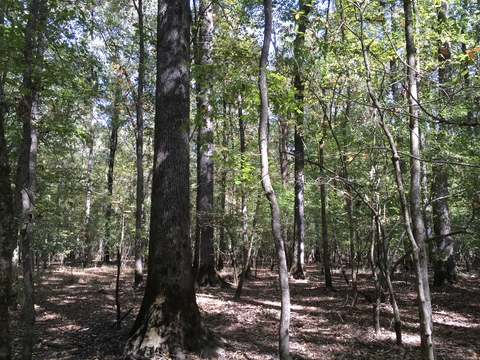
While several regeneration evaluation methods have been developed for use in upland hardwoods, only one has been formulated for bottomland hardwoods. This method evolved with modifications through the work of several researchers to increase ease of use and applicability in the field.
Background
The first quantitative method for evaluating advance regeneration and sprouting potential for bottomland hardwood stands was formulated in 1980 by R. L. Johnson. The method was based on silvical characteristics, the number of advance regeneration present, and seedling size 1 year before harvesting is scheduled. It considered root and stump sprouting potential of larger stems and assumed a final harvest operation would remove all midstory and overstory trees. The overall objective of Johnson’s method was to determine the likelihood of regeneration success in a hardwood stand by assessing the number and distribution of adequately stocked seedlings.
Johnson’s method required installation of 0.01-acre circular plots (11.78 feet radius) on a systematic grid across the stand being assessed. The recommended number of plots depended on stand size, with one plot per acre suggested for stands of 50 acres or less. Recommended sampling for larger stands was one plot per acre up to 50 acres and one plot for each additional 2 acres after 50 (Johnson & Deen 1993).
Point assignments ranged from 1 to 3 and were based on the number and size of seedlings and trees present in the sample plot as well as their inherent capabilities for growth and survival at different sizes. Depending on management desirability, a variety of species could be assessed, including ash, red and white oaks, hickories, sweetgum, blackgum, elms, yellow poplar, maples, sugarberry, and persimmon. An accumulation of 12 points on any given plot indicated that at least one stem would be in a competitive position during normal stand development.
Johnson’s method was heavily dependent on the observational experience of the author, who indicated that more testing was needed before it was put into common use. Hart et al. (1995) studied the method and incorporated research results focusing only on bottomland red oaks and ash, with point values modified to reflect a more realistic assessment of regeneration potential. The greatest shortcoming of these methods was that, while they could determine plot stocking, neither could predict the probability of stocking over time.
Belli’s Method
To enhance land managers’ ability to predict stocking over time, Belli et al. (1999) tested the validity of these two earlier models by assessing red oak and ash advance regeneration (i.e., older established seedlings present before overstory removal) at pre- and post-harvest timings in clearcutting operations. They defined a stocked plot as having at least one free to grow (FTG) seedling in the upper canopy at the end of the third post-harvest growing season.
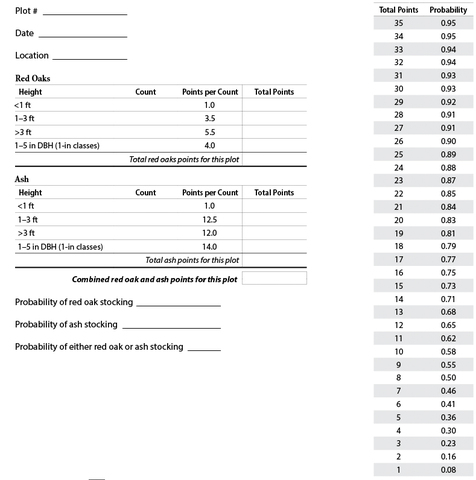
The percentage of regeneration by size class was converted to probability of having this FTG position stem by using a tally sheet to reflect modified point values for seedlings less than or equal to 1 foot tall, those between 1 and 3 feet tall, those greater than 3 feet tall, or those between 1 and 5 inches in diameter at breast height (DBH; 4.5 feet aboveground; Tally Sheet 1). Points can be tallied for red oak or ash regeneration and stocking probabilities produced for either, or a combination of the two can then be determined.
Example
Here is an example that uses Tally Sheet 1. Assume the following hypothetical inventory of regeneration and trees were obtained from one 0.01-acre plot:
- Six red oak seedlings less than 1 foot tall
- Two ash seedlings more than 3 feet tall
- One red oak tree 3 inches DBH
Using Tally Sheet 1, each of the six red oak seedlings receive 1 point and the 3-inch DBH red oak receives 4 points, for a total of 10 points for red oak. A cumulative 10 points yields a 58 percent probability of at least 1 FTG red oak stem 3 years post-harvest. At this point, a forest manager must determine what percent chance of producing at least one FTG stem is acceptable for management goals. Belli suggested that an 80 percent chance might be acceptable.
The two ash seedlings total 24 points, indicating an 88 percent chance of at least one FTG stem at 3 years post-harvest. Combined red oak and ash points total 34, which corresponds with a 95 percent stocking probability for the plot.
References
Belli, K. L., Hart, C. P., Hodges, J. D., & Stanturf, J. A. (1999). Assessment of the regeneration potential of red oaks and ash on minor bottoms of Mississippi. Southern Journal of Applied Forestry, 23, 133–138.
Hart, C. P., Hodges, J. D., Belli, K., & Stanturf, J. (1995). Evaluating potential oak and ash regeneration on minor bottoms in the southeast. In M. D. Edwards (Ed.), Proceedings of the eight biennial southern silvicultural research conference (pp. 434–442). USDA Forest Service General Technical Report SRS-1.
Johnson, R. L. (1980). New ideas about regeneration of hardwoods. Proceedings, Hardwood Committee’s Symposium on Oak Regeneration (pp. 17–19). Southeastern Lumber Manufacturing Association.
Johnson, R. L., & Deen, R. T. (1993). Prediction of oak regeneration in bottomland forests. In D. L. Loftis & C. E. McGee (Eds.), Oak regeneration: Serious problems, practical recommendations (pp. 146–155). USDA Forest Service General Technical Report SE-84.
Publication 4177 (POD-02-26)
By Brady Self, PhD, Extension Professor, Forestry.
The Mississippi State University Extension Service is working to ensure all web content is accessible to all users. If you need assistance accessing any of our content, please email the webteam or call 662-325-2262.
Download
P4177
Hardwood Regeneration Evaluations
1012.79 KB
Departments
Authors
-
 Extension Professor
- Forestry