P3839
Creating a Pollinator Garden
One-third of the foods we eat rely on pollinators. Pollinators travel from plant to plant carrying pollen on their bodies. This vital interaction allows the transfer of genetic material critical to the reproductive systems of many flowering plants. These are the very plants that bring us countless fruits, vegetables, and nuts and provide half of the world’s oils, fibers, and raw materials. They also sustain our ecosystems and produce our natural resources by helping plants reproduce.
Who are the pollinators? Birds, bats, butterflies, moths, flies, beetles, wasps, small mammals, and, most importantly, bees. They visit flowers to drink nectar or feed from pollen and transport pollen grains as they move from plant to plant.
Bees
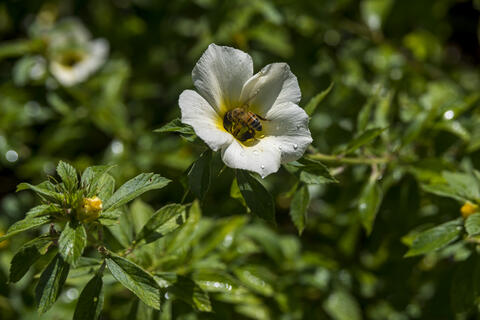
There are 14 types of bees in Mississippi, 13 of which are pollinators. They are bumblebees, honeybees, carpenter bees, long-horned bees, sweat bees, squash bees, digger bees, polyester bees, masked bees, cuckoo bees, mason bees, leafcutter bees, miner bees, and wasps. Table 1 describes Mississippi’s bees and their preferred plants.
| Bee | Description | Preferred Plants |
|---|---|---|
| Bumble bee | Feed on flower nectar and collect pollen to feed young. | Butterfly weed, summersweet, false indigo |
| Western honeybee | Only group of bees that produce honey. | Asters, goldenrod, sunflowers |
| Carpenter bee | Pollinate wildflowers, fruit trees, and garden plants. | Salvia, lavender, Golden Day lilies, poppies |
| Long-horned bee | Primarily solitary and pollinate wildflower prairies and sunflowers. | Wildflowers and sunflowers |
| Sweat bee | Attracted to sweat as they need to consume salt to live. | Most attracted to white, blue, and violet flowers |
| Squash bee | Specialist pollinators that visit only squash family blooms. | Squash blossoms |
| Digger bee | Nest in the ground and build homes from mud. | Any flowering plants near nest site |
| Polyester bee | Apply a coating to the inside of nests that dries into a plasticky, waterproof coating. | Preferred flower is different for individual species |
| Masked bee | Carry pollen internally and regurgitate it to feed young. | Goldenrod |
| Cuckoo bee | Cleptoparasitic, meaning to lay a single egg in another’s nest. The hatched egg kills all other larva and eats stored pollen. | Not a pollinator |
| Mason bee | Kept on farms to be highly efficient pollinators. Drop pollen on most every flower visited. | |
| Leafcutter bee | Line nests with tiny circles of leaves. | Wildflowers, gardens, and commercial plants |
| Miner bee | Dig through dry earth, clay, and even mortar to make nests. | Woodland wildflowers, shrubs, and trees |
| Wasp | These important pollinators feed on pollen and nectar instead of meat. |
Butterflies
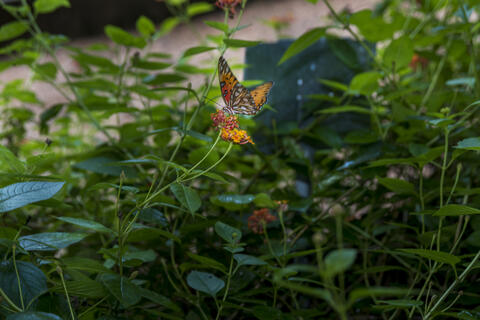
Though we most often enjoy and appreciate the winged adults, understanding the entire butterfly life cycle is important. A butterfly’s life begins as an egg laid on a host plant, usually on the leaf bottoms, and the eggs can vary widely in shape, form, size, and color. Within 2 weeks, the tiny eggs hatch and caterpillars emerge and consume the host plant’s leaves. They consume numerous leaves over the next 2–5 weeks and then pupate to form a chrysalis. This turns into a butterfly in 1–2 weeks depending on the species. Gardens need host plants (Table 2) for egg-laying and nectar plants as a food source.
Add native plants (Table 3) to your landscape as they provide an excellent source of food and shelter for pollinators. They also can require less watering, fertilization, and other maintenance than traditional landscape plants.
Some non-native nectar plants that attract pollinators include butterfly bush, Mexican sunflower, tall verbena, lantana, lavender, Japanese honeysuckle, and Mexican petunia.
| Butterfly | Host Plant |
|---|---|
| Pearl crescent | Aster |
| Painted lady | Hollyhock |
| Monarch | Milkweed |
| Swallowtail | Parsley |
| Gulf fritillary | Passionflower |
| Spicebush swallowtail | Spicebush |
| Mourning cloak | Birch tree |
| Admiral, red-spotted purple | Cottonwood tree |
| Plant | Attracts |
|---|---|
| Aster | Butterflies |
| Bee balm | Hummingbirds, bees, and butterflies |
| Coneflower | Hummingbirds, bees, and butterflies |
| Coreopsis | Bees and butterflies |
| Whirling butterfly bush | Bees and butterflies |
| Milkweed varieties | Many different butterflies |
| Oakleaf hydrangea | Bees and butterflies |
| Button bush | Hummingbirds, bees, and butterflies |
| Lanceleaf tickseed | Hummingbirds, bees, and butterflies |
Birds
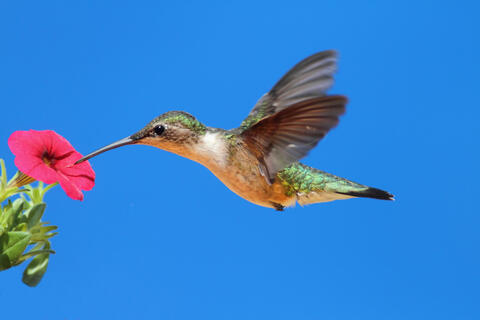
Most people know that hummingbirds are pollinators, but more than 50 species of birds in North America consume nectar. The Baltimore oriole, yellow-bellied sapsucker, scarlet tanager, and Tennessee warbler are a few. Hummingbirds need several resources, including flowers with nectar, trees to nest in and perch on, and a source of water. Hummingbirds do prefer red flowers but will feed from other flowers (Table 4).
| Plant | Hummingbird Resources |
|---|---|
| Scarlet buckeye | nectar |
| Trumpet creeper | nectar |
| Summersweet | nectar |
| Coral honeysuckle | nectar |
| Bee balm | nectar |
| Beardtongue | nectar |
| Obedient plant | nectar |
| Azalea | nectar, perch |
| Petunia | nectar |
| Sage | nectar |
Pollinator Garden Construction
Size
Start small to see how the garden grows, and expand as needed. It may be easiest to start off using pots or containers, then move to in-ground plantings or raised beds.
Location
Most pollinator plants require full sun, but many can also thrive in partial sun. Late-afternoon sun can sometimes be too hard on pollinators, so a little shade during the day can be beneficial. A water source should be easily accessible. Consider if the garden will be in a permanent location or in pots that can be moved to different locations.
Planting Tips
Remember that black pots get very hot in direct sun. Bubble wrap as a liner inside the pot will help keep the plant’s roots cool. Drainage holes are a must for any pot or container. For an in-ground pollinator garden, some type of edging material will be needed. Brick, plastic or metal edging, concrete blocks, or wood will all work.
To attract more pollinators, consider providing a diversity of species that bloom in succession from spring through fall. Include a variety of flower colors, shapes, and sizes, and plant in groups of three or more of the same plant to help pollinators locate them.
When preparing the area, remove all weeds or grass by hand, with a tiller, or with an appropriately labeled herbicide. Read the label and wait the recommended number of days before installing plants. A weed barrier can be used but may interfere with future plantings. A soaker hose on top of the bed area can slowly irrigate the plants without washing away any leaves or mulch. Lastly, install the plants and label each one with a permanent tag. Soon there will be butterflies, bees, and hummingbirds all over the garden.
Resources
Pollinator Conservation Program
USDA Natural Resources Conservation Service
References
Eierman, K. (2020). The pollinator victory garden. Quarry Books.
14 Types of Bees in Mississippi!
The information given here is for educational purposes only. References to commercial products, trade names, or suppliers are made with the understanding that no endorsement is implied and that no discrimination against other products or suppliers is intended.
Publication 3839 (POD-12-25)
By Jeff Wilson, PhD, Associate Professor, North Mississippi Research and Extension Center; Donna Kovach, Master Gardener, Marshall County; and Susan McGukin, Extension Program Associate, Lee County.
The Mississippi State University Extension Service is working to ensure all web content is accessible to all users. If you need assistance accessing any of our content, please email the webteam or call 662-325-2262.
Download
P3839
Creating a Pollinator Garden
615.69 KB
Programs
Departments
Authors
-
 Associate Professor
- North MS Research and Extension Ctr
-
 Extension Program Associate
- MSU Extension- Lee County
Contacts
-
Associate Professor
- North MS Research and Extension Ctr
-
Extension Program Associate
- MSU Extension- Lee County