P2938
Crape Myrtle Bark Scale Management and Control
Download the full publication by selecting the publication image in the right column.
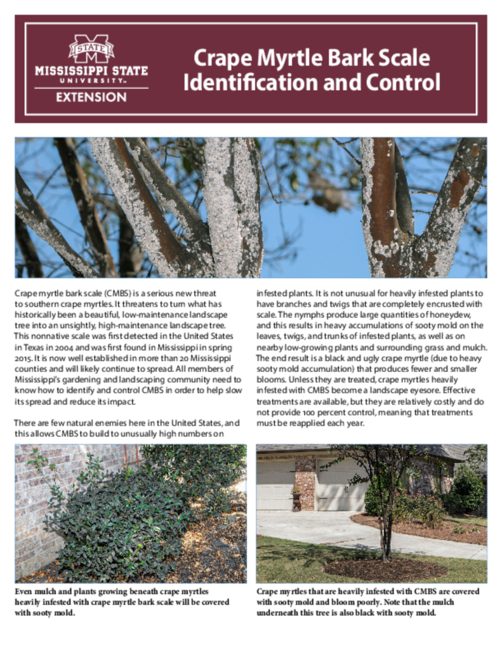
Crape myrtle bark scale (CMBS) is a serious threat to southern crape myrtles. It threatens to turn what has historically been a beautiful, low-maintenance landscape tree into an unsightly, high-maintenance landscape tree. This nonnative scale was first detected in the United States in Texas in 2004 and was first found in Mississippi in spring 2015. This insect is now well established in the state. All members of Mississippi’s gardening and landscaping community need to know how to identify and control CMBS to help reduce its impact.
There are few natural enemies here in the United States, and this allows CMBS to build to unusually high numbers on infested plants. It is not unusual for heavily infested plants to have branches and twigs that are completely encrusted with scale. The nymphs produce large quantities of honeydew, and this results in heavy accumulations of sooty mold on the leaves, twigs, and trunks of infested plants, as well as on nearby low-growing plants and surrounding grass and mulch. The end result is a black and ugly crape myrtle (due to heavy sooty mold accumulation) that produces fewer and smaller blooms. Unless they are treated, crape myrtles heavily infested with CMBS become a landscape eyesore. Effective treatments are available, but they are relatively costly and do not provide 100 percent control, meaning that treatments must be reapplied each year.
You can also contact state Extension specialists or your local Extension office for answers to specific questions.

This work is partially supported by Crop Protection and Pest Management, Extension Implementation Program grant no. 2017-70006-27200/project accession no. 1014037 from the U.S. Department of Agriculture’s National Institute of Food and Agriculture.
Any opinions, findings, conclusions, or recommendations expressed in this publication are those of the author(s) and should not be construed to represent any official USDA or U.S. Government determination or policy.
The information given here is for educational purposes only. References to commercial products, trade names, or suppliers are made with the understanding that no endorsement is implied and that no discrimination against other products or suppliers is intended.
Publication 2938 (POD-09-26)
Revised by Zia Williamson, PhD, Assistant Professor, Agricultural Science and Plant Protection, from a previous version by Blake Layton, PhD, Extension Entomologist (retired).
The Mississippi State University Extension Service is working to ensure all web content is accessible to all users. If you need assistance accessing any of our content, please email the webteam or call 662-325-2262.
Download
P2938
Crape Myrtle Bark Scale Management and Control
3.06 MB
Authors
-
 Assistant Professor
- Agricultural Science & Plant Protec