P4233
Common Barriers to Adoption of Precision and Regenerative Agriculture Technologies in the Lower Mississippi River Basin
Introduction
Row crop producers in the Lower Mississippi River Basin (LMRB) are dealing with rising input costs, labor shortages, and growing pressure to improve resource efficiency and environmental sustainability. In response, producers are increasingly adopting precision agriculture (PA) and regenerative agriculture (RA) to help use inputs more efficiently, build healthier soil, and stay productive long-term.
Across the region, more producers are using precision and regenerative practices than in past years. The 2024–2025 Precision and Regenerative Agriculture Survey found that many LMRB producers already use tools like zoned soil sampling, irrigation decision-support tools, and data-driven management practices. More than half of the producers surveyed reported using zoned soil sampling for variable-rate nutrient applications or irrigation decision tools. However, adoption is uneven across the board, with more advanced or data-intensive practices, such as variable-rate nitrogen prescriptions or variable-rate pesticide applications, remaining less common. These patterns suggest that producers are willing to try new practices, but certain barriers are holding back some technologies more than others.
This publication shares findings from the 2024–2025 Precision and Regenerative Agriculture Survey, which evaluated 58 row crop producers and 100 agricultural consultants and Extension agents across the LMRB. The survey examined the factors influencing the use and recommendation of key precision and regenerative practices. Where producers and advisors agree on the barriers, opportunities emerge to develop targeted Extension programming, hands-on technical training, and stronger producer-advisor learning networks. This publication identifies the barriers that producers and advisors report most often.
Survey Administration
Administered online between December 2024 and January 2025.
Respondents
Producers (n=58)
Consultants and Extension agents (n=100)
Description
The survey included closed-ended questions and covered the following areas:
- Adoption and use of PA technologies: variable rate (VR) applications of lime, phosphorus, potassium, or other nutrients; VR planting prescriptions; VR nitrogen prescriptions; and VR pesticide applications.
- Adoption and use of RA technologies: irrigation decision-support tools; cover crops; and tillage practices.
- Perceived benefits and barriers to adoption.
- Sources of information and recommendations.
- Demographic and contextual characteristics.
Analysis
Data were analyzed descriptively using SPSS and Excel. Frequencies and percentages were calculated for both groups.
Survey Information
The Precision and Regenerative Agriculture Survey was conducted by the Water Resources Research Institute in collaboration with the Social Science Research Center as part of the Precision Agriculture Accelerates Nutrient Reductions project funded by the U.S. Environmental Protection Agency.
The online survey, administered between December 2024 and January 2025, consisted of closed-ended questions addressing the adoption and use of PA and RA technologies. PA technologies included variable rate (VR) applications of lime, phosphorus, potassium, and other nutrients; VR planting prescriptions; VR nitrogen prescriptions; and VR pesticide applications. RA practices and technologies included irrigation decision-support tools, cover crops, and tillage practices.
In addition to technology and practice adoption, the survey examined respondents’ perceived benefits of and barriers to adoption, sources of information and recommendations, and demographic and contextual characteristics.
The data were analyzed descriptively using SPSS Statistics and Microsoft Excel. Frequencies and percentages were calculated for both groups in order to summarize their responses and characterize patterns in technology adoption and use.
Key Cross-Cutting Barriers Observed Across Technologies
PA and RA practices cover a range of tools and practices that help producers use inputs more efficiently and improve soil and water resources. Beyond overall adoption levels, survey findings highlight recurring constraints that producers and consultants or Extension agents encounter and report across technologies, shaping the use and recommendation of these practices (Figure 1). Across practices, respondents pointed to three key factors influencing adoption decisions (Table 1):
- Cost and resource limitations, reflecting economic and operational risk.
- Technical complexity and capacity constraints, including the need for specialized knowledge and support.
- Concerns about the reliability and accuracy of data, highlighting the need for locally relevant information and trust-building through demonstration and peer-learning.
Adoption looks different from farm to farm, depending on which barriers matter most locally. Therefore, not all constraints apply equally to every technology.
Factor 1. Cost and Resource Limitations
Cost and resource limitations are a key factor shaping the use and recommendation of precision and regenerative agriculture technologies. These constraints extend beyond upfront financial investment and include equipment compatibility, software limitations, and ongoing maintenance costs. Among producers, cost-related barriers were closely tied to equipment and infrastructure constraints. Farmers who do not use PA technologies—particularly VR applications for nutrients and pesticides—frequently cited inadequate or incompatible equipment as a primary barrier to adoption. In many cases, existing machinery cannot support newer VR technologies due to outdated hardware or software systems. This means adoption often requires investing in new technology and upgrading existing equipment. As a result, high up-front transition costs were often reported as a key constraint.
Similar patterns emerged for RA practices. For example, some producers reported not using cover crops because of cost considerations, including both establishment expenses and concerns about whether the benefits justify the additional expense. For irrigation decision-support technologies, cost-related barriers were often interconnected with resource and capacity constraints, including limited knowledge of how to use the technology, a lack of technical support, and the associated need for additional resources to implement these systems. In addition, producers noted that both adoption and ongoing maintenance costs influenced decisions to adopt, continue using, or discontinue these technologies.
Consultants and Extension agents described comparable constraints affecting their recommendations. For PA technologies, consultants pointed to equipment and software limitations, high adoption costs, and insufficient technical support as key factors limiting broader use. In some cases, consultants also reported limited familiarity with specific technologies, which affected their ability to confidently recommend them. For RA practices, including irrigation technologies and cover crops, consultants similarly noted gaps in technical knowledge, limited support systems, and concerns about whether the benefits justify the additional effort or cost. Some consultants who had previously recommended cover crops indicated that questions about the practical value of these practices influenced their current recommendations.
Overall, findings suggest that cost is not just the price tag; it also includes ongoing maintenance and compatibility of existing equipment and systems with new technologies. These interconnected factors shape both producer adoption and advisor recommendations, influencing how and where precision and regenerative practices integrate into farm operations.
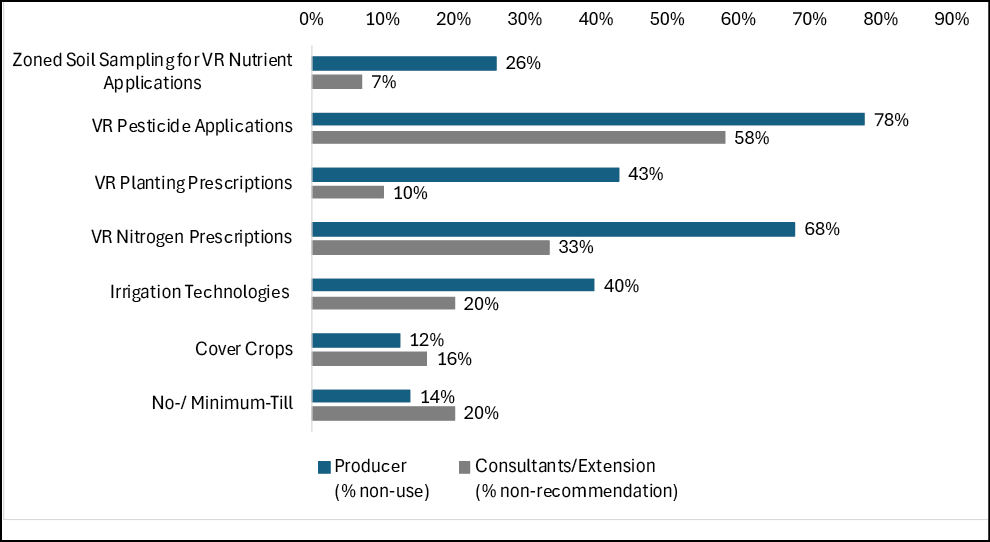
| Technology/Practice Type | Producer (% non-use) | Consultants/Extension (% non-recommendation) |
|---|---|---|
| Zoned soil sampling for VR nutrient applications | 26 | 7 |
| VR pesticide applications | 78 | 58 |
| VR planting prescriptions | 43 | 10 |
| VR nitrogen prescriptions | 68 | 33 |
| Irrigation technologies | 40 | 20 |
| Cover crops | 12 | 16 |
| No-/Minimum-till | 14 | 20 |
Factor 2. Technical Complexity and Operational Challenges
Technical complexity and operational challenges emerged as another shared set of constraints shaping the use and recommendation of PA and RA technologies. Technical complexity means having the knowledge and skills required to run these tools or having access to consultants or other personnel who can help. Operational challenges refer to how easily these tools and practices fit into everyday farm work.
Producers frequently identified limited technical support and gaps in knowledge as key constraints across PA technologies. Farmers who avoided technologies such as VR applications for nutrients and pesticides often cited lack of technical support as a primary reason for non-use. These technologies were commonly perceived as requiring a level of familiarity with data, software, and equipment that some producers did not feel they had. Challenges included difficulty operating the technologies, interpreting outputs, and using data to inform management decisions. While Factor 1 highlights cost-related constraints associated with adopting these technologies, this factor focuses on the complexity of using and integrating them into farm operations.
Operational challenges further influenced adoption decisions. Some producers noted that certain practices did not align well with their existing management systems or required adjustments to established workflows. For RA in particular, including cover crops and irrigation decision-support technologies, labor availability and time constraints were commonly reported as barriers. Non-adopting producers described difficulty allocating sufficient labor to implement and maintain these practices over time, particularly amid competing demands during the growing season.
Consultants and Extension agents reported similar constraints affecting their recommendations. For PA technologies, consultants cited limited familiarity with specific technologies, lack of technical support for both them and their clients, and challenges in advising on implementation. In some cases, consultants did not recommend technologies because they did not feel sufficiently confident in their ability to guide producers in their use. For RA practices, consultants similarly noted knowledge gaps, limited support systems, and concerns about how these practices would fit within existing production systems or affect current crops.
| Barrier Theme | Examples Across Practices | Practices Commonly Affected |
|---|---|---|
| Cost and resource limitations | High up-front costs, maintenance expenses, equipment compatibility issues, software limitations, labor and resource constraints | VR nutrient applications, VR pesticide applications, irrigation technologies, cover crops |
| Technical complexity and operational challenges | Limited technical support, difficulty using equipment or software, challenges interpreting outputs, labor demands, integration into existing farm workflows | VR planting prescriptions, VR-N prescriptions, VR pesticide applications, irrigation technologies, cover crops, no-/minimum-till practices |
| Data accuracy and technology reliability concerns | Uncertainty about data quality, reliability of technology outputs, inconsistent performance expectations, limited confidence in recommendations | VR-N prescriptions, VR pesticide applications, irrigation technologies |
Overall, technical difficulty and day-to-day workload go hand in hand. Limited familiarity, a lack of support, and challenges integrating new practices into existing operations influence both producer adoption and advisor recommendations, shaping how these technologies are used in practice.
Factor 3. Concerns About Data Accuracy or Technology Reliability
Concerns about data accuracy and technology reliability were the least frequently reported barriers to adoption and recommendation across technologies. While relatively limited among producers, these concerns were more evident in shaping consultant recommendations.
Data accuracy and reliability concerns reflect how much producers and advisors trust the results of these tools and how consistently the tools perform in practice. Among producers, only a small share of respondents indicated that they did not use certain PA technologies—such as variable rate nitrogen (VR-N) or VR pesticide applications—due to concerns about the accuracy of the data generated. Among consultants and Extension agents, however, data accuracy concerns more often influenced recommendations. Some consultants reported hesitancy in recommending specific technologies due to uncertainty about the reliability of results or the consistency of technology performance. In these cases, skepticism about data outputs contributed to more cautious or selective recommendations.
Although less prominent than cost- or capacity-related constraints, these findings suggest that trust matters—if people do not believe the numbers, they are less likely to use or recommend the technology. In particular, when combined with limited familiarity or technical support, concerns about data accuracy may reinforce hesitation to adopt or recommend certain technologies.
Recommendations
Three key barriers hinder adoption: cost and resource limitations, operational challenges associated with limited technical capacity and support, and concerns about the reliability and accuracy of data. To address these obstacles and increase adoption, recommendations should focus on expanding access to shared equipment and service-based models, strengthening demonstration projects and local validation efforts, and investing in simplified decision-support tools and user-friendly analytics.
Expand Access to Shared Equipment and Service-Based Models
Given that up-front transition and maintenance costs influence whether farmers adopt precision and regenerative agriculture technologies, sharing equipment regionally could help cover the cost of buying and upgrading the hardware and software these technologies need. For example, shared equipment pools or cooperative ownership models can reduce the financial burden on individual producers. Rental programs managed through cooperatives, Extension, or conservation districts may further expand access. In addition, hiring outside providers—with proper knowledge about data sharing and cost models—to handle data management, software, and setup can reduce both the cost and workload of adoption. These approaches may allow producers to access the benefits of precision and regenerative technologies without requiring full ownership or in-house technical capacity.
Strengthening Demonstration Projects and Local Validation Trials
Surveyed farmers, consultants, and Extension agents identified limited technical knowledge and lack of support as key constraints to adoption. These challenges can be addressed by expanding on-farm demonstrations, local field days, and producer-to-producer knowledge exchange networks. Such efforts can improve understanding of how technologies function in practice while also providing opportunities to observe outcomes under local conditions. These activities are particularly important given that many producers rely on peer networks, Extension specialists, and crop consultants as primary sources of information. Strengthening these channels can support both knowledge transfer and confidence in the use of precision and regenerative practices.
Invest in Simplified Decision-Support Tools and User-Friendly Analytics
While less frequently reported than cost- or capacity-related constraints, some producers and consultants expressed concerns about the reliability and accuracy of data generated by precision and regenerative technologies. Addressing these concerns may involve supporting the development of tools that are easier to use, require less technical expertise, and present information in clear and actionable formats. Efforts to simplify data interpretation, such as simpler dashboards, automated recommendations, and clear notes on how confident the results are, may improve producers’ and advisors’ trust in these tools. These approaches can help producers and advisors interpret and apply data more effectively in decision-making processes.
References
- Gilbert, F. (2018). A guide to sharing farm equipment: A toolsharing toolkit for farmers, cooperators, and organizers of shared equipment pools. Northeast SARE Farmer Grant.
- McFadden, J., Njuki, E., & Griffin, T. (2023). Precision agriculture in the digital era: Recent adoption on U.S. farms (EIB248). U.S. Department of Agriculture, Economic Research Service.
- Shearer, S., Stombaugh, T., & Dillon, C. (2024). What will this investment cost? (PA6). University of Kentucky Cooperative Extension Service.
- Social Science Research Center, Mississippi State University. (2025). Precision agriculture accelerates nutrient reduction: Survey on socioeconomic and cultural factors influencing technology adoption (Survey Technical Report, July 2025).
- U.S. Government Accountability Office. (2024). Precision agriculture: Benefits and challenges for technology adoption and use (GAO24105962).
Publication 4233 (POD-11-26)
By Sierra L Nelson, MS, Research Associate I, Social Science Research Center; Gina Rico Mendez, PhD, Associate Research Professor, Social Science Research Center; Dave Spencer, PhD, Associate Professor, Water Resources Research Institute; and Daniel Zach Reynolds, former Extension Research Project Manager, Water Resources Research Institute.
The Mississippi State University Extension Service is working to ensure all web content is accessible to all users. If you need assistance accessing any of our content, please email the webteam or call 662-325-2262.
Download
P4233
Common Barriers to Adoption of Precision and Regenerative Agriculture Technologies in the Lower Mississippi River Basin
126.93 KB
Departments
Authors
-
 Associate Professor
- Water Resources Research Institute