P4226
The Plant Doctor: Slime Molds
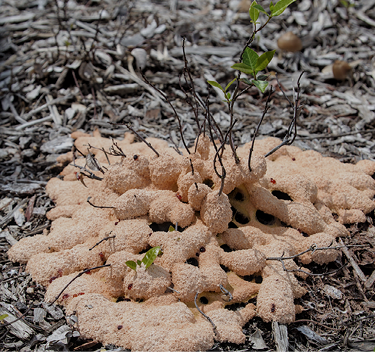
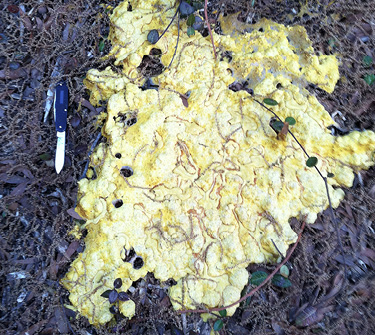
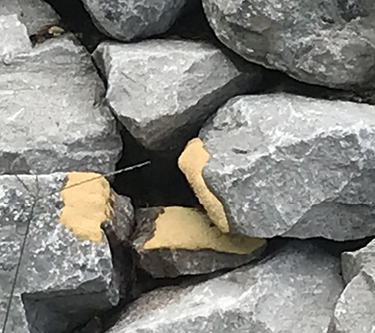
Slime molds are the cause of many panic calls to the MSU Extension Service. The caller says something like, “Everything was fine when we went to bed! But this morning, the yard (or a bush or mulch) is covered with—something!” (Figure 1).
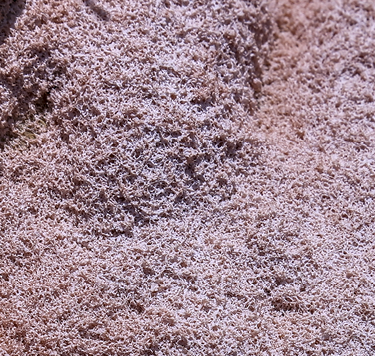
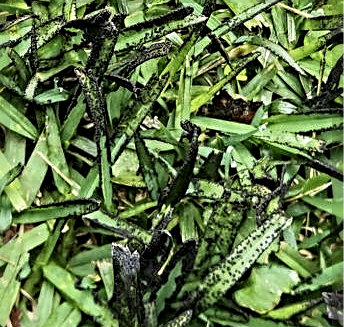
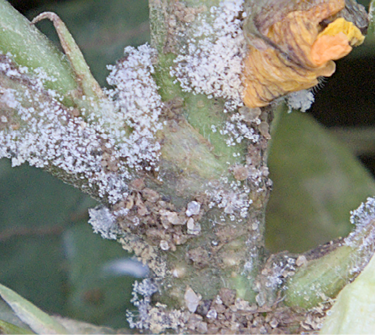
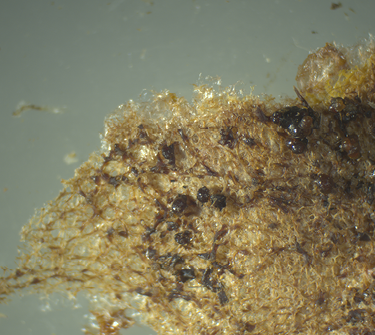
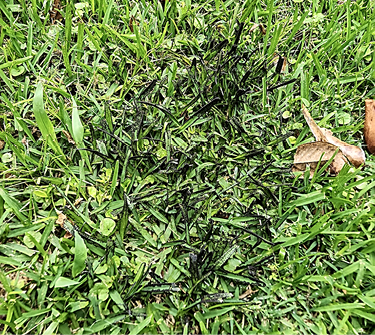
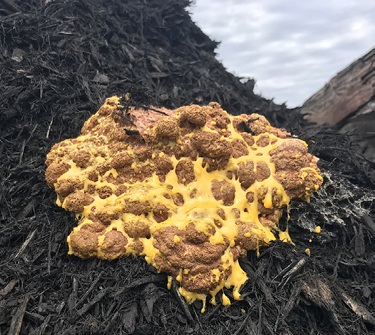
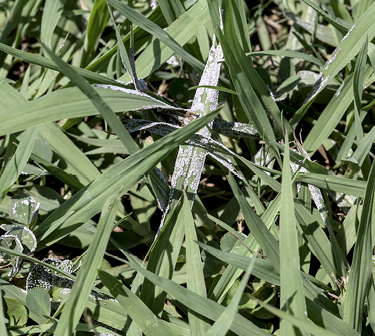
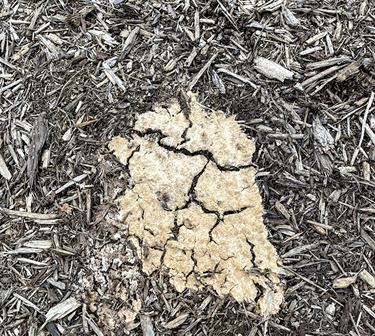
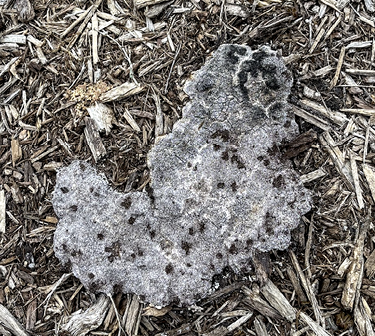
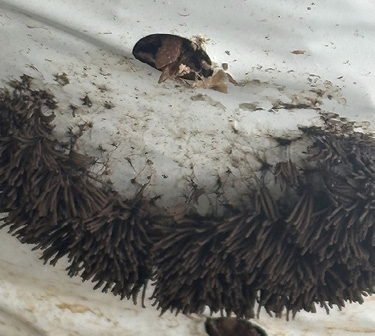
The “something” may be gray, blue, yellow, orange, or almost any other color. It may appear as a mass covering a plant, part of the lawn, or rocks. It may be shaped like an intricate fan or dog vomit. It may be wet-looking or rather dry. A close look at the mass shows either small pores (pin-sized holes; Figure 2) or round balls (Figures 3 and 4). If you rub the mass between your fingers, a sooty powder covers them. The mass covering your plant or mulch is a slime mold.
Slime molds live in dark, humid areas with decaying organic matter, such as under old bark, thick leaf layers, and wood mulch, or in decaying trees. They are found in many environments all over the world. The same slime mold may be found in tropical and temperate forests, illustrating impressive adaptability.
The classification of slime molds was long disputed. Some authorities placed them under fungi, others called them a class of amoeba, and others placed them in their own kingdom. They do have many amoeba-like characteristics, and most experts now agree on this categorization.
There are many genera of slime molds. The most common slime mold in Mississippi turf is Physarum, which is usually grayish in color. The circular patches of yellow, pink, or orange growth in shredded wood-mulched landscape beds are most often Fuligo sp. Figures 1, 6–10, and 13 show some of the common slime molds in Mississippi.
Slime molds have complicated life cycles, with some reproducing sexually and others not. A very generalized life history follows.
Life Cycle
Unlike amoebas, slime molds have two primary stages, a single-cell phase and a plasmodium phase. The single-cell stage is often genetically haploid (one set of DNA-containing chromosomes), whereas the plasmodium is genetically diploid (two sets of DNA-containing chromosomes, the second set coming from another genetically compatible single-cell slime mold). Unlike amoebas, slime molds in the plasmodium stage can become very large.
Like amoebas, slime molds spend most of their lives as a single cell. They move like amoebas, extending finger-like projections (called plasmodia). These projections pull the rest of the body along, letting the slime mold move as much as several feet per day. They can do this because they have no cell wall, unless the environment becomes unfavorable. Some slime molds can survive harsh conditions by forming a special, thick-walled structure called a sclerotium (Figure 5). Inside the protective sclerotium, a slime mold can survive a year or more. They become active again when conditions improve.
Slime molds feed similarly to amoebas, surrounding the food and then eating it. Slime molds may feed directly on dissolved substances escaping from organic matter, but they usually feed on microorganisms such as bacteria. In fact, some slime molds encase a strain of food bacteria inside their propagative spores, so newly hatched slime molds can start “farming”—increasing bacterial numbers for eating.
When unknown conditions are triggered, and compatible types of slime mold cells meet, they cross-fertilize and form a diploid plasmodium. This phase absorbs as many nutrients as rapidly as possible, and the mass becomes large—up to a square yard! The entire surface of an object can be covered by the slime mold, creating a dramatic appearance (Figures 1, 6–10, and 13). The large area mantled by the plasmodium is all one cell! This cell reacts negatively to light and chemicals, such as salt, and uses these sensitivities to locate food and move away from substances it considers dangerous and toward beneficial areas.
Unknown cues spark the reproductive process and a drive to spread itself to new areas. The plasmodium crawls upward to a lighted, dry area. The plasmodium will then clump and produce grayish-white sporangium (plural sporangia), an environmentally resistant structure that produces spores (Figure 4). About the size of a pinhead, they grow perpendicular to the surface. Once started, fruiting does not stop. The high area provides a launching point for the haploid spores, so they can travel farther and on breezes.
Management
In most cases, control is not necessary. As soon as the area dries (Figures 11 and 12), the slime mold disintegrates. In unusual cases, the layer of crusty growth may become heavy enough to shade leaves and cause temporary yellowing.
To remove slime molds from the landscape, you can easily break up the growth by sweeping with a broom, spraying the area with a garden hose, or spraying with a mild detergent solution (1 tablespoon of liquid detergent per gallon of water), which will destroy the growth. You can remove slime molds from lawns by mowing and collecting the clippings, poling with a switch of bamboo, or pulling a garden hose across the affected area.
Fun Facts About Slime Molds
Slime mold plasmodia locate food very efficiently—so much so that they can be used to design efficient transportation networks and mathematical algorithms. Using food bait to mark locations that need to be efficiently connected, the slime mold connects these points with the least possible wasted plasmodium. For instance, scientists placed food in a way to mimic the population centers of the cities surrounding Tokyo, Japan. The slime mold grew to form a network that rivaled the efficiency, reliability, and cost of Tokyo’s train network. Similar efforts have modeled other road networks.
Slime molds have been researched on the International Space Station. Computer scientists have used slime molds to model 2-D shapes by linking points on a surface, and to solve the famous traveling salesman problem. In fact, there is a whole sub-area of mathematics using the “slime mold algorithm.” These calculations are used for design, engineering, and computer games.
Slime molds don’t like salt but can be trained to overcome the dislike by placing food on the other side of a salt barrier. Slime molds that have been taught this trick pass it on to their progeny!
Raising Slime Molds
Slime molds are fascinating organisms and can make great science fair projects. Different types of decaying wood and forest debris can be collected, kept in a humid place or box, and the different types of slime molds growing from them used for many experiments. The sporangia can be collected and stored in a refrigerator for later use.
You can grow slime molds in petri plates or storage containers that hold moisture. Place a moistened (not wet), heavy piece of porous paper (such as filter paper or a coffee filter) in the container. Place a piece of sporangium on the moistened paper, and close the top. They can be fed anything from water-soaked old-fashioned rolled oats to Bonner’s solution inoculated with a non-mucoid strain of Escherichia coli.
You will need to check the chamber every day and moisten it, if needed, with drops of water. You will see the hatched and active plasmodia start to grow. Then, add pre-moistened rolled oats to the surface of the paper in the pattern you wish. If you do not feed your plasmodia, they may form the resting sclerotium, which you can save. Kits are available from some biological supply houses.
For more information, see Steve Stephenson’s 2000 book Myxomycetes: A Handbook of Slime Molds.
References
- Adamatzky, A. (2010). Routing Physarum with repellents. European Physical Journal E, 31, 403–410.
- Adamatzky, A., & Ilachinski, A. (2012). Slime mold imitates the United States interstate system. Complex Systems, 21(1), 1–20.
- Adamatzky, A. I. (2012). Slime mould computes planar shapes. International Journal of Bio-Inspired Computation, 4(3), 149–154.
- Baldauf, S. L., & Doolitle, W. F. (1997). Origin and evolution of the slime molds (Mycetozoa). Proceedings of the National Academy of Science, 94(22), 12007–12012.
- Brock, D. A., Douglas, T. E., Queller, D. C., & Strassmann, J. E. (2011). Primitive agriculture in a social amoeba. Nature, 469, 393–396.
- Dickinson, D. J., Nelson, W. J., Weis, W. I. (2011). A polarized epithelium organized by beta- and alpha-catenin predates cadherin and metazoan origins. Science, 331(6022), 1336–1339.
- Li, S., Chen, H., Wang, M., Heidari, A. A., & Mirjalili, S. (2020). Slime mould algorithm: A new method for stochastic optimization. Future Generation Computer Systems, 111, 300–323.
- Tero, A., Takagi, S., Saigusa, T., Ito, K., Bebber, D. P., Fricker, M. D., Yumiki, K., Kobayashi, R., & Nakagaki, T. (2010). Rules for biologically inspired adaptive network design. Science, 327(5964), 439–442.
- Vogel, D., & Dussutour, A. (2016). Direct transfer of learned behaviour via cell fusion in non-neural organisms. Proceedings of the Royal Society B, 283(1845), 20162382.
- Zhu, L., Aono, M., Kim, S. J., & Hara, M. (2013). Amoeba-based computing for traveling salesman problem: Long-term correlations between spatially separated individual cells of Physarum polycephalum. Bio Systems, 112(1), 1–10.

This work is supported by Crop Protection and Pest Management, Extension Implementation Program, project award no. 2024-70006-43496, from the U.S. Department of Agriculture’s National Institute of Food and Agriculture. Any opinions, findings, conclusions, or recommendations expressed in this publication are those of the author(s) and should not be construed to represent any official USDA or U.S. Government determination or policy.
Publication 4226 (POD-09-26)
By Alan Henn, PhD, Extension Professor, Plant Pathology.
The Mississippi State University Extension Service is working to ensure all web content is accessible to all users. If you need assistance accessing any of our content, please email the webteam or call 662-325-2262.
Download
P4226
The Plant Doctor: Slime Molds
2.35 MB
Departments
Authors
-
 Extension Professor
- Agricultural Science & Plant Protec