P3825
Interpreting Your Soil Test Report—for Homeowners
Targeted to homeowners or producers of crops grown over a small area. Units in pounds per 1,000 square feet.
Step 1: Do You Need Lime?
The most important information the soil test provides is based on the pH of your soil. If the pH is too low for the crop you are growing, we will recommend an application of lime. This application should come before any fertilizer is added (preferably about 2 months) to allow the liming material to raise the pH to an optimal level for your crop. If your soil sample does not call for a lime recommendation, move on to the next step.
Step 2: Calculate the Amount of Fertilizer Required
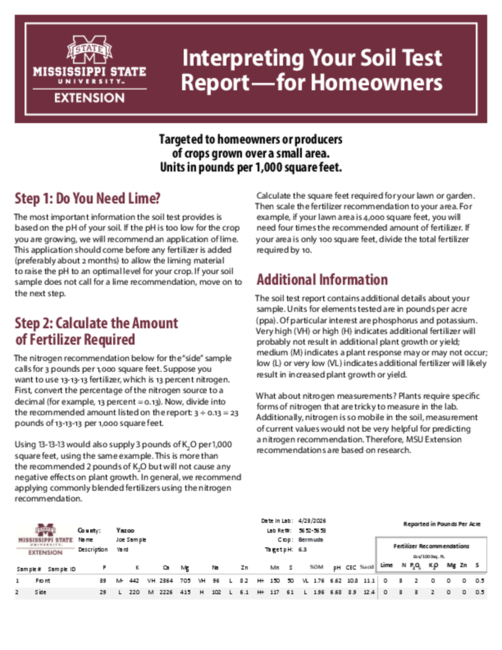
The nitrogen recommendation below for the “side” sample calls for 3 pounds per 1,000 square feet. Suppose you want to use 13-13-13 fertilizer, which is 13 percent nitrogen. First, convert the percentage of the nitrogen source to a decimal (for example, 13 percent = 0.13). Now, divide into the recommended amount listed on the report: 3 ÷ 0.13 = 23 pounds of 13-13-13 per 1,000 square feet.
Using 13-13-13 would also supply 3 pounds of K2O per 1,000 square feet, using the same example. This is more than the recommended 2 pounds of K2O but will not cause any negative effects on plant growth. In general, we recommend applying commonly blended fertilizers using the nitrogen recommendation.
Calculate the square feet required for your lawn or garden. Then scale the fertilizer recommendation to your area. For example, if your lawn area is 4,000 square feet, you will need four times the recommended amount of fertilizer. If your area is only 100 square feet, divide the total fertilizer required by 10.
Additional Information
The soil test report contains additional details about your sample. Units for elements tested are in pounds per acre (ppa). Of particular interest are phosphorus and potassium. Very high (VH) or high (H) indicates additional fertilizer will probably not result in additional plant growth or yield; medium (M) indicates a plant response may or may not occur; low (L) or very low (VL) indicates additional fertilizer will likely result in increased plant growth or yield.
What about nitrogen measurements? Plants require specific forms of nitrogen that are tricky to measure in the lab. Additionally, nitrogen is so mobile in the soil, measurement of current values would not be very helpful for predicting a nitrogen recommendation. Therefore, MSU Extension recommendations are based on research.

Publication 3825 (POD-06-26)
Revised by Brendan Zurweller, PhD, Associate Professor, Plant and Soil Sciences.
The Mississippi State University Extension Service is working to ensure all web content is accessible to all users. If you need assistance accessing any of our content, please email the webteam or call 662-325-2262.
Download
P3825
Interpreting Your Soil Test Report—for Homeowners
159.39 KB
Departments
Authors
-
 Associate Professor
- Plant and Soil Sciences