P3313
Sweet Mississippi Flower Bowl
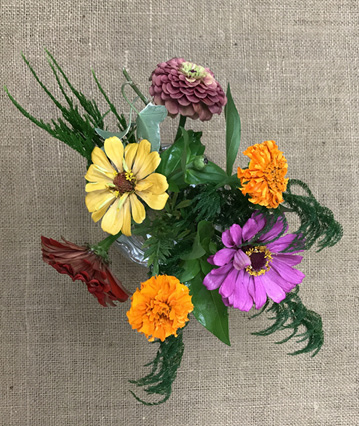
A collection of Mississippi-grown cut flowers creates a beautiful picture of memories. Many of us grew up with gardens that included bright, colorful flowers. This arrangement is easy to create, and, as a floral design project, its learning emphasis is on the importance of clean vase water and pleasing proportion.
For this design, you will need:
- One bunch of assorted Mississippi-grown, fresh cut flowers
- A few stems of extra greenery trimmed from the outdoor landscape
- You can use a wide variety of greenery, but keep stems in proportion to the size of flowers in the bouquet. We used asparagus fern and ivy in our example.
- 1 glass bowl (or similar) floral vase, about 5 inches tall by 5 inches wide
- Scissors, snips, pruners, or a floral knife
- Fresh flower food solution (or plain tap water if flower food is not available)
About Fresh Flower Food
It is best to arrange flowers using fresh flower food solutions because they contain carbohydrates to help flowers bloom and biocides to help keep bacteria from quickly growing in the vase water. Always mix flower food according to directions. Whether using flower food or not, change the vase water every 3 days. Wash the vase thoroughly, add new solution (or tap water if flower food is not available), and recut the flower stems to expose fresh tissue. Display the finished design in a cool place, out of direct sunlight.
About Floral Tools
A sharp floral knife will not crush flower stems as do scissors; however, it is important to master proper floral knife usage for your safety. See MSU Extension Publication 3121 Using a Knife to Cut Fresh Flowers to learn the proper technique. For beginning designers, including those in this workshop, it may be best to use scissors to cut fresh flowers.
Sweet Mississippi Flower Bowl
Step One
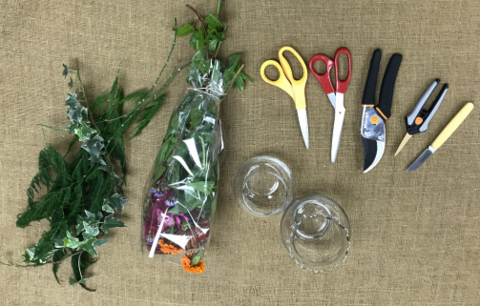
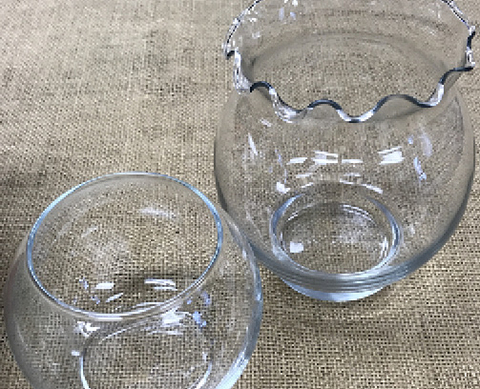
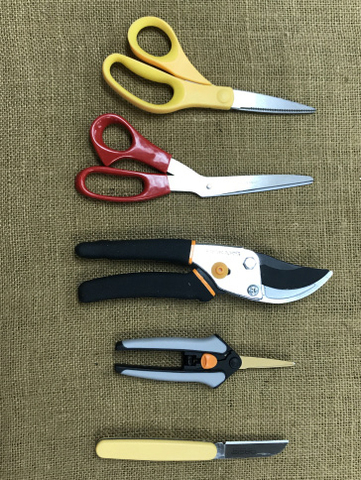
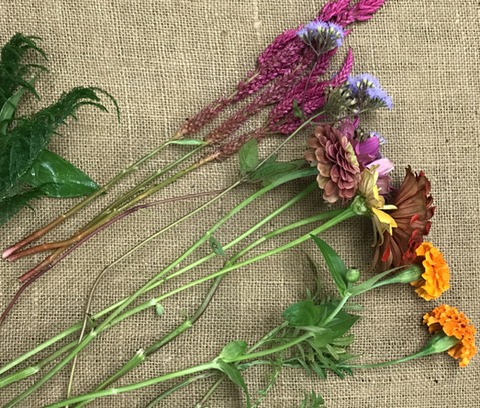
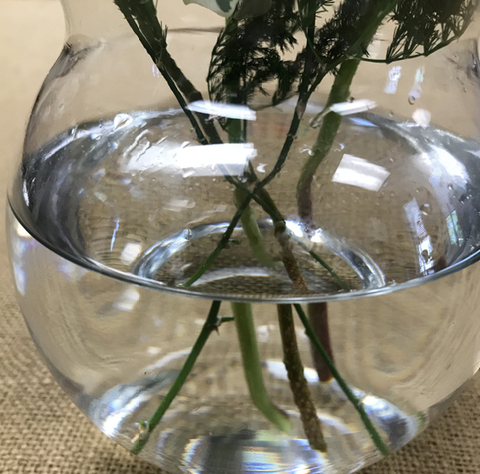
Before you begin, harvest a few stems of greenery from your yard or local landscape. Find a tabletop work space, and gather the materials needed to make the design (Figure 1). This design uses a glass ivy bowl, which is an old-fashioned floral container with many floral design possibilities. Make sure that the vase is clean with no film or residue (Figure 2). Choose a cutting tool appropriate for your skill level. Any of the tools in Figure 3 are effective, and beginners can use scissors for safety.
Step Two
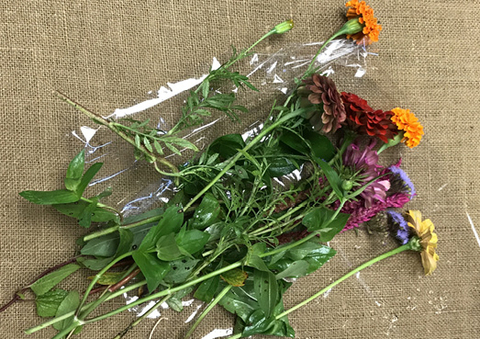
Carefully unwrap the bunch of Mississippi-grown flowers from its package and cut away the bands holding the stems in place (Figure 4). Remove all the foliage from the stems except the leaves attached within 3 inches of the flower heads (Figure 5). This remaining foliage will not come in contact with vase water and helps to fill in the design pattern.
Step Three
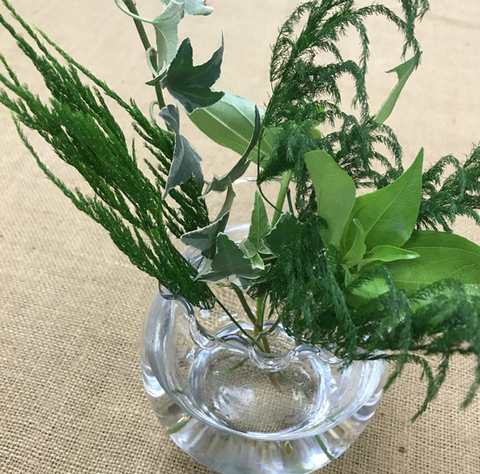
Take a few stems of the harvested foliage, and remove any leaves that may fall below the water line before placing them in the vase. Leaves introduce larger amounts of bacteria that can clog the cut ends of stems. Recut the stems and place them in the vase water (Figure 6). These stems should be about double the height of the container or just a bit taller (Figure 7). These initial greenery stems provide a grid work that helps to hold the flowers in place.
Step Four
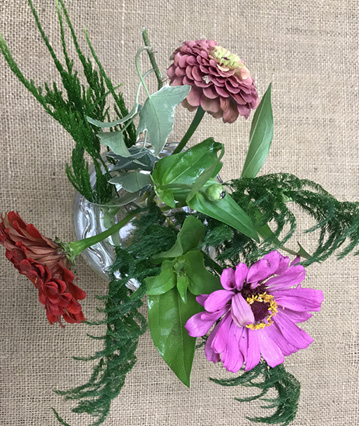
Add three flowers to the vase, following a triangular pattern (Figure 8). The stems of the flowers should rest on the container’s rim. Add a second set of three flowers, leaving the stems about an inch longer, to fill the spaces between the first set (Figure 9). Add the remaining flowers to the design to fill in the gaps (Figure 10). Any linear, spike-shaped flowers may look best if used toward the center of the arrangement. Note that light-textured filler flowers, the smallest flowers in the bunch, should be placed last in the design. This allows them to “float” among the other flowers without being hidden or crowded by them.

Participating Mississippi Flower Growers
- Little Bluestem Farm, Beth Foose, Carthage, MS | Leake County, littlebluestemfarmms@gmail.com, (662) 571-3413, Flowers available May–October
- Happy Trails Flower Farm, Tanis Clifton, Dennis, MS | Tishomingo County, sales@happytrailsflowerfarm.com, (662) 279-3668, Flowers available May–November
- Coastal Ridge Flower Farm, Terri and Dave Doyle, Picayune, MS | Hancock County, doylescoastalridge@gmail.com, (601) 918-3770, Flowers available May–October
- Twelve2 Farm, Dana Nowell, Canton, MS |Madison County, twelve2farm@gmail.com, (769) 447-8444, Flowers available February–October
If you would like your Mississippi flower farm included in this program, please contact Dr. Jim DelPrince at j.delprince@msstate.edu.
The information given here is for educational purposes only. References to commercial products, trade names, or suppliers are made with the understanding that no endorsement is implied and that no discrimination against other products or suppliers is intended.
Publication 3313 (POD-07-26)
By James M. DelPrince, PhD, AIFD, PFCI, Extension Horticulture Specialist and Associate Extension Professor, Coastal Research and Extension Center.
The Mississippi State University Extension Service is working to ensure all web content is accessible to all users. If you need assistance accessing any of our content, please email the webteam or call 662-325-2262.
Download
P3313
Sweet Mississippi Flower Bowl
705.77 KB
Departments
Authors
-
 Associate Extension Professor
- CREC-Coastal Research & Ext Center