P2339
Preserving Trees in Construction Sites
Trees add lasting value to the places we live, work, and relax. They provide shade, enhance curb appeal, improve air and soil quality, and create a sense of place in both residential and commercial developments. However, these benefits are often compromised during construction. Whether you are building a home, installing a sidewalk, or upgrading utilities, construction activities can significantly impact tree health. Excavation, trenching, soil compaction, and grading may damage roots and alter critical soil conditions. Even post-construction landscaping, such as laying sod, installing irrigation, or planting ornamental beds, can further disturb sensitive root zones.
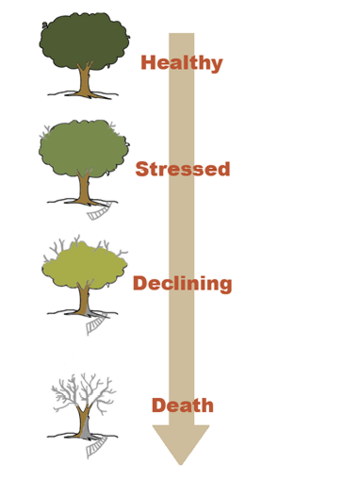
When trees are damaged during construction, the effects are often not immediately visible and may take years to fully appear. Injury to roots or compacted soil may seem minor at first, but these changes can trigger a slow decline called the “mortality spiral” (Figure 1). This process starts when one stressor, like root damage from trenching, weakens the tree. Once compromised, the tree becomes more susceptible to other threats such as drought, insects, or disease. As these stresses accumulate, a tree’s ability to recover diminishes. Eventually, visible signs like dead branches and canopy thinning appear, but by this time, it is often too late. Emergency interventions from a tree care specialist are costly and usually ineffective. Very few trees recover once they are in decline, and many ultimately die due to structural failure, infestations, or infections.
Download the full PDF to learn how to protect trees during construction.
The information given here is for educational purposes only. References to commercial products, trade names, or suppliers are made with the understanding that no endorsement is implied and that no discrimination against other products or suppliers is intended.
Publication 2339 (POD-12-25)
Revised by Josh Granger, PhD, Associate Professor, and Brady Self, PhD, Extension Professor, Forestry, from a previous version by Stephen Dicke, PhD, Emeritus Extension Professor, Forestry. Original publication funded by an Urban and Community Forestry Grant from the Mississippi Forestry Commission in cooperation with the USDA Forest Service and the Southern Group of State Foresters.
The Mississippi State University Extension Service is working to ensure all web content is accessible to all users. If you need assistance accessing any of our content, please email the webteam or call 662-325-2262.
Download
P2339
Preserving Trees in Construction Sites
1.08 MB
Authors
-
 Extension Professor
- Forestry