P1816
Natural Regeneration Using Seed Trees
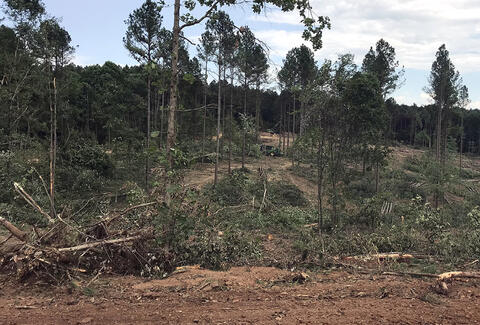
Over the past few decades, the forestry field has moved away from the traditional “cut and walk away” approach to regeneration; however, one of the most serious forest management problems in Mississippi is still a lack of proper regeneration. This is especially true on nonindustrial, private forestland. Unless a stand of desirable crop trees is regenerated on these lands, all the intermediate management available is relatively useless. All forestry endeavors either start with or eventually end up at the regeneration stage, but many landowners do not realize that several options are available and that often regeneration work should start long before harvest of the current crop of trees.
Reasons for not regenerating are varied and, for the most part, not ecologically or economically savvy. One of the most common reasons is the belief that trees will regenerate themselves with no managerial input. This is true, but we have little control over what species regenerate or how long the process takes in this scenario.
Another major concern in regeneration is cost. While money is a valid consideration, it should not be prohibitive because many regeneration options are available. Often, when landowners learn the per-acre cost of site preparation, seedlings, and planting can be $100 to $200 for pines and $200 to $500 for hardwoods, many of them immediately stop considering any regeneration work. Does regeneration have to cost so much? The answer is “no,” but alternatives to high-cost systems require careful planning and effort from the forest manager or landowner before harvest. Typically, if no provisions are made for regeneration prior to timber being cut, the amount of effort, money, and time needed to reestablish the stand increases dramatically.
The landowner may have alternatives for regeneration. These alternatives will be determined by these factors:
- what is occupying the site currently
- what is desired on the site
- when regeneration efforts will begin
The key to regeneration is to manage your stands so that you have alternatives, then use the most cost-effective system to obtain the desired crop.
The information given here is for educational purposes only. References to commercial products, trade names, or suppliers are made with the understanding that no endorsement is implied and that no discrimination against other products or suppliers is intended.
Publication 1816 (POD-02-26)
Revised by A. Brady Self, PhD, Extension Professor, Forestry; from an earlier edition by Andrew W. Ezell, PhD, Professor Emeritus, Forestry.
The Mississippi State University Extension Service is working to ensure all web content is accessible to all users. If you need assistance accessing any of our content, please email the webteam or call 662-325-2262.
Download
P1816
Natural Regeneration Using Seed Trees
1.14 MB
Departments
Authors
-
 Extension Professor
- Forestry