P4224
Managing Pastures and Hay Fields After Damaging Weather Events
Mississippi and the southern United States frequently experience significant or severe weather, which can bring destruction to rural communities. Heavy winds and tornadoes disperse dangerous debris and hazardous materials across hay and pasture fields, posing threats to livestock and equipment (Figure 1). Immediate hazards include sharp metal, nails, insulation (fiberglass), and toxic plants.
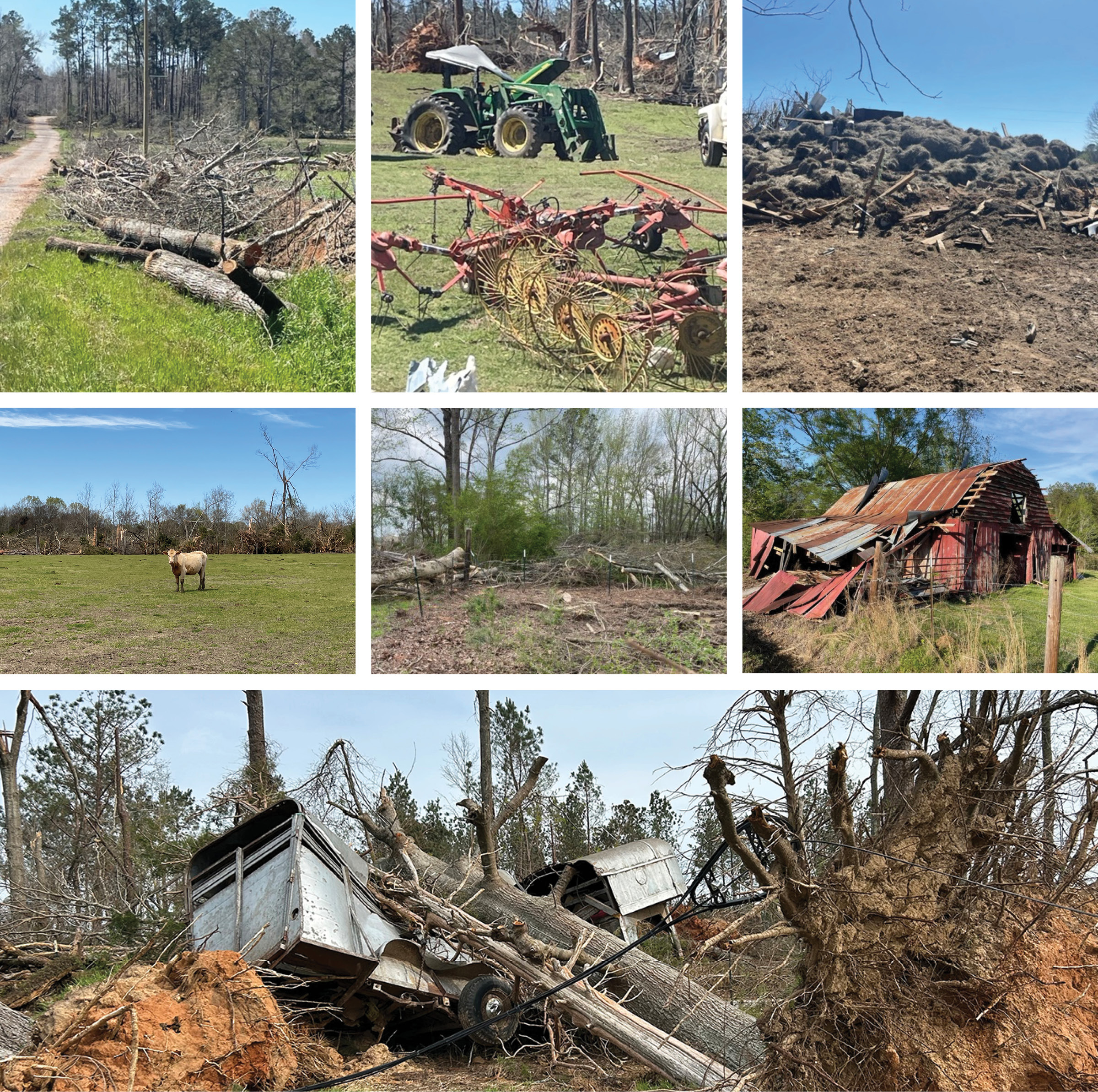
Cleaning such hazardous debris can take time and economic investment that can impact land use and revenue. This can lead to pasture and hay production losses for a season or longer. In animals, fiberglass insulation debris can cause blockages, bloat, and severe cuts in the esophagus, in addition to severe gastrointestinal irritation.
Broken or tangled fences can pose a serious risk to livestock, potentially causing cuts, scrapes, and punctures. Animals can find themselves either unconfined or trapped. Metal, wire, and fiberglass can be wrapped around hay equipment, causing damage or overheating of the equipment and leading to a fire hazard. Metal and nails can damage truck and equipment tires.
High winds can carry tree limbs that can be toxic to livestock, such as black cherry. Wilted black cherry leaves are highly toxic to cattle, sheep, and goats, causing prussic acid poisoning. Producers should observe livestock closely and inspect premises well for these hazards and be ready to contact their veterinarian for prompt intervention and treatment, if necessary.
Manually removing storm debris is time-consuming and labor-intensive. While mechanical equipment can help speed up the removal of large, heavy material, smaller pieces will likely involve manual labor. Securing the affected pastures and hay fields might require significant time and result in the loss of grazing potential and hay production.
Before allowing animals back into the affected areas or making hay, it is important to conduct a complete survey by walking the affected area or using a drone to scan for hidden or hard-to-reach debris that is scattered over a large area. Drones can be useful for obtaining a visual assessment of an area and reducing the time spent searching for debris.
The most obvious mitigation approach is to pick up as much of the debris as possible. This can be difficult, especially if there are multiple damaged areas on a farm or ranch. In those instances, removing grazing livestock from pastures containing debris could buy time to address emergency concerns. You may need to construct temporary or permanent perimeter fences and/or cross fences that can allow livestock to return safely to the affected area.
When natural disasters occur, such as tornadoes, ice storms, high winds, and flooding, there are programs available to help producers get their production back up and running. While preserving life and safety takes priority, timely assessment and documentation of damage and losses are critical. Producers should first reach out to their local emergency management agency to determine the immediate needs and available resources. It is important to document and preserve any evidence that might be needed to apply for assistance programs.
Livestock Loss
It may be difficult to assess how many cattle, horses, sheep, and goats were lost as a direct result of a storm, but regardless of the number, it is important to assess the losses as soon as possible. If livestock deaths occurred as a result of a significant weather event, you will need written documentation of the type, number, and age of livestock; stage of production or pregnancy; and conditions and location of losses. If possible, obtain the GPS coordinates of losses, and take multiple, clear photos to document the losses.
In addition to photos of losses, a veterinarian’s certification that the natural disaster caused the death of the livestock is usually required. The veterinarian may need to examine the animals more closely to determine the cause of death, so any carcasses should be preserved and kept as cool as possible until they can be examined. This information will be needed when applying for the U.S. Department of Agriculture (USDA) Farm Service Agency (FSA) Livestock Indemnity Program (LIP). Producers will need to provide photos, preferably with time stamps, and a written affidavit to document the losses.
Storms can carry metal, wire, and nails for long distances. If ingested by livestock, sharp objects can puncture the stomach, leading to a painful condition known as hardware disease. This condition may be challenging to diagnose because symptoms of depression, poor appetite, and reluctance to move can often mimic other conditions. Debris in pastures can also lead to additional injuries, such as puncture wounds and lacerations by screws, nails, and metal wire when cattle are grazing or traveling across pastures.
Livestock likely will suffer injuries during violent storms, including lacerations and broken bones, and will require veterinary assistance. Working with a local veterinarian to evaluate injuries is important for developing treatment protocols and documenting the number of animals treated and the cost of treatments.
Hay Loss
Livestock producers must assess and document crop losses as soon as it is safe to do so. Be sure to time-stamp photos of hay fields or any bales lost during the event. Document the number of acres of hay production losses, including the number of bales, bale size, type of hay, and quality of hay. Hay that was stored in barns and sustained flood damage should be removed immediately. Excessive moisture will likely cause the hay to get hot, and spontaneous combustion is a real possibility.
Eligible hay losses may be covered under the Emergency Assistance for Livestock, Honeybees, and Farm-Raised Fish (ELAP) program. To qualify for this program, hay must have been baled before the damage occurred. The program will not cover hay that was cut and on the ground or hay that had not yet been harvested. The program also only covers hay purchased or cut to feed on the farm. It does not cover hay that was cut to sell commercially. Producers must file a notice of crop loss to the FSA office within 30 days of the loss.
Hay contaminated with insulation or large amounts of metal can be harmful to livestock. It is important not to sell contaminated hay. Sellers may be liable for harm to livestock that consume contaminated hay. Avoid these circumstances.
If you have hay bales that got flooded, they will be prone to rapid mold growth, which could be highly toxic to horses and pregnant animals. Test forage damaged by rain or storm debris for basic nutrient quality as well as for mold, mycotoxins, and nitrate levels.
Pasture Loss
Heavy rain or flooding can damage forage crops and prevent grazing. Warm-season grasses, such as bermudagrass or bahiagrass, can survive under flood waters for a week or longer with minimal damage to the pasture. On the other hand, cool-season forages, including wheat, rye, oats, and annual ryegrass, will not survive more than a day or two completely submerged.
Tornadoes can scatter debris in pastures, limiting pasture use and causing excess residual forage to accumulate. Removing debris from pastures should be a priority. Be extremely careful when mowing these areas to minimize potential damage to equipment from residual storm debris.
While grazing forage residue may be possible, it is essential to inspect the affected areas, as heavy rain and winds could have deposited soil and other contaminants, thereby limiting the livestock’s ability to graze the remaining forage. Also be aware that livestock may not readily eat the remaining forage.
Document the extent of pasture losses by keeping a record of the forage species and acres of each species on a map. Keeping a log of lost grazing days is important, as is documenting flooded areas with proof that livestock had to be removed from those areas.
Infrastructure Loss
High winds and flying debris can cause significant damage to permanent perimeter and cross fencing. The priority will be moving the livestock to areas with minimal damage and using multiple strands of temporary electric fencing to contain them until repairs can proceed. Record the feet/miles of lost fencing, along with the type of wire, number of strands, and age/year the fence was constructed.
Shade and water structures may be damaged in storms. Not having access to clean, fresh water can result in heat stress, loss of production, and possibly death. Inspect your water structures for any leaks and possible contamination of the water source. If fences were damaged, ensure animals still have access to fresh water. You might need to use temporary waterers until repairs can be completed.
It is very important to take good pictures (ground and aerial, if possible) of the infrastructure affected. For water structures, it is important to record the type of water system, damage to the heavy-use area, and feet/miles of water lines that need to be repaired or replaced. If hay is being fed in the affected area, take time-stamped pictures of the hay feeders or bunks used.
Contact your local FSA office to determine whether the Emergency Conservation Program (ECP), which is an incentive or cost-share program, may cover the removal of debris and repair of land and fences. Keep in mind that a field inspection by the FSA might be needed to determine eligibility for the program. Also, reach out to your FSA county office before starting any restoration.
If handling facilities and barns sustain storm damage, document the damage and contact your insurance provider.
Feed Loss
Heavy winds and flooding can damage feed storage structures, and you might lose feed (commercial feed or harvested commodities). Flood-damaged feed or commodities are considered adulterated and need to be calculated as a loss in nutrients or a contributor to mold issues. Document the amount and type of feed that was damaged.
You might have other feed available that is for different livestock species. Do not feed it to grazing livestock unless the company’s manufacturing label indicates that it does not contain meat or bone meal, and it does not contain any antibiotics or other drugs not approved for the livestock. Be aware that feeds labeled for cattle and horses may contain copper levels that can be toxic to sheep and goats.
Lost feed that farmers had on hand (including commercial feed and harvested commodities) might be covered by the ELAP program. Contact your local FSA office for more information.
Summary
Severe weather events can result in significant economic damage to livestock pastures, hay and feed supplies, fencing, and water and shade structures. It is important to document losses and report them to your local FSA office in case any programs are available to cover them. Continue to seek assistance, as the recovery process is long and challenging.
For reporting any hay pasture losses, consult with your local FSA office if a natural disaster has been declared in the affected area. For more local recovery assistance and safety protocols, contact your county MSU Extension office.
References
U.S. Department of Agriculture, Farm Service Agency. Disaster assistance: Emergency Conservation Program (ECP).
U.S. Department of Agriculture, Farm Service Agency. Emergency Assistance for Livestock, Honeybees, and Farm-Raised Fish (ELAP).
U.S. Department of Agriculture, Farm Service Agency. Livestock Indemnity Program (LIP).
Publication 4224 (POD-09-26)
By Rocky Lemus, PhD, Extension Forage Specialist, Plant and Soil Sciences, J. Brett Rushing, PhD, Extension/Research Professor, Plant and Soil Sciences, and Josh Maples, PhD, Associate Extension Professor, Agricultural Economics.
The Mississippi State University Extension Service is working to ensure all web content is accessible to all users. If you need assistance accessing any of our content, please email the webteam or call 662-325-2262.
Download
P4224
Managing Pastures and Hay Fields After Damaging Weather Events
945.6 KB
Departments
Authors
-
 Extension/Research Professor
- Plant and Soil Sciences
-
 Extension/Research Professor
- Coastal Plain Experiment Station
-
 Assoc Professor & Assistant Di
- Agricultural Economics