P3850
How Do Log Truck Drivers Receive Payment?
Download the full publication by selecting the publication image in the right column.
Forestry is a large business in the southeastern United States, and a vital component of that business is regular harvesting to capture the growth, yield, and value of the trees. These harvests include thinnings, partial cuttings (e.g., uneven-aged group or individual tree selection), and clearcuts. Forest harvesting, or logging, is extremely important to the fiber supply chain, allowing landowners to conduct management on their property and receive financial compensation for their capital investment. Harvesting also provides fiber to processing facilities that convert the raw woody resource into products like paper, boxes, cartons, lumber, plywood, flooring, among many other useful everyday items.
Most forest harvesting operations involve the following:
- felling the trees,
- transporting (i.e., skidding) those trees to a central processing location,
- processing the trees (includes delimbing and removal of tops and other non-merchantable portions),
- merchandizing the stems into product classes to optimize the fiber uses for maximum financial return.
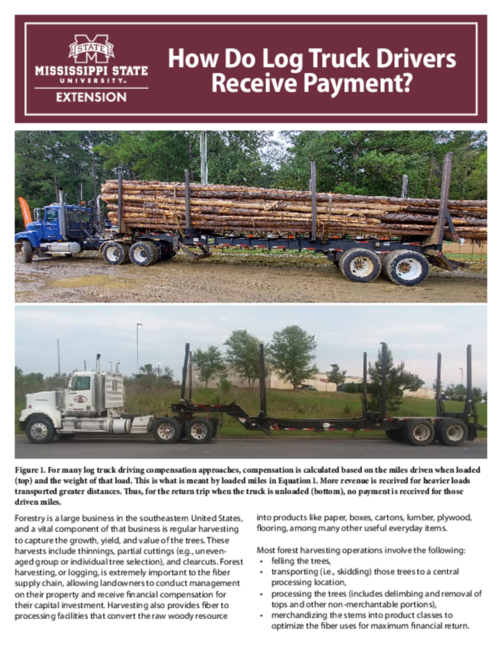
The trees are then transported to a processing facility, usually a mill. The hauling and transport component, or the trucking component, is vital to the forest harvesting process.
Many loggers will tell you the most expensive component of harvesting operations is trucking. Several assessments and studies have also shown this to be true. This is particularly true in recent years as truck insurance and diesel fuel costs have been rising at rapid rates. Additionally, the financial difficulties associated with trucking increase with lower value wood products (e.g., hauling pulpwood versus hauling sawlogs). Many foresters, landowners, and loggers—particularly newer loggers—may wonder about the different ways that log truck drivers receive compensation. Additionally, it is important to understand the advantages and disadvantages of each compensation method to better grasp how various aspects of the wood supply chain may impact driver salaries, and perhaps forest landowner stumpage values.
You can also contact state Extension specialists or your local Extension office for answers to specific questions.
The information given here is for educational purposes only. References to commercial products, trade names, or suppliers are made with the understanding that no endorsement is implied and that no discrimination against other products or suppliers is intended.
We would like to thank Dr. Scott Barrett of Virginia Tech University and Dr. Patrick Hiesl of Clemson University for providing useful comments.
Publication 3850 (POD-02-26)
By Curtis L. VanderSchaaf, PhD, Associate Professor, Central Mississippi Research and Extension Center; Joe Conrad, PhD, Assistant Professor of Forest Operations, Warnell School of Forestry & Natural Resources, University of Georgia; Wayne Withers, Instructor, Logger Equipment Operator Academy, Hinds Community College; and David Livingston, Executive Director, Mississippi Loggers Association.
The Mississippi State University Extension Service is working to ensure all web content is accessible to all users. If you need assistance accessing any of our content, please email the webteam or call 662-325-2262.
Download
P3850
How Do Log Truck Drivers Receive Payment?
835.27 KB
Departments
Authors
-
 Associate Professor
- Central MS Research & Ext Center