P1983
Forestry Income Tax Series: Basics of Basis
Download the full publication by selecting the publication image in the right column.
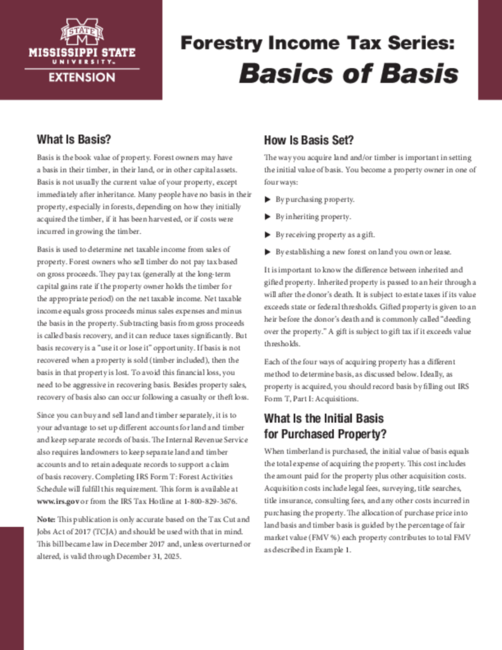
Basis is the book value of property. Forest owners may have a basis in their timber, in their land, or in other capital assets. Basis is not usually the current value of your property, except immediately after inheritance. Many people have no basis in their property, especially in forests, depending on how they initially acquired the timber, if it has been harvested, or if no costs were incurred in growing the timber.
Basis is used to determine net taxable income from sales of property. Forest owners who sell timber do not pay tax based on gross proceeds. They pay tax (generally at the long-term capital gains rate if the property owner holds the timber for the appropriate period) on the net taxable income. Net taxable income equals gross proceeds minus sales expenses and minus the basis in the property. Subtracting basis from gross proceeds is called basis recovery, and it can reduce taxes significantly. But basis recovery is a “use it or lose it” opportunity. If basis is not recovered when a property is sold (timber included), then the basis in that property is lost. To avoid this financial loss, you need to be aggressive in recovering basis. Besides property sales, recovery of basis also can occur following a casualty or theft loss.
Since you can buy and sell land and timber separately, it is to your advantage to set up different accounts for land and timber and keep separate records of basis. The Internal Revenue Service also requires landowners to keep separate land and timber accounts and to retain adequate records to support a claim of basis recovery. Completing IRS Form T: Forest Activities Schedule will fulfill this requirement. This form is available at www.irs.gov or from the IRS Tax Hotline at 1-800-829-3676.
Note: This publication is only accurate based on the One Big Beautiful Bill Act (OBBBA) and should be used with that in mind. This bill became public law in July 2025 and, unless overturned or altered, is valid indefinitely.
This publication is for educational purposes only and is based on typical situations of forest landowners. It should not be used to replace advice from a qualified tax professional based on your individual facts and circumstances. A qualified tax professional, along with a consulting forester, may help you determine your best forest management and tax position.
Information on timber taxation is available at extension.msstate.edu or at your local MSU Extension Service office. Additional information is available online at www.timbertax.org.
Publication 1983 (POD-06-26)
Revised by Curtis VanderSchaaf, PhD, Associate Professor, Central Mississippi Research and Extension Center, and Sabhyata Lamichhane, PhD, Assistant Professor, Forestry.
The Mississippi State University Extension Service is working to ensure all web content is accessible to all users. If you need assistance accessing any of our content, please email the webteam or call 662-325-2262.
Download
P1983
Forestry Income Tax Series: Basics of Basis
155.09 KB
Departments
Authors
-
 Associate Professor
- Central MS Research & Ext Center
-
 Assistant Professor
- Forestry