P3300
Considerations for Planting Longleaf Pine
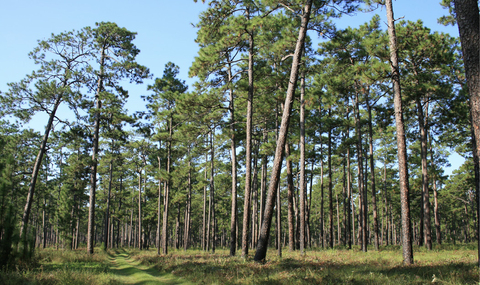
Species selection is an important component of timber production. Advances in nursery production, especially the widespread availability of container-grown seedlings, have improved the reliability of artificial longleaf pine (Pinus palustris Mill.) regeneration.
Longleaf pine offers several potential advantages over other southern pines, including relatively high tolerance of drought, wind, and fire once trees are adequately established. Longleaf pines also have long needles, straight trunks, and greater self-pruning potential, making them good for pole production and the pine straw industry.
These advantages may offset some of the additional time and management required to produce merchantable longleaf timber. For many landowners, financial assistance programs also influence the decision to establish longleaf. Many federal and state agencies offer financial assistance to help offset costs associated with establishing and maintaining longleaf.
These cost-share programs have contributed to restoration on private lands throughout portions of the species’ historical range. However, their availability is not the only factor to consider when selecting a species. Landowners should understand longleaf biology, establishment requirements, competition-control needs, fire-management constraints, and expected markets. This publication summarizes the principal biological, site, market, competition, fire, and invasive species considerations that should be evaluated before planting longleaf pine.
Longleaf Biology
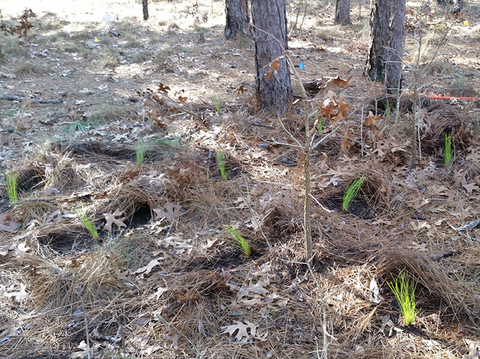
Longleaf pine differs from loblolly pine (Pinus taeda L.) and slash pine (Pinus elliottii Engelm.) in its early growth strategy. Instead of immediately initiating height growth, longleaf seedlings remain stemless in a developmental stage known as the grass stage (Figure 1). While in the grass stage, longleaf allocates the majority of its resources to root development rather than height growth. The grass stage may last less than a year under favorable conditions but can persist for many years when seedlings are suppressed by competition, poor planting, low vigor, or unfavorable site conditions.
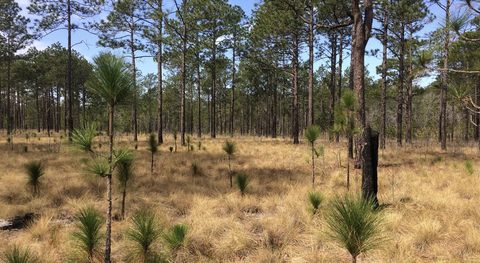
Height growth, also known as bolting, typically begins once seedlings develop a root collar of about one inch (Figure 2). The length of the grass stage is influenced primarily by competition from surrounding vegetation for light, soil moisture, and nutrients. Longleaf is shade-intolerant and generally requires abundant sunlight for satisfactory survival and growth. Therefore, effective site preparation and early competition control are critical for shortening the grass stage and improving establishment success. Growth rates following the grass stage are comparable to the other southern pines.
Site Considerations
Longleaf can be grown across a wide range of soils. Its competitive advantage over loblolly or slash pine is often greater on drought-prone, well-drained sandy sites, but species performance varies with soils, drainage, climate, and management objectives.
On drought-prone sites, longleaf may maintain survival and growth better than loblolly or slash pine because of its comparatively strong drought tolerance. However, drought tolerance should not be confused with maximum productivity; very sandy, nutrient-poor soils may support relatively slow volume growth. Growing longleaf on more productive soils is possible but may require more intensive vegetation management to bring seedlings through the grass stage.
Market Availability
Market awareness is a key consideration when growing forest products. Many of the advantages of growing longleaf are derived from pine straw and pole markets. Pine straw markets are often stronger where landscaping demand, dealer networks, labor, and transportation access are favorable. Pole production depends on suitable soils, appropriate stocking and thinning, excellent stem quality, and economical access to pole-buying facilities. Longleaf timber typically weighs more than loblolly or slash pine, making it slightly more valuable on a tonnage basis.
Longleaf may require a longer rotation than loblolly or slash pine, particularly when establishment is delayed, but the difference is not fixed and varies with site, genetics, stocking, management, and target products. Where the sole objective is rapid sawtimber production, loblolly or slash pine may provide earlier returns on suitable sites. Longleaf may be preferred when objectives also include resilience, wildlife habitat, pine straw, poles, prescribed fire, or ecosystem restoration.
Competition Control
Competition control is critical for bringing longleaf through the grass stage. Historically, frequent, low-intensity fire helped longleaf become the dominant tree species throughout much of the Coastal Plain. Grass-stage seedlings become increasingly fire tolerant as root-collar diameter and vigor increase, but fire injury and mortality remain possible, especially during drought, after herbicide injury, under heavy fuels, or while seedlings are bolting.
The occurrence of frequent, low-intensity surface fire was important for not only controlling competition from less fire-adapted species but also for controlling brown spot needle blight. Consequently, prescribed fire is often recommended every 2 to 3 years once seedlings have developed an adequate root collar.
Unfortunately, many liability factors, including proximity to major roadways, poultry operations, hospitals, and residential areas, can hinder the use of prescribed fire as a silvicultural tool. Prescribed burn laws, liability standards, permitting requirements, and smoke management rules vary by state; landowners should follow applicable law and use qualified personnel.
Prescribed fire is important, but it is not the only tool available for vegetation management. Properly selected and applied herbicides can control many woody and herbaceous competitors before or after planting. However, longleaf is more susceptible to damage from herbicides commonly used to promote loblolly and slash pine production. Herbicides will not be as effective as prescribed fire to treat brown spot needle blight.
Invasive Species
Invasive species have changed the function of many of our native forests. This concern is especially important within Mississippi’s historical longleaf range, where several invasive plants are widespread. Two particularly problematic species are cogongrass (Imperata cylindrica (L.) P. Beauv.) and Japanese climbing fern (Lygodium japonicum (Thunb. ex Murr.) Sw.).
Cogongrass forms a dense thatch (dead vegetation layer) on top of the ground during the winter. This layer can increase fire intensity and often results in the death of longleaf seedlings. Because cogongrass can recover rapidly after burning, prescribed fire alone may stimulate regrowth or spread rather than provide control.
Japanese climbing fern can act as a ladder fuel, carrying fire from surface fuels into shrubs and tree crowns. Although established longleaf pine is well adapted to frequent surface fire, crown scorch and crown fire can cause severe injury or mortality. Landowners should identify and control invasive plants before site preparation and continue monitoring after planting.
Reinvasion from roadsides, rights-of-way, disturbed areas, and neighboring properties can create a recurring management problem. As such, landowners should assess the invasive species population not only on their own property but also on surrounding properties before planting longleaf pine.
References
Boyer, W. D. (1990). Growing season burns for control of hardwoods in longleaf pine stands (Research Paper SO-256). U.S. Department of Agriculture, Forest Service, Southern Forest Experiment Station.
Burns, R. M., & Honkala, B. H. (1990). Silvics of North America: Vol. 1. Conifers (Agriculture Handbook 654). U.S. Department of Agriculture, Forest Service.
De Stefano, A. (2026). The many faces of fire forests: A guide to longleaf pine habitats for better stewardship (Publication 4178). Mississippi State University Extension Service.
Self, A. B. (2022a). Planting southern pines: A guide to species selection and planting techniques (Publication 1776). Mississippi State University Extension Service.
Self, A. B. (2022b). Herbicide options for management of longleaf pine (Publication 3405). Mississippi State University Extension Service.
Self, A. B. (2020). Growing pine needles and timber (Publication 3129). Mississippi State University Extension Service.
The information given here is for educational purposes only. References to commercial products, trade names, or suppliers are made with the understanding that no endorsement is implied and that no discrimination against other products or suppliers is intended.
Publication 3300 (POD-08-26)
Revised by Andrea De Stefano, PhD, Assistant Professor, Coastal Research and Extension Center, from an earlier revision by Brady Self, Extension Professor, Forestry. Written by John Willis, PhD, former Assistant Professor, Forestry.
The Mississippi State University Extension Service is working to ensure all web content is accessible to all users. If you need assistance accessing any of our content, please email the webteam or call 662-325-2262.
Download
P3300
Considerations for Planting Longleaf Pine
1.53 MB
Departments
Authors
-
 Assistant Professor
- CREC-Coastal Research & Ext Center
-
 Extension Professor
- Forestry